


Arrrrr! 🏴☠️ Welcome to a 🔒 subscriber-only edition 🔒 of Category Pirates. Each week, we share radically different ideas to help you design new and different categories. For more: Audiobooks | Category design podcast | Books | Sign up for a Founding subscription to ask the Pirate Eddie Bot your category design questions.
Dear Friend, Subscriber, and Category Pirate
In Part 1 of Turn Marketing into a Profit Center, we showcased how Tesla is using its new rental car business as profit-positive marketing for everything else.
But they aren’t the only ones doing it.
And they weren’t the first.
Some startups vaporize half their VC dollars on Google and Meta ads. Legacy companies pour millions into campaigns with fuzzy ROI. Brand marketers waste $10 million dollars on Super Bowl ads and call it “brand building.” All of them operate on the same primitive model: spend money, hope revenue happens, repeat.
And no one questions it—because they’ve never seen anything else.
The entire marketing industrial complex is built on one assumption: that marketing is supposed to cost money.
What if that assumption is wrong?
Fish in the Monterey Bay spend their whole lives in water. Water is everything. They swim in it, breathe through it, orient their entire existence around it. They never think there might be something other than water.
Until a brown pelican breaks the surface.
In that final suspended second—mid-air, mid-truth—the fish realizes something devastating: there was more to the world than water. The world was bigger than the rules it lived by. It was also the moment it stopped being part of it. That knowledge arrives at the exact moment it no longer matters.
Here’s the thing about that fish. It isn’t stupid. It’s obedient. It did exactly what the environment rewarded: optimize inside the water you were given. And as long as everyone else believes the same thing, it feels rational. Even responsible.
Until the pelican shows up.
There are two kinds of marketing in the world.
Cost Center Marketing spends money and hopes revenue happens.
It lives at the bottom of the food chain—begging for budget, apologizing for ROI, and praying the CFO doesn’t ask too many questions.
Profit Center Marketing makes money—and makes everything else more valuable.
It doesn’t ask for budget approval. It generates revenue. It pays for itself and then pays dividends.
One drains the balance sheet. The other fills it.
Most marketers have only ever seen the first kind. They’ve spent their entire careers swimming in Cost Center water, optimizing inside the rules they were given, never realizing there’s a world above the surface.
Most CMOs spend their careers defending budgets instead of generating revenue. Most marketing teams measure success by how much they spent, not how much they made. Most companies treat marketing like a toll they pay to exist—not an engine that prints money.
This mini-book is the pelican.

We’re going to show you what marketing looks like when you reject the premise that it has to be an expense—when you stop renting attention and start owning it, when you climb out of Cost Center hell and build something that prints money.
But first, here’s the uncomfortable question most CMOs never ask themselves:
Do you want to be efficient at losing money?
Or do you want to build something that makes money—even if it means rejecting everything you were taught about marketing?
Because Cost Center Thinking and Profit Center Thinking require different skills, different metrics, and different courage.
You can’t play both games.
Why Cost Center Thinking Has Got To Go
Let’s be direct about something most marketing articles dance around.
Cost Center Marketing is dying. Not because it’s old-fashioned. Not because “digital changed everything.” It’s dying because the economics have flipped—and they’re never flipping back.
Attention costs are compounding against you.
Every year, the platforms extract more.
Google and Meta aren’t getting cheaper—they’re getting more expensive while delivering less.
CPCs rise. CPMs rise. Conversion rates fall. The algorithms optimize for their revenue, not yours. If your marketing depends on renting attention from platforms, you’re on a treadmill that speeds up every quarter. Pirate Eddie spent years watching Fortune 500 CMOs justify marketing budgets with fuzzy metrics.
He knows the dance:
“We need to build brand awareness.”
“Attribution is complicated.”
“Marketing is an investment, not an expense.”
These are the phrases marketers use when they can’t explain why the money disappeared.
The math is getting worse, not better. Nielsen says most digital campaigns return $1.00 or less in revenue for every dollar spent.
(Read that again. Most. Not some. Most.)
Top performers hit $2.60. At 34% gross margin, that’s $1.17 profit for every $1.00 spent. You’re running as fast as you can to barely break even. And that’s the best case.

While you’re optimizing CPMs, someone in your category is building an experience people pay for. While you’re A/B testing headlines, someone is creating a transformation that generates word of mouth. They’re not playing the same game anymore. And once they reach altitude, the air gets thin for everyone still at sea level.
Trust in brands is collapsing. Consumers don’t believe ads. They believe other consumers. They believe outcomes. They believe transformations they can see and feel. Cost Center Marketing talks at people. Profit Center Marketing creates outcomes people talk about. One of these has a future. One doesn’t.
The real cost of Cost Center Marketing isn’t the money you spend.
It’s the money you’ll never make.
Here’s the question that should keep every CMO awake at night:
What would happen if we took our entire marketing budget and used it to build something people would pay for?
Not ads. Not campaigns. Not impressions.
An experience. A transformation. An asset that compounds.
Most marketers can’t even process this question. It doesn’t fit inside the mental model they inherited. Marketing is supposed to spend money, not make money. That’s just how it works. But “how it works” is exactly the problem.
Consider the opportunity cost:
Every dollar you spend on Cost Center Marketing is a dollar you didn’t invest in building an Owned Attention Asset. Every campaign that resets to zero at the end of the quarter is a flywheel you didn’t build. Every impression you rented is demand you didn’t create.
Companies stuck in Cost Center Thinking aren’t just spending money inefficiently. They’re systematically destroying the opportunity to build something that pays for itself. They’re choosing linear economics over exponential economics. They’re choosing gravity over altitude.
And the gap is widening.
The companies that climb the ladder will pull further ahead every year. The companies that stay at sea level will spend more and more just to stay in place—until they can’t.
This is why Cost Center Thinking has got to go.
Not just because it’s theoretically suboptimal.
But because it’s becoming competitively unsurvivable.
Marketing Is Trapped At The Bottom Of The Progression Of Economic Value
Once again, Pine and Gilmore’s Progression of Economic Value explains the world. And we’re going to redesign it for marketing—because once you see the altitude ladder, you can never unsee it.
Most marketing operates at the lowest rungs:
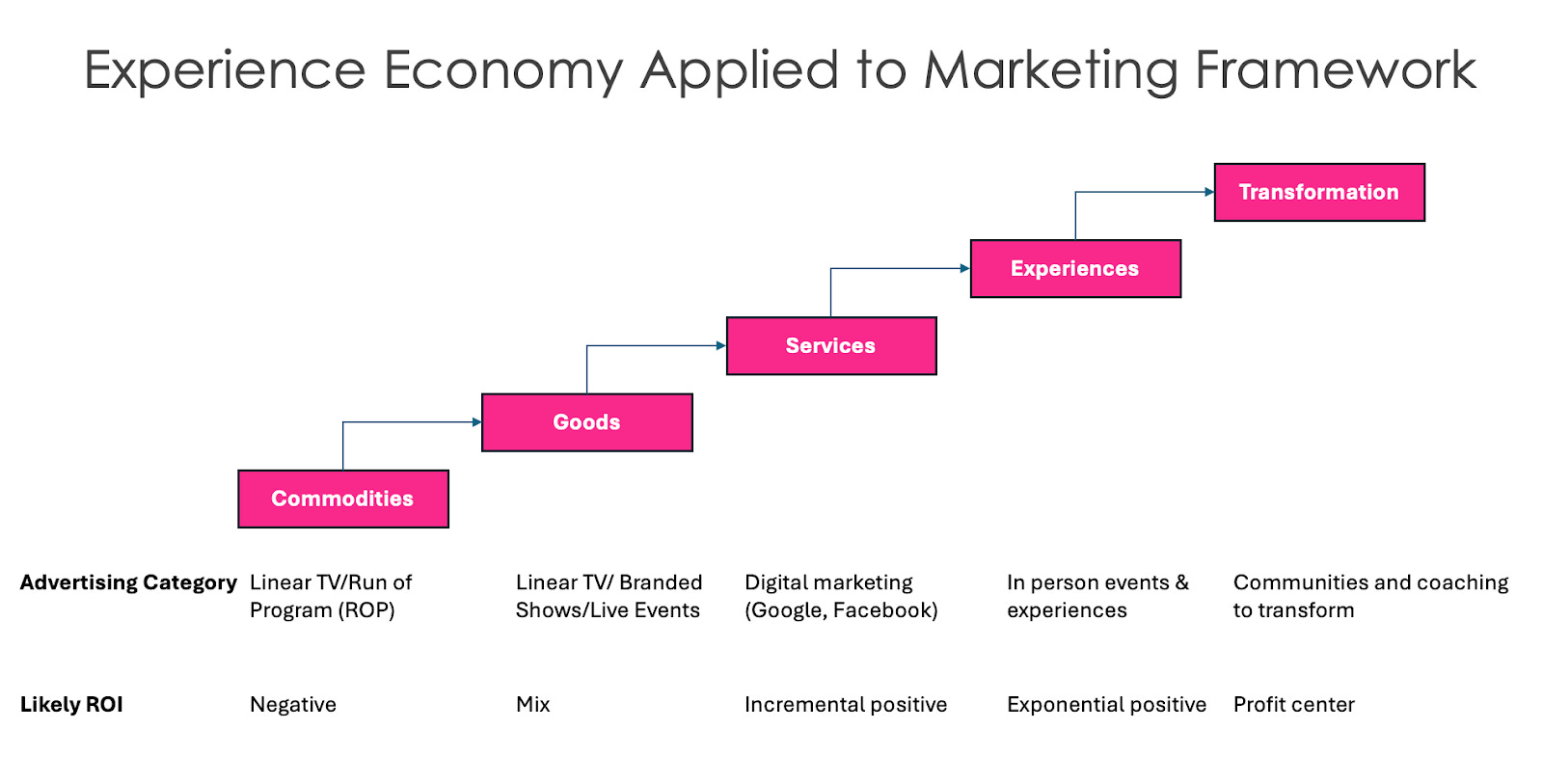
Cost: Marketing treated like other functions that support “the business”—something to manage, minimize, and make more efficient.
Commodities: Cheap impressions bought in bulk. CPMs of $5–$10 with minimal impact. (Yes, we know what CPM stands for. Cost Per Mille. Also known as Cost Per Money-Lit-On-Fire.) Interchangeable attention that disappears the moment you stop paying.
Goods: Paid slots that scale linearly with spend. More money, more exposure. Less money, less exposure. The relationship is predictable, safe, and structurally disadvantaged.
Services: Performance-based tactics that still behave linearly. Dashboards light up like Christmas trees. Attribution models hum. But gravity still wins. Costs scale. Value doesn’t.
It’s CFO hell.
No wonder so many CMOs sit at the kids’ table. No wonder finance rolls their eyes. No wonder marketing keeps insisting it’s undervalued while the economics stubbornly refuse to cooperate. Both sides are right—because they’re looking at marketing at the wrong altitude.
But climb the ladder, and everything flips:
Experiences: Events, brand homes, interactive tools customers choose to engage with. Customers pay for the experience. Marketing sustains itself. ROI ranges from breakeven to exponentially positive.
Transformations: Education, community, intellectual capital that changes the customer. Customers pay premium prices for transformation. Marketing becomes its own P&L line. Marketing prints money.
This is why Lightning Strike Marketing works.
It skips the low-value sludge and goes straight to outcomes. It concentrates resources on a few high-altitude moments—experiences, transformations, and Intellectual Capital—that generate revenue, spark word of mouth (the most powerful marketing), and create enduring assets.
At the bottom, marketing costs money.
In the middle, marketing sustains itself.
At the top, marketing makes money—and makes everything else more valuable.
The question is NOT “how do we market better?”
Don’t Rent Attention—Own It Like Red Bull
Red Bull won by doing something radical.
They stopped marketing.
They understood something most companies never will: advertising is what you do when you don’t own the stage. Instead of buying attention, they built the arenas where attention already lives. Cliff diving. Air races. Rampage. Stratos. Not campaigns. Not sponsorships. Owned Attention Assets.
When Red Bull shows up, it’s not interrupting your life. It is the thing you showed up for.
Think about what that means for the economics. Red Bull gets paid to market. The events sell tickets. The broadcasts sell rights. The sponsors fund the spectacle. The content monetizes itself. The drink is almost incidental. Red Bull isn’t a beverage company that markets—it’s a media company that happens to ship liquid. And because they own the media, they control the category, the pacing, the emotion, and the mythology.
This is real category power.
Red Bull skipped the obvious question (”how do we sell more cans?”) and asked a stranger one: What kind of world makes Red Bull inevitable? Then they went and built that world—one gravity-defying act at a time. They skip the discounts. Skip the performance ad scramble. Skip the rebrand-every-three-years cycle. Instead: one point of view, held relentlessly, until the market does the selling for them.
Pirate Christopher refuses to advertise his podcasts because advertising is what you do when you don’t own the stage. He’d rather build something people seek out than pay to interrupt people who didn’t ask.
Most brands rent attention and pray it converts.
Red Bull manufactured belief. And belief pays dividends.
Marketing at the bottom bleeds cash.
Marketing at the top prints money.
Truth-Telling Via Edu-tainment: How A Watch Dealer Gets Paid To Market
“But we’re not Red Bull,” you’re thinking. “We don’t have hundreds of millions to build arenas and throw people out of space.”
Fair enough.
Let us introduce you to Charlie Walker.