


Welcome to Category Pirates. Each week, paid subscribers get one radically different framework for turning what you already know into a category you own, instead of a market you fight over. Sign up for a Founding subscription to ask the Pirate Eddie and Christopher Bot your category design questions and get complimentary digital copies of all 7 of our big books.
Dear Friend, Subscriber, and Category Pirate,
In Lightning Strike Legends Part 1, we shared a Creator Capitalist story of two solopreneurs who teamed up.
Pirates Nick Kringas and Lydia Flocchini have leveled up even more since then. They published a mini-book on AI for Personal Injury. They shared how the Pirate Eddie bot helped them design yet another strike.

This time we’re sharing a Category Designer story that shows companies of all sizes can execute a Lightning Strike too.
Rest assured, the lessons still apply if you’re a solopreneur, entrepreneur, or material impact executive. Like Clint Carnell and Denise Keeler, the CEO and Chief Growth Officer of OrangeTwist. But leadership skills are just one of many of their talents.
Pirates Denise and Clint know how to throw a party.
And not just a fun one, though it was fun. One that makes the cash register sing.
A Party So Epic Even Your CFO Will Be Thrilled
OrangeTwist is the Category Queen of Medical Spas, founded in 2011.
Clint and Denise saw and sought to solve the inherent paradox of medical aesthetics that held back exponential profit potential. Consumers loved the transformation outcomes of aesthetics. And they hated the cold, clinical experience it came with.
Enter OrangeTwist. A fun, bright, and approachable experience in aesthetics.
They made it easy by going to where the superconsumers were, putting centers by Whole Foods. They created a bright, approachable, and warm experience and team. They launched TwistEd, a membership program that made it simple to build a custom treatment program.
Now they have 24 centers across the country with many more coming.
They are backed by Private Equity (Hildred Capital Management and Athyrium Capital Management), as well as a strategic sponsor, SBC Medical Group in Japan. So now that the playbook is proven and they have the right investors and capital partners, they are laser-focused on scaling.
So they launched a Lightning Strike.
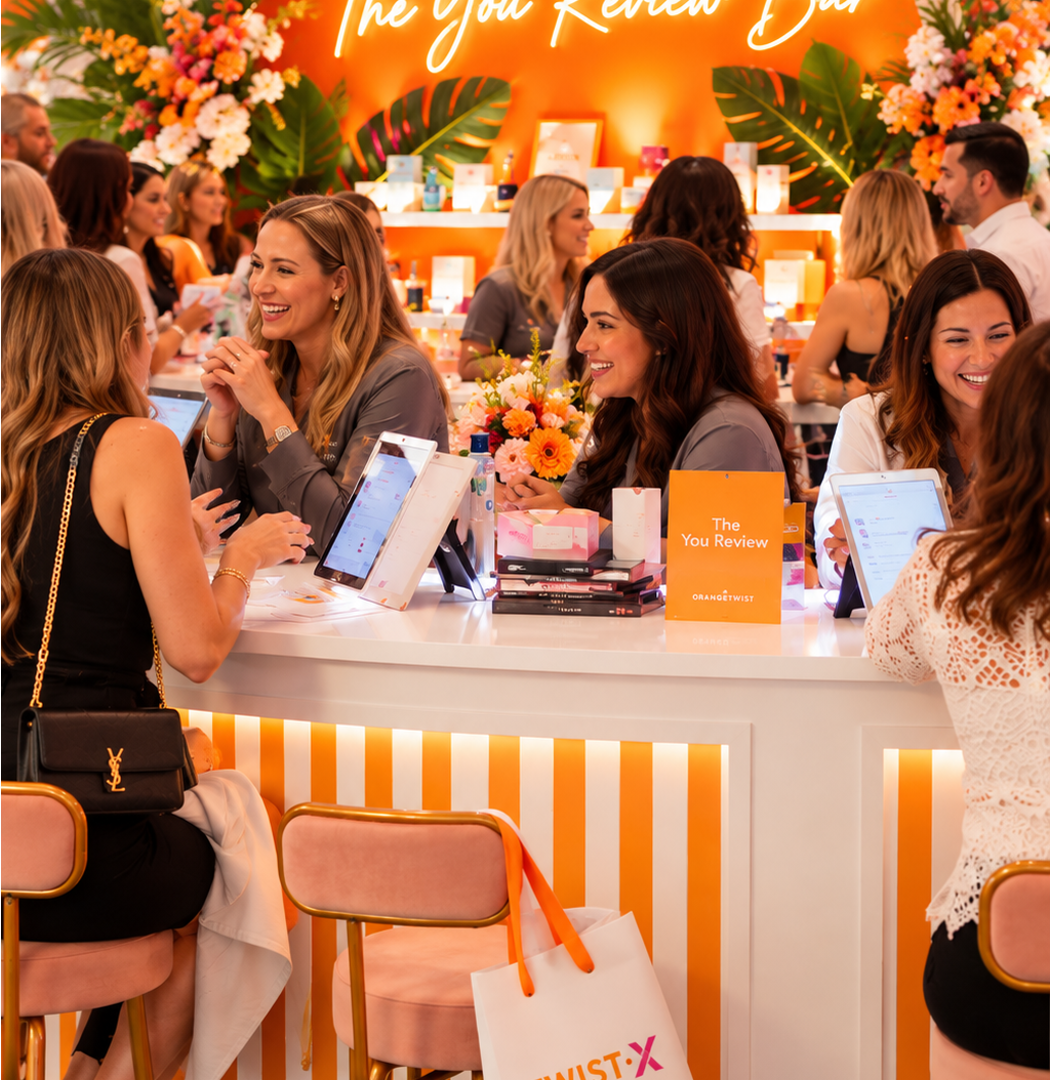
Not just any Lightning Strike. But a strike that brought together superconsumers, vendors, and employees. A B2B2C2E Lightning Strike that everyone who was a superconsumer eagerly paid $250 per person to attend.

A strike where superconsumers got to talk to vendors and Twisters (OrangeTwist employees).

Where supers were eager to learn more about new treatments they longed to try.
A strike where every OrangeTwist employee got to hear from Pirates Clint and Denise about the future of the company and the category.
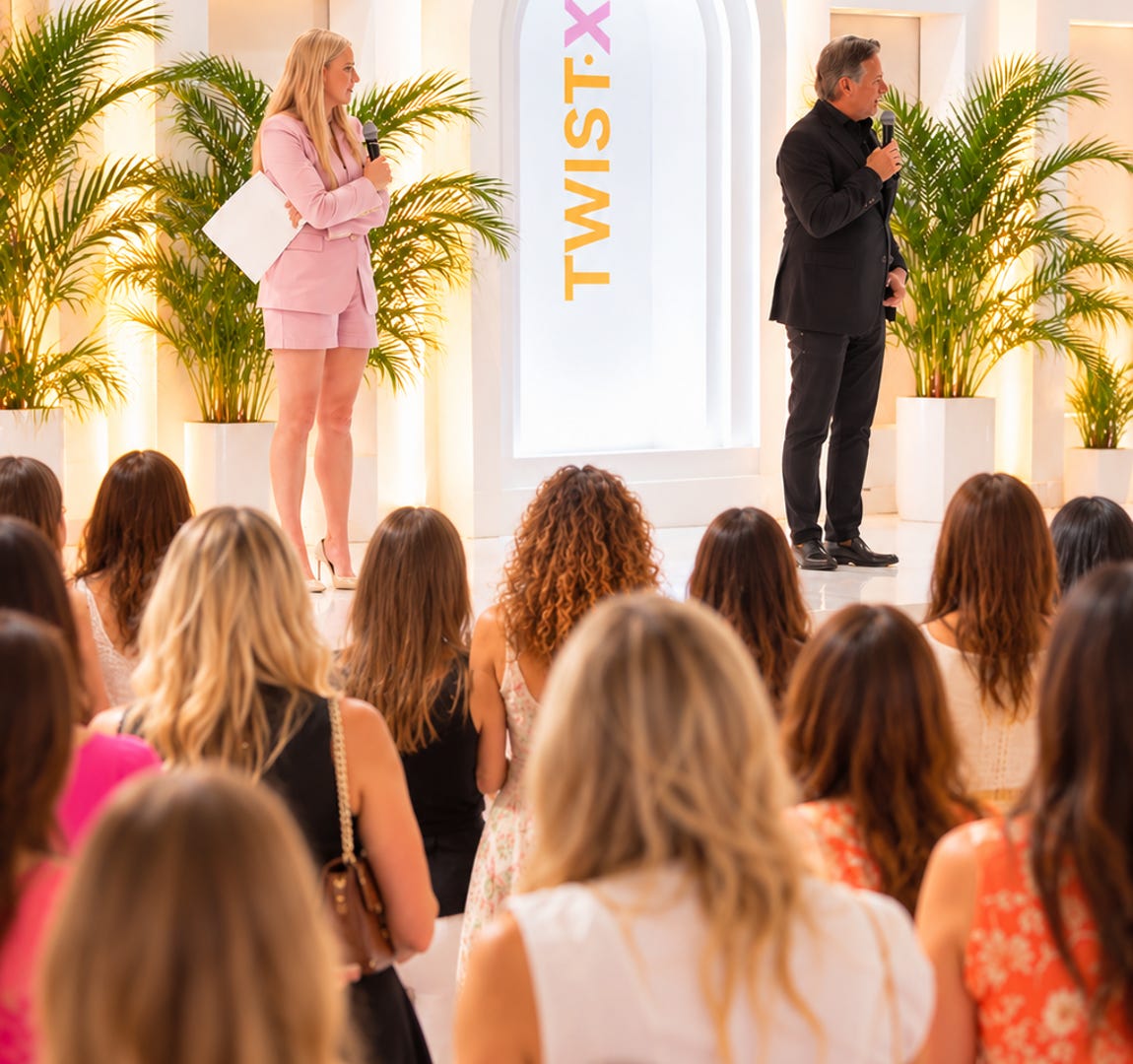
A strike where supers could share their love of the category.

A strike that rained revenue, simplified strategy, and accelerated execution. All by addressing the fundamental problem of the legacy category.
The Waves of Word Salads in Medical Aesthetics
As Pirate Christopher and any surfer know, waves come in sets.
This is why many surfers skip the first wave, because they know if they catch the first wave of a set, the rest will pummel them on the inside. Being stuck in the white wash is a disorienting, disheartening, and sometimes deadly experience.
Zebra hole!
If sports were accurately named, surfing would not be called surfing. It would be called paddling. And when you’re “caught inside” a set wave, after the set wave breaking is in front of you – or on you – pushing you further back, holding you underwater, all while sucking in foam and paddling.
Mostly, it makes you want your mommy.
This is how most consumers in aesthetics feel when they encounter marketing from medical aesthetics. Medical device marketers love to market features and talk about tech no one really understands or cares about. No one loves buzzwords more than the Medical Aesthetics industry. (And we bet your world is not different. Business people think bizno-babble makes them sound smart.)
After attending IMCAS, the mecca of Medical Aesthetics in Paris, Pirate Eddie had two words to sum it all up.
Word salad.
Sweet Greens is jealous of the wall of word salads the Medical Aesthetics industry spews. The salads overwhelm consumer curiosity. People’s attention span fires after about 20 seconds. That’s all you have. So US household penetration of the category remains in single digits. Because of the blah, blah, blah.
But the worst weird data is this.
The vast majority of medical aesthetic consumers only get one type of treatment.
Cross-selling is a concept so basic, even retail banks have figured out how to get a customer with a checking account to open a credit card. McDonald’s can’t believe the Medical Aesthetics industry hasn’t figured out how to say, “Would you like fries with that?”
OrangeTwist cracked the code by understooding simplicity is velocity.
Understand the superconsumers’ needs and life context through an initial intake. Focus on empathy ahead of economics. Build trust ahead of treatments. And eventually, the superconsumer will just hand you her wallet and tell you, “Do what you think is best.”
And the best way to simplify complexity is via superconsumers.
When one superconsumer meets another superconsumer who loves the same medical aesthetic treatment, it’s a joy. But when one superconsumer is introduced to a wonderful new category of treatment from another super they trust and respect, they feel overjoyed.
Complexity was the central problem to solve in the category.
The Three Things That Must Be True For Legendary To Happen
This is something every Pirates face when talking about a lightning strike.
The idea of taking your precious marketing dollars and betting big on an experience that will drive word of mouth is frightening for even the most fearless finance folks. Everyone has a marketing calendar, where they peanut butter their marketing budgets across the usual suspects of trade shows and events.
This is why Pirates like Denise and Clint reject the premise.
But three things must be true to quiet the naysayers.
The strike must generate real revenue. Remember, marketing that doesn’t generate revenue is called arts and crafts.
The strikes should be a profit center. The vast majority of marketing is a cost center.
The strike can generate enterprise value. One successful strike is great, but a repeatable playbook that consistently generates profit-positive strikes has stand-alone enterprise value.
A strike that generated massive revenue. A strike that proved marketing could be a profit center, not a cost center. A strike that is turning into a repeatable strength that has enterprise value incremental to the core business.
Zebra hole!
Legendary strikes inflict psychological damage on competition. Never forget. The CEO, every executive, board member, product manager, marketer, engineer, and salesperson at your competition will consume your strike.
You want them to have an oh 💩 moment.
You want them to “know” they just lost.
You want them to psychologically surrender.
Any good prize fighter will tell you the fight is over before it begins. In that context, a strike is like trash-talking in boxing. You want to “live rent-free in their head”. You want them to wish they did what you just did. You want them to want to quit and come work for you.
So set your bar for legendary appropriately.
This is how they did it and how you can too.