


Arrrrr! 🏴☠️ Welcome to a 🔒 subscriber-only edition 🔒 of Category Pirates. Each week, we share radically different ideas to help you design new and different categories. For more: Audiobooks | Category design podcast | Books | Sign up for a Founding subscription to ask the Pirate Eddie Bot your category design questions.
Dear Friend, Subscriber, and Category Pirate,
In Part 1 of Marketing As A Profit Center, we showcased how Tesla is using its new rental car business as profit-positive marketing for everything else.
In Part 2 of Marketing As A Profit Center, we showed how others are doing it and the true cost of Marketing As A Cost Center mindset.
Here, we show you the way out.
Because climbing the value ladder isn’t just an economic shift. It’s a transformational shift.
Companies don’t stay stuck at the bottom because the marketing team lacks ideas. They stay stuck because the system around marketing (the calendar, the politics, the budgeting rituals) is designed to keep them grounded.
Every organization has gravity, and most leaders mistake it for strategy.
Gravity always pulls toward the familiar.
Most marketing organizations are prisoners of the calendar. Plans locked months in advance. Optimized around buying media, filling channels, delivering impressions. But the calendar is a product of the lower rungs of the value ladder—where activities scale linearly with spend, and the safest move is to spread dollars wide enough that no single bet can be blamed for failure.
If you want marketing to ascend, you have to break this gravitational field

The 5 Step Playbook To Turn Marketing Into A Profit Center
Most marketers know something is wrong. Fewer know where to start fixing it.
The answer isn't better tactics—it's a different operating system.
One that changes how you talk, what you focus on, what you sell, and how it all connects.
Let’s jam. 🎸🏴☠️
Step 1: Stop Talking Like A Cost Center
George Carlin had the seven dirty words you can’t say on Television.
Pirate Christopher wonders why George Carlin stopped at seven?
The words you use shape how others see you.
When a CFO hears “marketing budget,” they hear “expense.” When they hear “marketing capital,” they hear “investment.” This isn’t semantics—it’s positioning. And if you can’t position yourself internally, you have no business positioning anything externally.
Marketers, there are seven dirty words you must no longer say in marketing.
Dirty word #1: Budgets
Nothing says cost center more than ‘my marketing budget’. Budgets say, “This is mine to spend.” Budgets create a ‘spend it or lose it’ mindset. Budgets create entitlement at annual planning time. This is how kids think about their allowances.
The word you want is Capital.
Capital forces you to think like a VC or PE fund. Your Board, CEO, and CFO are your Limited Partners (LPs), who have entrusted you with capital to grow.
Dirty word #2: Calendar
The moment we hear a marketer say “marketing calendar,” we know this is a peanut butter marketing situation. The marketer lacks courage and conviction and defaults to small bets that no one will blame them for.
The words you want are Lightning Strike.
Lightning Strikes create immediate revenue and word of mouth. Strikes can turn cost centers into profit centers. Do the category design work and augment it with Category Science, and you’ll have no fear.
Dirty word #3: Brand Awareness
When a marketer says we’re spending to build awareness, it’s a tell that they are about to light some money on fire. This is because most marketers fixate on building awareness of their brand or product.
The words you want are Problem Awareness.
Market a consumer’s problem, and they think you want to help them. Market your brand, and customers think you want their money.
Dirty word #4: Reach
No one cares how many people your marketing reached. Oh, so your creative flashed before a person who is multi-tasking, flicking between silly animal videos, and isn’t even in the category? Oh, you reached one million of these? See if your CFO cares.
The word you want is WOM.
Word of mouth creates more word of mouth. How many superconsumers are able to remember your problem and POV and repeat it to someone else? WOM trumps reach every time.
Dirty word #5: Impressions
No one cares how many people saw your marketing. Pirate Christopher has seen Pirate Eddie’s blue minivan on the Big Island many times. He’s ridden in Pirate Eddie’s blue minivan many times. Now, picture Pirate Christopher buying one. LOL.
The words you want are Installed-Base.
Great businesses don’t have customers or transactions, they have an installed base of Supers that they can easily market and sell to. Apple estimates the global iPhone user base is ~1.5 billion. Now that’s an installed base.
Dirt word #6: Campaigns
A campaign is a one-off event. One-off events don’t build momentum. One-off events don’t become assets. One-off events are and will always be a one-time expense that you can never get back.
The word you want is Flywheels.
Not funnels of campaigns. Your marketing must drive a Super to buy and get an outcome, which leads the Super to talk about the outcome, which leads more Supers to buy. Forever.
Dirty word #7: Brand Equity
Do brands matter? Of course. But too many marketers have fallen prey to the Big Brand Lie. They focus on brand awareness and equity metrics. They worry about making the logo bigger and pantones.
The word you want is Category Potential.
Are you building awareness of the new category and the problem it solves? Are you converting legacy supers to the new one? Categories make brands.
To reject the premise, you must reject the legacy language.
To change your language, you must change how you think.
To change how you think, you must change what you do.
If you change what you do, you will change the outcomes you enjoy.
Let’s get specific.
CMOs! It’s time to change the power dynamics between you and your C-Suite brothers and sisters. Aren’t you tired of the side eye glances when your marketing budget is flashed on the screen? Can’t you hear the thought bubbles?
“Marketing budget. What a waste of money.”
“I need the CMO’s budget. What are they thinking?”
“We’d be better off buying lottery tickets than letting marketing light that money on fire.”
Here’s the secret that most CMOs miss:
Self-funding marketing changes power dynamics.
Do you remember the look on your parents’ faces when you, as an adult, picked up your first-ever dinner check? It’s a look of surprise and eventually a smile of satisfaction so deep you never forget it.
It’s the same look a CFO gives the CMO when the CMO says, “I can self-fund this. Don’t worry.”

The moment marketing clearly and transparently produces revenue directly (ticket sales, sponsorships, subscriptions, deal flow, ecosystem gravity), it stops being a “cost” and becomes an investment.
When marketing behaves like a business, it doesn’t need permission—it creates leverage. Revenue-driven marketing builds its own flywheel: money funds momentum, momentum funds belief, belief funds growth.
The more revenue marketing drives, the more optionality the company has—and the less marketing gets treated like a service department begging for headcount.
This is the line between marketing as decoration and marketing as destiny.
One burns cash and patience.
The other earns reinvestment and authority.
Step 2: Find & Focus On The Niche Of Your Core Business.
Every business has a core—the part that funds everything else.
At Amazon, it’s AWS: 17% of revenue, 60% of profit. At Apple, it’s iPhone. At Alphabet, it’s Search. These are the core businesses that fund everything else.
But you don’t have to be a trillion-dollar company to have a core. Even simple, one-category businesses have power SKUs and super-geos—the products and places where disproportionate value concentrates.
Take Ben & Jerry’s. At one point, Cherry Garcia was their #1 flavor. And two decades ago, just 3,000 out of 30,000 grocery stores accounted for over half of Cherry Garcia sales. The consulting recommendation wrote itself: don’t be out of stock in those 3,000 stores.
Not every CMO knows this.
Not every CEO knows this.
But most CFOs know this very well.
And the fastest way to get buy-in from the CFO is to ask, “What is our core business?” and market that. But answering, “What is your core business?” is not always as easy as it seems. Category Pirates defines your core business as the part of your business that:
It is the centerpiece of your enterprise value (e.g., investors care the most about it)
You have a powerful marketing flywheel that drives LTV and low CAC
You are the Category King (76% of category economics)
You are different in your product and/or business model
Your supers get massive outcomes & drive WOM
Aligns with the core problem to solve and POV
Gets simpler over time
Your core can hide at different altitudes. Sometimes it’s a category. Sometimes it’s a category in a specific country. Sometimes it’s a single product, in a single market, in a single channel.
Take Colgate-Palmolive.
They operate in Oral Care, Pet Care, Personal Care, and Home Care.

So what’s the core?
Your first instinct might be Oral Care or Pet Care—both are #1 share positions where Colgate is the Category King. Both have strong marketing flywheels, powered by endorsements from dentists and veterinarians.
But the real answer is more specific: Oral Care in Latin America.
That’s where Colgate dominates market share. That’s where population and per capita income are trending up for decades. That’s what fuels Colgate’s dividends for the foreseeable future.
If your company has one category, one brand, one product—this exercise is straightforward. But for larger companies with many brands across many categories, finding the core takes real work.
Chris Zook’s Profit From the Core is one of Pirate Eddie’s favorite business books.
Zook defined your core as the part of your business where you have the deepest, most defensible advantage. Where your most profitable customers live. Where operating leverage compounds.
Put simply, it’s the system of products, customers, and capabilities that produces the majority of your profit with the least complexity. Everything sustainable grows from there.
His team at Bain did the Category Science to prove it. They studied mega-brands—companies with multiple products and categories under the same brand—and found something striking.
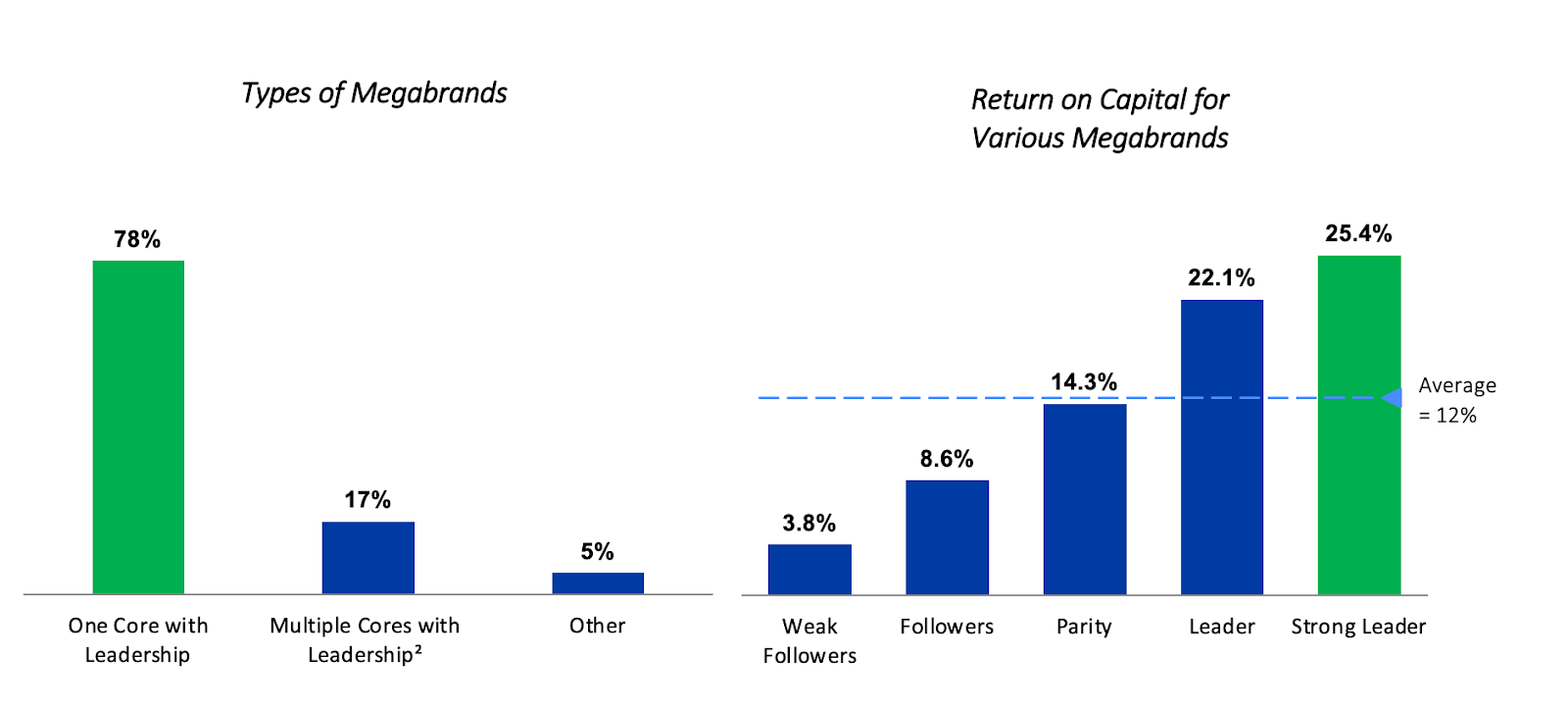
Zook found two things.
First, most mega-brands had one core business where they were the Category King. Not two. Not five. One.
Second, companies that were Category King in their core generated more than 2x the return on capital versus other mega-brands.
Dominance in your core isn’t a nice-to-have. It’s the whole game.
Why do we know this question is hard to answer? Because Category Pirates are still wrestling with it ourselves. More on that later.
Step 3: Launch An “Experience” Event For Your Core Business
Most companies treat events as brand building.
That is code for “who knows if this works?”
It’s arts and crafts with a bar tab.
Here’s how category designers think different:
