


Arrrrr! 🏴☠️ Welcome to a 🔒 subscriber-only edition 🔒 of Category Pirates. Each week, we share radically different ideas to help you design new and different categories. For more: Audiobooks | Category design podcast | Books | Sign up for a Founding subscription to ask the Pirate Eddie Bot your category design questions.
Dear Friend, Subscriber, and Category Pirate,
Lightning Strike Legends is a new mini-book series.
We will share outcomes of real pirates executing real strikes and getting real receipts.
This first one belongs to Pirates Lydia Flocchini and Nick Kringas. Two Category Design Academy alumni. Different cohorts and different coasts. Children of immigrants who know what hardship looks like and aren’t afraid of it.
Both are proven Creator Capitalists.
The strike you’re about to read didn’t work because they followed a marketing playbook. It worked because they’d already built the Creator Capitalist foundation underneath it. The capitals came first. The revenue followed.
Pirates Lydia and Nick each have an abundance of the Four Capitals: Reputation Capital, Relationship Capital, Financial Capital, and, most importantly, Intellectual Capital.
Pirate Lydia can take any legal tech sales funnel and grow it using magic words.
Pirate Nick sees new categories everywhere and knows how to create them.
They have both created massive economic outcomes for others.
If you’d like to read more about them, you’ll have to turn to page 619 of our Creator Capitalist book! Or listen to the Creator Capitalist podcast we did with them next week.
Now they are creating massive economic outcomes for themselves too.
Here’s what they did. They planned a Lightning Strike in three weeks, invested $24,000, signed a $90,000 recurring client on Day 2, generated $270,000 likely to close, and had a total potential pipeline of up to $1,000,000!
4x ROI before they caught their flights home. 11x near-term potential ROI with a near 42x ROI in the total pipeline.
We’re not just bragging about Pirates Nick and Lydia (though we are.)
We are trying to shake the unbelief out of you.
However, some don’t like having their beliefs challenged. You can see it in some of the negative reviews for our Lightning Strike Marketing book.
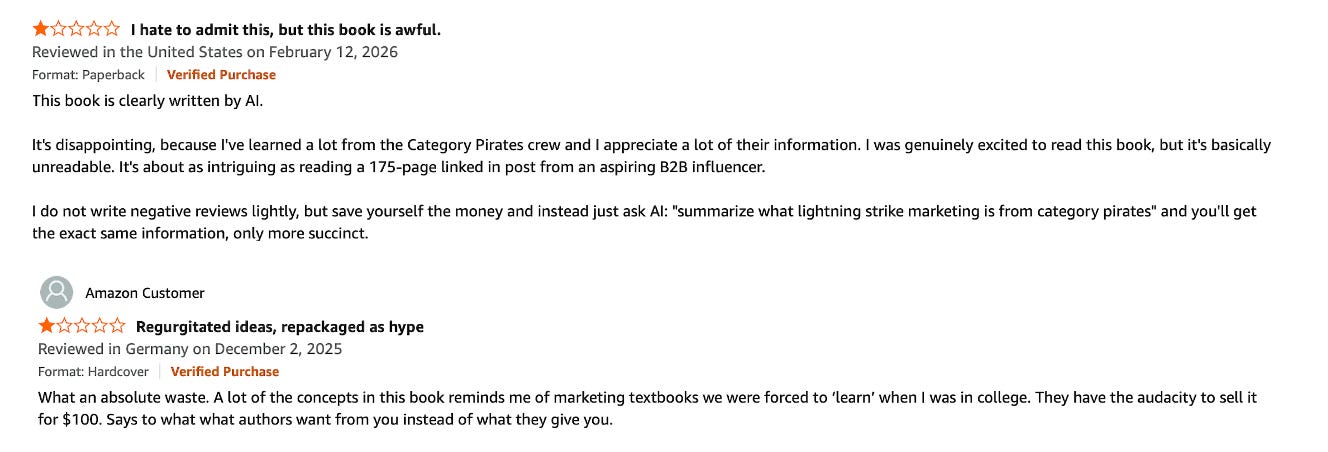
For the record, we love negative reviews.
They are informative if you read them correctly.
These folks are disappointed about what they learned. But Lightning Strike Marketing is not a teaching book. It’s a Transformation book. The context of a Teaching book is a classroom. The context of a Transformation book is getting into the arena and slaying dragons.
The purpose of the book is to get you to take action and make it rain revenue.
Do You Believe There is Buried Treasure?
We are trying to tell you there is buried treasure right in front of you.
But you can’t get the treasure by just reading a book.
Outcomes require action.
This is like the joke of the two economists walking on the sidewalk. One says, “Look, there’s a $100 bill in front of us.” The other says, “That’s impossible. If a $100 bill was actually there, someone else would have picked it up.” And they walk right past it.
Our favorite quote in the negative review is “They have the audacity to sell it for $100.”
But what happens when a $100 book results in $90,000 in real revenue on Day 2 of the strike? And another $270,000 in near-term pipeline has the potential upside to $1,000,000?
Is it audacious? We think it is audacious and generous.
More than one thing can be true.
Creator Capitalist launches March 17. If you want to start mapping your own buried treasure before the book drops—join the waitlist at creatorcapitalist.ai. You’ll get the Introduction and Section 1 opener immediately.
We don’t care nearly as much about bad reviews of a book as a bad review about yourself, your superpowers, and the potential upside of the new category you’ve been sitting on.
That’s what we’re trying to help you believe.
Creator Capitalists unlock massive economic abundance.
Lightning Strikes produce real revenue.
You just need to pick it up.
Just like Nick and Lydia.
Proven Creator Capitalists Join Forces
Nick Kringas is the oldest son of a Greek immigrant who built a bar near a General Motors plant and lost it.
Nick was caddying that summer when his mom called, crying. We lost the bar. He was the oldest child. He began negotiating a forbearance with the mortgage company before leaving for college.
Like many children of immigrants, Nick had to become a Pirate early on.
He borrowed $139,000 against his parents’ house to open an authentic Greek restaurant. His mom is in the kitchen. His dad is out front. Family style, run-out-of-food-three-days-in-a-row successful.
Pirate Nick was an intuitive Category Designer.
The market figured out that following Pirate Nick was a good idea. Competition has copied Nick everywhere he’s gone.
As other ‘authentic Greek’ restaurants followed, Pirate Nick taught himself SEO from a home study course. He pivoted and built an agency for personal injury law firms, grew it fast, and watched it commoditize.
That’s when he found Play Bigger.
Lydia Flocchini is the oldest daughter of immigrant parents.
Twenty-six years in legal tech. She is a lawyer by training and also a category designer by instinct. She led marketing for Thomson Reuters’ flagship legal research product when they were the Category King. Then she caught the startup bug and joined Lex Machina to invent legal analytics from scratch, which was later acquired by LexisNexis.
She kept building, kept scaling, and kept delivering for everyone around her.
Then she stopped.
Not because things were going badly, but because Pirate Lydia realized everyone else was benefiting from her superpower, but she hadn’t fully capitalized on it as a Creator Capitalist.
Pirates Lydia and Nick are not just exceptional because they’re talented.
They’re exceptional because they’ve both spent their lives carrying weight that not everyone has to carry. The burden of not just providing for themselves, but for parents who sacrificed everything to give them a shot, for families who depended on them to get it right.
This is also known as the American Dream.
That kind of pressure doesn’t break people like Nick and Lydia.
Here’s what most people miss when they hear stories like Nick’s and Lydia’s: you think they had something you don’t. They didn’t. They had the same thing you have—years of Intellectual Capital trapped inside other people’s businesses, Reputation Capital locked inside institutions, Relationship Capital they’d never activated, and Financial Capital they’d never structured for investment. The difference is that they finally saw it. Creator Capitalist exists to help you see yours.
The only thing they were missing was each other.
They met inside the Category Design Academy. Different cohorts on different coasts. Pirate Eddie connected them, seeing two people working in the legal space from opposite ends of the country, whose superpowers are even more powerful together.
Nick was the strategist. Always seeing the whole field. Always asking what’s happening at the category level before asking what to do about it.
Lydia was the revenue scientist, marketer, and writer. The former CMO, who had been accountable to boards throughout her career, knew that marketing without a number attached to it is considered arts and crafts.
He asked her to review his Languaging. She gave him feedback. They kept talking.
What started as an advisor and founder became something more valuable.
They became a band.
Two people who had done enough work on their own superpowers to recognize what the other one had.
Pirate Nick said it plainly, “I wanted a thinking partner, not someone coming in and out of my life.”
Then Nick mentioned a conference. Three weeks away.
Lydia said yes before she’d thought it through.
That’s the moment this story really starts.
Nick and Lydia found what we call Business Bandmates—and how to find yours is one of the most important chapters in Creator Capitalist. Chapter 14 breaks down exactly what to look for, how to know when you’ve found them, and why the right bandmate compounds everything you’ve already built. Join the waitlist to be the first to get our new book, Creator Capitalist, here.
The OG Problems in Personal Injury: The Invisible Victim and Settle for Safety Attorneys
Before we get to the strike, you need to understand their problem and POV.
A problem worth solving and a point of view worth defending—these are two of the most important things a Creator Capitalist must have before they do anything else. Without them, you don’t have a business. You have a hobby with expenses.
Do not execute a Lightning Strike until you do the core Category Design work.
Pirate Nick had been jamming on the core category problem in personal injury law back when he was in Strategy Therapy with the Pirates.
The conventional wisdom about Personal Injury (PI) law is:
PI has too many clients faking and inflating injuries.
PI attorneys are ambulance chasers.
PI law is too big as it is.
But Nick knows how to reject the premise. His POV is that:
There are too many victims who don’t get the legal help they need.
PI attorneys are too risk-averse, settling for too little, too fast.
PI law should be billions of dollars bigger.
Is he right? Let’s look at some weird data.
Each year, there are 400K PI clients.
5.1MM/year medical consulted injuries from motor vehicles.
5.45% of PI leads turn into a consult, the lowest of any law field.
96% of PI cases settle before reaching trial, per Clio and the DOJ.
Are there excessively litigious folks who inflate their injuries? Sure.
But the numbers suggest there are exponentially more people who suffer in silence.
Here are the three stages of how a person becomes a personal injury client.
The Invisible Victim. You get hurt, but medical help comes before legal help.
The Perplexed Prospect. You Google lawyers, but have no idea what to do.
The Undervalued Client. You find a PI attorney who settles for less.
Most people handle a personal injury and hope their insurance covers as much as possible. Or worse, they end up in medical bankruptcy. As high as two-thirds of all bankruptcies are medical.
This is despite the fact that personal injury legal pricing is as missionary as they come.
Your PI attorney is paid only if and when you are paid. Otherwise, victims pay nothing. The incentives are so strongly aligned that they can be paid one-third of the settlement.
Ambulance chaser has a greedy connotation. But the data shows attorneys aren’t chasing ambulances, they’re watching them drive past. And when they do take a case, they don’t fight hard enough. They fold.
The problem with PI attorneys is not that they are too greedy, but not greedy enough.
That’s why PI lawyers love SEO. It was the one form of client acquisition that was easy. You optimized your website, you ranked for the right terms, and the phone rang. On the other end was a prospect who refused to be an Invisible Victim or Perplexed Prospect.
Then AI happened.
Google is no longer the default first step anymore. Now, when a personal injury happens, more and more people open an AI before they open a search engine.
Because of AI, it’s not just the victims who are invisible.
The personal injury lawyers are invisible, too.
Invisible Victims Can’t See AI Invisible Lawyers
Pirate Eddie has recent, first-hand experience as an Invisible Victim.
Pirate Eddie broke his ankle as he walked from the men’s locker room to the pool deck at Lifetime Fitness. He wasn’t running. He was wearing running shoes. He was walking to the sauna when the next thing he knew, his Apple Watch was going bonkers, asking if he wanted to call 911.
As soon as he got home, he started asking AI medical questions. He got an X-ray at Urgent Care. He uploaded his X-rays to AI. He was told he needed surgery, so he asked about surgery outcomes.
He would repeatedly ask AI medical questions during his early recovery. After a while, it was easy and natural to start asking AI legal questions.
He knew AI was not a lawyer. But Pirate Eddie didn’t know what he didn’t know. And AI was perfect for asking the right questions.
Pirate Eddie wasn’t even aware he was an Invisible Victim. At some point, he became a Perplexed Prospect.
But the scary part for PI attorneys?
Google never got a glance from Pirate Eddie, who didn’t know any PI attorneys.
Which meant the PI attorneys were AI invisible too.
If your business is AI invisible, then it will be like your business doesn’t exist.
Quick zebra hole for the Pirates who want the practical takeaways from Eddie’s experience—skip ahead to ‘Category Science for the Win’ if you want to get back to the strike.
If you fall and break your ankle like Pirate Eddie at a gym, you will be facing a few mini-crossroads where you have to make rapid decisions that could matter. You will be presented with a lot of binary choices. Reject the premise and look for the third option.
To Ambulance or not?
Right after, Pirate Eddie was asked if he wanted an ambulance. Or he could go home on his own. But the choice isn’t binary as there is a third option.
You can call someone you trust and have them help you home. Have someone bring you crutches or a scooter.More information is better.
Right when he fell, two good Samaritans rushed to his side. He was grateful for their help, but never got their names. One said to him, “Let me know if I can help. I saw everything.” He wasn’t sure what that meant, but in hindsight, Pirate Eddie wishes he had gotten their contact info, as well as taken photos/videos of the fall area.ER or tough it out?
For an injury like his that wasn’t life-threatening, it’s tempting to tough it out. But once Pirate Eddie’s wife saw he couldn’t bear weight, she told him he needed an X-ray. But the choice wasn’t just ER or nothing. Immediate/Urgent care is the smarter choice.
For an injury that isn’t life-threatening, Immediate/Urgent care will cost hundreds, whereas the ER can cost thousands.
Pirate Eddie asked Lifetime whether they would offset his out-of-pocket medical bills. They were polite and referred him to a third-party processor, and the claim was denied. Like most gyms, Lifetime requires members to sign a waiver.
Pirate Eddie’s revenue to Lifetime Fitness was nearly $4K per year. The entire experience left a bad taste in his mouth, and he canceled his membership, even though he knew another gym would require another waiver.
Gym unit economics mean that after a certain number of memberships, each dollar of revenue yields mostly profit. A good-faith gesture would be breakeven in one to two quarters, along with strong positive word of mouth. Lifetime value matters, ironically.
Okay, back to our originally scheduled program!
Organic click-through rates have dropped 61% for queries with AI Overviews per Seer Interactive. Someone gets rear-ended, is scared, opens Claude, and asks, "Should I call an attorney?" Who should I call in my city?
Those cases are gone before they ever hit a search results page. Can’t track them. Can’t retarget them. Can’t see them in Google Analytics. Just gone.
This is where Pirates Nick and Lydia Language a legendary POV in the Category Design Academy.
Are you AI invisible?
Category Science for the Win
Pirates Nick and Lydia had the right words.
Now they needed the right numbers. They conducted Category Science, built an index, and created a diagnostic.
Here’s what Nick and Lydia found.
