


Arrrrr! 🏴☠️ Welcome to a 🔒 subscriber-only edition 🔒 of Category Pirates. Each week, we share radically different ideas to help you design new and different categories. For more: View the mini-book archive | Listen to another category design jam session | Dive into an audiobook | Enroll in the free Category Accelerator email course
Dear Friend, Subscriber, and Category Pirate,
This episode is about the most undervalued skill in the world right now: thinking.
Not “consuming content” thinking. Not “I read a thread on X” thinking. Not “my algorithm told me what to believe” thinking.
Real thinking.
The kind where you sit with an idea long enough that it changes you.
We call this Thinker’s High.
Today, we’re talking about where it came from, why we turned it into a book, and why it might be the most important thing we’ve ever made—for you and for the people in your life who need Category Design but don’t know it yet.
This is the book you hand someone when they ask: “What is this Category Design thing you keep talking about?”
Gift it to your coworker. Your kid heading to college. Your work spouse for Valentine’s Day. (Eight days away. You’re welcome. Get it here.)
Or gift it to yourself so you can see the world through a category design lens every single day.
But first—a taste of what’s inside.
Three Proverbs. Three Ways To Think Differently This Week.
Every proverb in Thinker’s High comes with four layers:
What (the idea)
So What (why it matters)
Now What (what to do today)
AI Prompts (to jam on the idea with your AI co-founder).
Here are three from three different chapters:
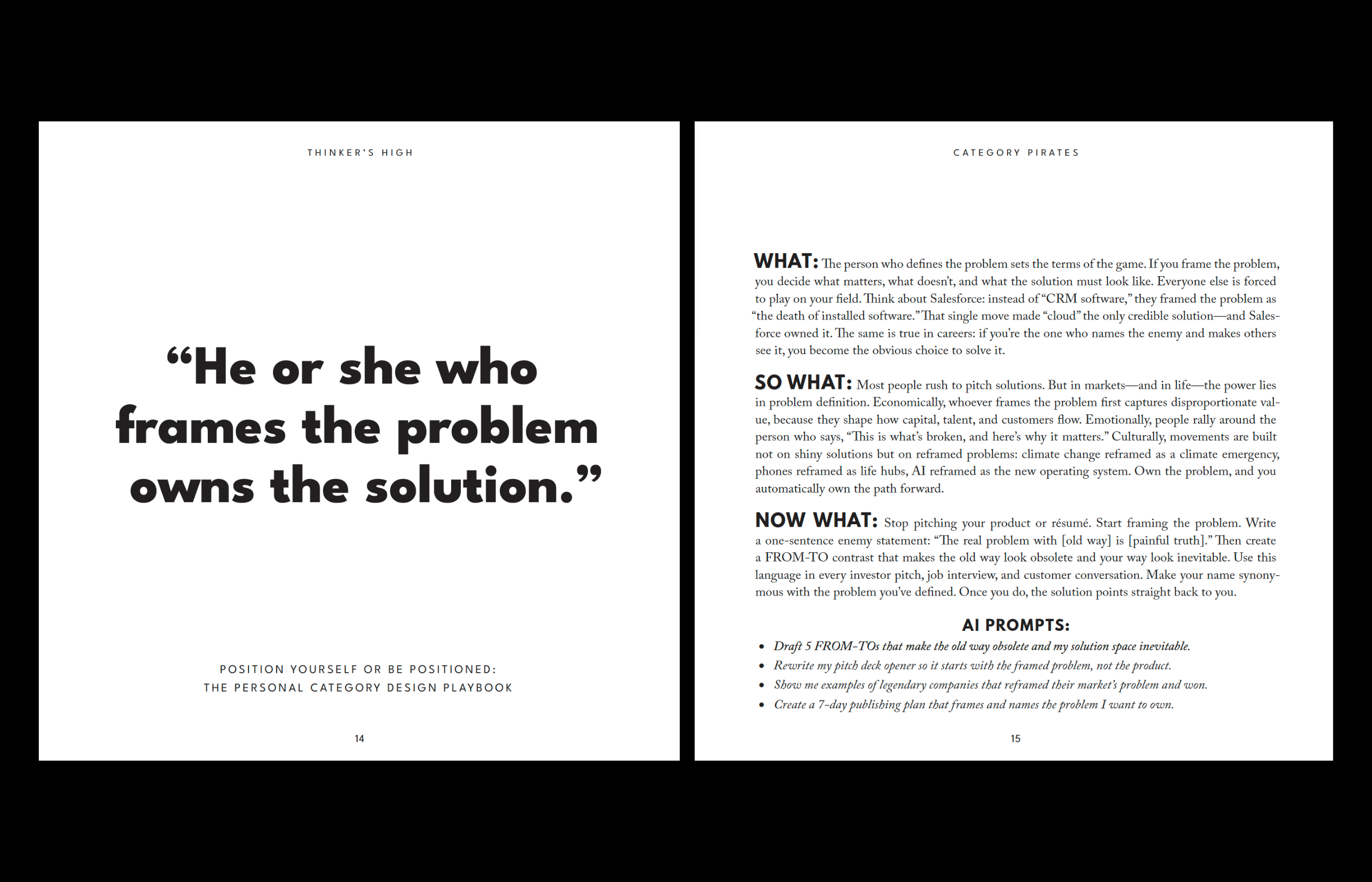
“He or she who frames the problem owns the solution.”
(Chapter 1: Clarity—from the Position Yourself Or Be Positioned mini-book)
What: The person who defines the problem sets the terms of the game. If you frame the problem, you decide what matters, what doesn’t, and what the solution must look like. Everyone else is forced to play on your field. Think about Salesforce: instead of “CRM software,” they framed the problem as “the death of installed software.” That single move made “cloud” the only credible solution—and Salesforce owned it. The same is true in careers: if you’re the one who names the enemy and makes others see it, you become the obvious choice to solve it.
So What: Most people rush to pitch solutions. But in markets—and in life—the power lies in problem definition. Economically, whoever frames the problem first captures disproportionate value, because they shape how capital, talent, and customers flow. Emotionally, people rally around the person who says, “This is what’s broken, and here’s why it matters.” Culturally, movements are built not on shiny solutions but on reframed problems: climate change reframed as a climate emergency, phones reframed as life hubs, AI reframed as the new operating system. Own the problem, and you automatically own the path forward.
Now What: Stop pitching your product or résumé. Start framing the problem. Write a one-sentence enemy statement: “The real problem with [old way] is [painful truth].” Then create a FROM-TO contrast that makes the old way look obsolete and your way look inevitable. Use this language in every investor pitch, job interview, and customer conversation. Make your name synonymous with the problem you’ve defined. Once you do, the solution points straight back to you.
AI Prompts:
Draft 5 FROM-TOs that make the old way obsolete and my solution space inevitable.
Rewrite my pitch deck opener so it starts with the framed problem, not the product.
Show me examples of legendary companies that reframed their market’s problem and won.
Create a 7-day publishing plan that frames and names the problem I want to own.
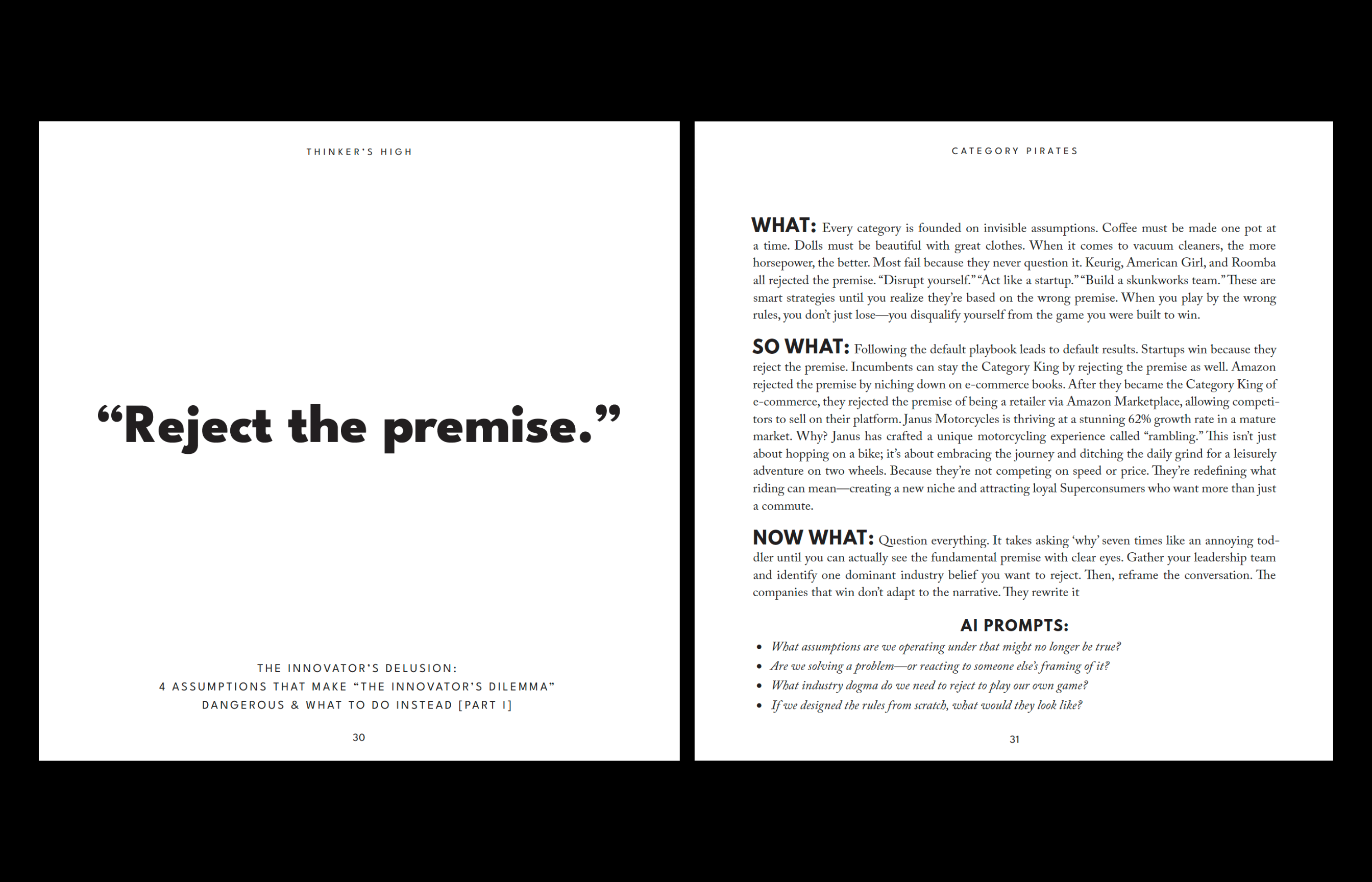
“Reject the premise.”
(Chapter 2: Courage—from The Innovator’s Delusion mini-book)
What: Every category is founded on invisible assumptions. Coffee must be made one pot at a time. Dolls must be beautiful with great clothes. When it comes to vacuum cleaners, the more horsepower, the better. Most fail because they never question it. Keurig, American Girl, and Roomba all rejected the premise. “Disrupt yourself.” “Act like a startup.” “Build a skunkworks team.” These are smart strategies until you realize they’re based on the wrong premise. When you play by the wrong rules, you don’t just lose—you disqualify yourself from the game you were built to win.
So What: Following the default playbook leads to default results. Startups win because they reject the premise. Incumbents can stay the Category King by rejecting the premise as well. Amazon rejected the premise by niching down on e-commerce books. After they became the Category King of e-commerce, they rejected the premise of being a retailer via Amazon Marketplace, allowing competitors to sell on their platform. Janus Motorcycles is thriving at a stunning 62% growth rate in a mature market. Why? Janus has crafted a unique motorcycling experience called “rambling.” This isn’t just about hopping on a bike; it’s about embracing the journey and ditching the daily grind for a leisurely adventure on two wheels. Because they’re not competing on speed or price. They’re redefining what riding can mean—creating a new niche and attracting loyal Superconsumers who want more than just a commute.
Now What: Question everything. It takes asking ‘why’ seven times like an annoying toddler until you can actually see the fundamental premise with clear eyes. Gather your leadership team and identify one dominant industry belief you want to reject. Then, reframe the conversation. The companies that win don’t adapt to the narrative. They rewrite it.
AI Prompts:
What assumptions are we operating under that might no longer be true?
Are we solving a problem—or reacting to someone else’s framing of it?
What industry dogma do we need to reject to play our own game?
If we designed the rules from scratch, what would they look like?
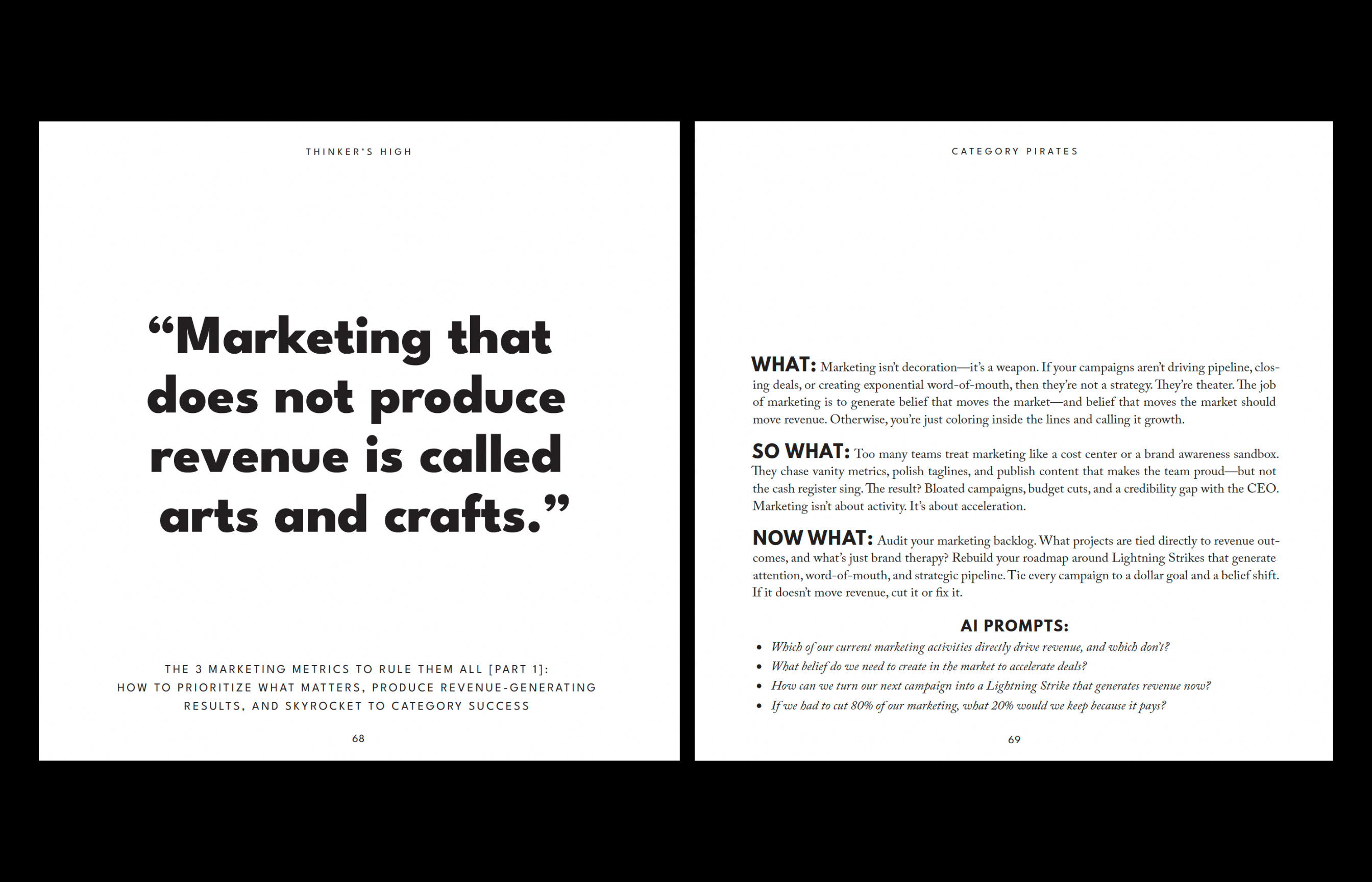
“Marketing that does not produce revenue is called arts and crafts.”
(Chapter 5: Marketing—from The 3 Marketing Metrics To Rule Them All mini-book)
What: Marketing isn’t decoration—it’s a weapon. If your campaigns aren’t driving pipeline, closing deals, or creating exponential word-of-mouth, then they’re not a strategy. They’re theater. The job of marketing is to generate belief that moves the market—and belief that moves the market should move revenue. Otherwise, you’re just coloring inside the lines and calling it growth.
So What: Too many teams treat marketing like a cost center or a brand awareness sandbox. They chase vanity metrics, polish taglines, and publish content that makes the team proud—but not the cash register sing. The result? Bloated campaigns, budget cuts, and a credibility gap with the CEO. Marketing isn’t about activity. It’s about acceleration.
Now What: Audit your marketing backlog. What projects are tied directly to revenue outcomes, and what’s just brand therapy? Rebuild your roadmap around Lightning Strikes that generate attention, word-of-mouth, and strategic pipeline. Tie every campaign to a dollar goal and a belief shift. If it doesn’t move revenue, cut it or fix it.
AI Prompts:
Which of our current marketing activities directly drive revenue, and which don’t?
What belief do we need to create in the market to accelerate deals?
How can we turn our next campaign into a Lightning Strike that generates revenue now?
If we had to cut 80% of our marketing, what 20% would we keep because it pays?
That’s 3 out of 52.
Each one designed to stop you mid-scroll and start you mid-thought.
(Already know you need this on your coffee table? You can get it here.)
Thinking About Thinking Is The Most Important Kind Of Thinking
Everyone’s scrambling to learn prompts. Watching tutorials. Optimizing what they feed AI.
Nobody’s asking: What am I actually thinking—and why?
There’s a difference between reflexive thinking and reflective thinking. Reflexive is fast, automatic, unquestioned. It makes you feel productive while you recycle the same ideas everyone else has. Reflective is where you pause and ask: Where did that belief come from? Is it a fact, a filter, or a feeling?
Most of us were taught what to think our entire lives. By school. By media. By marketing.
Thinker’s High is what happens when you pierce through being told what to think and start doing the thinking yourself.
It’s the dopamine hit you get when you shift from consuming ideas to generating them. Shaping them. Turning them into value that changes someone’s life.
Once you experience it, you get addicted. You start asking “why” five to seven times. You start realizing the assumptions you had were never yours. You start designing new futures instead of decorating old ones.
It’s a runner’s high for your mind. Except the more you do it, the more valuable you become.
Why A Book Of Proverbs (Not Another Mini-Book)
We’ve written over 200 mini-books.
Some of our best lines—the ones we come back to in our own jams, the ones Pirates quote back to us—get buried inside 10,000-word pieces. Highlighted once. Never found again.
So we asked: what if we extracted the sharpest lines across everything we’ve ever written and built a book designed to be used, not read?
We started with AI. Ingested all 200+ mini-books. Extracted roughly 4,000 candidate quotes. Built a scoring system. Then we went in as humans and picked the 52 that made the final cut.
10 chapters: Clarity. Courage. Treasure. Creativity. Marketing. Relationships. AI. Future. Simplicity. Legendary.
Open any page. Find what you’re looking for. Start thinking.
👉 Order your copy of Thinker’s High here.
Here’s how to navigate this conversation:
00:00 – What Is Thinker’s High? The origins of the concept and why human thinking is the most important skill in the age of AI.
04:59 – Thinking About Thinking: Why most of us have been taught what to think, not how to think—and why that distinction changes everything.
08:39 – The 10 Chapters: How we organized 52 proverbs across clarity, courage, treasure, creativity, marketing, relationships, AI, future, simplicity, and legendary—and how to use each one when you’re stuck.
11:47 – How We Used AI To Write This Book: We cranked the dial to 11, extracted 4,000 quotes, and learned what AI can and can’t do in the book creation process. A behind-the-scenes look at the process—useful for anyone writing books with AI.
14:57 – The Gift Strategy: Why this book was designed to be gifted—and why gifting is the most underused superconsumer strategy in the world.
15:24 – The Richard Bach Inspiration: How Pirate Christopher’s favorite childhood book inspired the serendipity design of Thinker’s High.
17:53 – Why It’s Not On Amazon: We walked away from the largest book retailer on earth. Because we practice what we preach.
You won't find it on Amazon.
On purpose.
This is a direct relationship between us and you—no algorithm, no comparison carousel, no middleman.
Grab Thinker’s High for yourself (or gift it) here.
Arrrrrrr,
Category Pirates 🏴☠️
P.S. - Each proverb comes with AI prompts designed to be jammed on with the Pirate Eddie Bot.
The prompts work with any AI.
But they work best with the Pirate Eddie Bot—who’s trained on our entire mini-book library and can take the proverb deeper, apply it to your specific business, and walk you through the full framework behind each quote.
Book + Eddie = the full Thinker's High experience. If you're a Founding Subscriber, you already have the Pirate Eddie Bot. If you're not, now you know what you're missing.
P.P.S. - This is Volume 1.
There will be a Volume 2. Probably a Volume 3. We’re building a collector’s set because words matter and the more mini-books we write, the more legendary quotes we extract. But this is where it starts.


