


Arrrrr! 🏴☠️ Welcome to a 🔒 subscriber-only edition 🔒 of Category Pirates. Each week, we share radically different ideas to help you design new and different categories. For more: Dive into an audiobook | Listen to a category design jam session | Enroll in the free Strategy Sprint email course
Dear Friend, Subscriber, and Category Pirate,
In the late 90s, no one talked about “experiences” as a product.
So when Joe Pine and James Gilmore dropped the bombshell concept of the Experience Economy back in 1999, they flipped the script on traditional business strategy.
At a time when most companies were duking it out over product features or price wars, Pine and Gilmore threw down the gauntlet: the real money, they argued, was in crafting incredible experiences.
They said, "Forget just selling stuff. Sell the memory, the vibe, the whole damn show."
This was radical because it vaulted experiences from the background to front and center, treating them as a product you could design, sell, and deliver (like a latte or a laptop). It wasn’t just about the coffee but about the buzz of the cafe, the velvet touch of the sofa, the indie music (softly) playing—elements that turn a coffee run into a mini-escape.
Today, the “experience economy” is everywhere.
Everything Airbnb does revolves around an experience—whether it’s going on a tour with a local guide, getting detailed “experience” itineraries, or waking up in the Musée d’Orsay on the day of the Opening Ceremony of the 2024 Olympic Games in Paris. (Pirate Katrina’s dream!)

And there are “experience” examples across almost every industry:
Disney: Disney is the quintessential example of an experience-focused company. Whether through its theme parks, cruise lines, or entertainment productions, Disney excels at creating magical experiences that are both immersive and memorable. The company's theme parks transport visitors into fantastical worlds that make them feel as though they are part of their favorite stories. It even has a “My Disney Experience” app to help visitors navigate the parks.
IKEA: IKEA turns shopping for home furnishings into an experience, from the layout of its stores that encourages a winding journey through various room setups to the in-store cafeterias serving Swedish food. The overall design beckons visitors to envision their lives with IKEA furniture in them.
Starbucks: Starbucks transformed the coffee shop experience by creating a "third place" between home and work where customers can relax, meet friends, or work while enjoying their coffee. It’s not just about selling coffee. It’s about the ambiance, the service, and the consistent experience across all its locations worldwide.
Apple: Apple stores are a great example of the experience economy at work in retail. These stores provide a hands-on experience with products, workshops, and a clean, minimalist design that emphasizes the products and the experience of using them. The Genius Bar provides personalized tech support, turning a simple visit to the store into a total tech experience.
Virgin Atlantic: In the airline industry, Virgin Atlantic designed its own category of experience by focusing on the passenger experience. From mood lighting and upscale lounges to on-board bars and innovative seating configurations, Virgin Atlantic aims to make flying a pleasure rather than a chore.
Each of these companies shows how integrating experiences into their offerings can elevate their products, create deeper customer loyalty, and position their category as something new and different.
The Experience Economy has morphed with the tech tide, making experiences more personalized, more Instagrammable, and way more immersive.
Social media cranks up the need for experiences to be share-worthy—nobody’s posting a bland meal or a dull hotel room. And with VR, AR, and AI in the mix, we’re not just talking about jazzing up reality but creating new ones.
Now, consumers aren’t just buying.
They’re part of the show.
It’s not just what you sell, but how you make people feel that hooks them in for the long haul.
They expect to roll up their sleeves and dive into the experience, influencing and shaping it as they go. This is the playground where they want to co-create, tweak to their taste, and put their own stamp on the experience. And as the global market keeps leaning hard into services, standing out is tougher than ever.
That's where experiences swing in like a hero.
Joe Pine’s early vision of the Experience Economy laid down the tracks that have led to a vast, vibrant landscape where experiences are the main event. And it’s constantly evolving with new tech, deeper consumer involvement, and a relentless push for the next big thing that’ll connect with customers.
Building on this foundation, Joe Pine introduced the Hero's Journey as a transformative tool within the Experience Economy.
This concept, drawn from Joseph Campbell's universal motif of adventure and transformation, lets companies reframe their customer interactions as narrative-driven adventures.
By applying the Hero's Journey, businesses design each phase of the customer experience as part of an overarching narrative, transforming customers from passive recipients into protagonists of their own stories.
In this narrative-driven model, customers face challenges, receive guidance, overcome obstacles, and ultimately achieve a transformational victory.
For example, in healthcare, a patient's journey through treatment can be seen as a heroic quest against illness, with providers acting as mentors. In financial services, guiding clients toward financial independence becomes a journey of overcoming trials to reach a rewarding retirement.
This use of the Hero's Journey does more than enhance a customer’s experience.
It connects on a deeper emotional level, creating a sense of accomplishment and resonance that's so important for building a community of dedicated Superconsumers.
This narrative approach shifts the interaction from transactional to emotionally engaging and personally significant. It embodies the core of value creation in the Experience Economy. And today, we’re hearing about it from Joe Pine himself.
This “Contributing Pirate” mini-book is by the legendary Category Designer Joe Pine.
Co-author of The Experience Economy, Joe Pine II is an internationally acclaimed author, speaker, and management advisor to Fortune 500 companies and entrepreneurial start-ups alike.
Joe has been on a decades-long mission to show companies how goods and services are no longer enough. Instead, they have to offer experiences—memorable events that engage each customer in an inherently personal way. The economic competitive reality of the future is fast-paced change. At his firm Strategic Horizons, Joe helps clients design strategies to leverage these new economic opportunities and create experiences that drive revenue.
Now, let’s dive into Joe’s take on how making your customers the heroes of their own story can transform your product, company, and category.
The Hero’s Journey
Goods are inventoried after production, services are delivered on demand, and experiences—transformative experiences included—are revealed over a duration of time.
Experience design is the design of time, as I learned from the late famed architect, Jon Jerde, and dramatic structure shows how the complication or intensity of an experience changes over time—rising up to a climax and coming back down again—and thus do experiences become memorable.
In The Experience Economy, Jim Gilmore and I describe a number of ways to think about dramatic structure.
Most notably, we introduced seven stages of the famed Freytag Diagram (taught in almost every theatre class), which I love to use to analyze and design experiences of all stripes.
Then we tell of the 5E model that originated with the Doblin Group (now a Deloitte Business) and alliterated by Kathleen Macdonald, one of our Certified Experience Economy Experts: Enticing, Entering, Engaging, Existing, Extending. This generally proves much easier for businesses to use (certainly to remember).
We further discuss two three-stage models, the first one being the simple structure of a story: beginning, middle, and end.
Then there’s the Imagineering model of The Walt Disney company: pre-show, show, post-show, which like the 5Es recognizes that experiences begin before guests actually take in “the show” and that they can and should be extended through time.
And finally there’s the one-stage model: signature moment, the climax of the experience where you create something bordering on spectacular that is so famous that guests expect it, look forward to it, and enjoy it immensely. Think of the end-of-day parade at Disney theme parks or the throwing of fish at the Pike Place Fish Market.
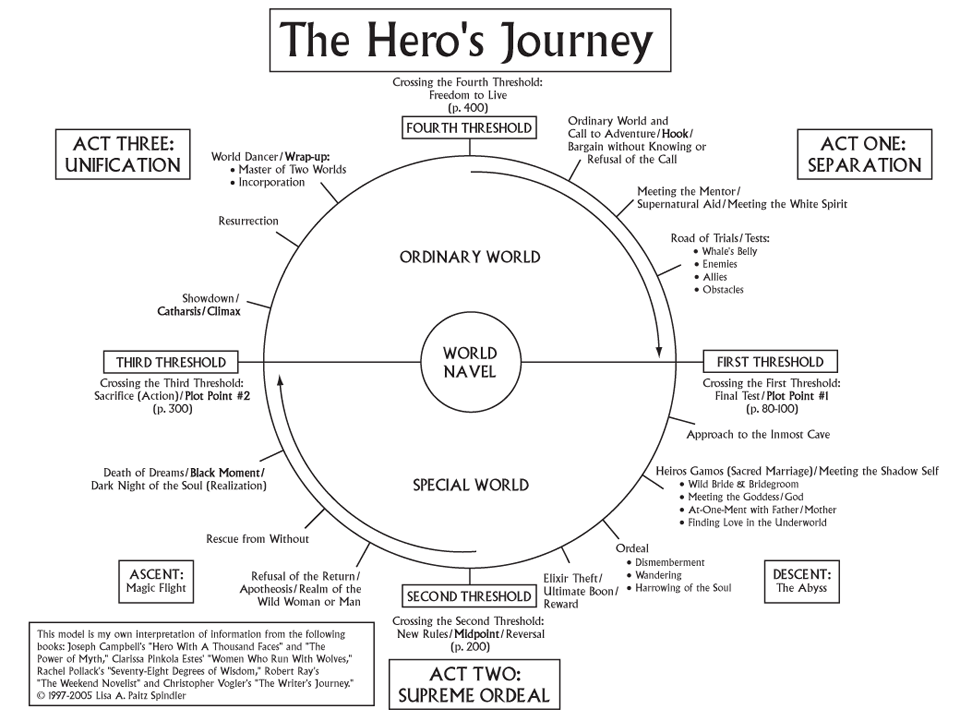
One dramatic structure framework we did not discuss there is the Hero’s Journey, discovered and delineated by Joseph Campbell in his seminal book The Hero with a Thousand Faces.
What’s most interesting about this framework—elucidated through Campbell’s reading and study of mythologies—is that it’s not only a dramatic journey, it’s a transformational journey. It describes how a seemingly ordinary person (or hobbit), living a normal life, encounters something very unexpected (what Gustav Freytag called “the inciting incident”), which sets him off on a journey into the unknown. He leaves his ordinary world into a “special world” where he confronts dangers, is helped and guided by a wise old man/wizard/Jedi. He faces the threat of death (if not death itself, as with Harry Potter), and eventually saves the world/Middle-Earth/Galaxy far, far away. Finally, our hero returns to his ordinary world, transformed.
There are many differing representations of the Hero’s Journey that vary from eight to Campbell’s original 17 stages.
The one I like best was created by writer and content strategist Lisa Paitz Spindler.
As the note in the drawing indicates shows that she drew not only from Campbell’s work but other sources as well, and I think it provides a rich tapestry of thinking through the many possibilities in this twelve-stage model of transformation structure.
Make Your Customers Heroes
Think now about making your customers into the heroes of their own transformational journeys.
In health and well-being, for example, consider the months, even years, that someone with cancer spends being treated for and recovering from the disease as a hero’s journey.
Thanks to the trauma of the diagnosis, she separates herself from her normal life, crossing a threshold and descending into the trials of treatment after treatment under the guidance of a wizard of a healthcare provider (that’s you). She loses her hair, gets sicker and sicker, has good days and bad. But you are there not just to provide the healthcare treatments indicated by her particular situation, but to guide her in actively partaking in her personal care plan outside of the time she spends in your health facilities—enlisting as well the full participation and support of her fellowship of family and friends.
Thanks to your thorough, holistic guidance—treating her as a whole person rather than a collection of symptoms and disease—you see her through to the other side physically, emotionally, and even spiritually.
When her healthcare treatments end and she experiences the catharsis that entails, you regard her not as someone who’s merely completed treatment but as someone who conquered her disease. It is now as if she were almost “resurrected” to a new, cancer-free life. And yet, while the physical treatments may be done, you continue to guide her back into normal life, a transformed person.
In wealth and prosperity, one end to which money is but the means is retirement.
It’s a journey that one (hopefully) starts decades in advance, but has many ups and downs and maybe even trials and travails.
And its impact lies not only on the expectant retiree, but generally on a spouse as well. The climax of that journey, however, should not be the day of retirement; it’s the day when the retiree knows, without a doubt, that the couple can retire! That is the day that you, as the guiding financial transformations firm that’s been there from the beginning, celebrate the retiree as the hero of the family, for it is a day that reduces stress, induces calm, and enables dreams to come true.
Even if this does not closely follow the stages of the Hero’s Journey, it honors it in spirit, with elements of the journey to be used along the way, such as the initial goal-setting meeting as a Call to Adventure; the crossing of various thresholds; and helping the retiree, after the you-can-do-it! climax, be “The Master of Two Worlds”, ie, current work and future retirement.
If you applied the Hero’s Journey, how much better would be your financial experiences and how much more would you enable aspirants to achieve their dreams?
In wisdom and understanding, you can apply this to K-12 school with each grade level its own journey where students “level up” every year.
To undergraduate students in college with its Separation from family life, Descent into an often faraway realm with many dangers, traps, and (especially) tests, and Ascent to graduation and work life as a new person; to MBAs and other master’s degrees where the student leaves the Ordinary World of work to enter the Special World of learning; to PhD programs under the tutelage of professors-as-guides; and to employees taking internal courses, achieving external certifications, gearing for promotions, and achieving work milestones.
Here, accepting employment is most definitely a Call to Adventure.
And as an employer, you invite workers on a set of quests that cycle between the ordinary world of work and the special world of training, preparation, and development discussions, with Mentors to guide them across the thresholds of performance, projects, and promotions.
In each of these situations, think of how much more transformative your experiences would be if you conceptualized them as Hero’s Journeys.
(This demonstrates too how this model, like all dramatic structure frameworks, can be a fractal, a pattern that repeats itself at multiple levels.)
In purpose & meaning, imagine you work for a consulting company brought in to help a customer transform its business.
The Call to Adventure here may result from the Discovery of a new possibility that dwarfs the current business, the Deviation of commoditized offerings, the Disruption of new technology overtaking its value propositions (other versions of this model label the Call to Adventure “Disruption and Awakening”), or a Desire to ensure that neither commoditization nor a disruptive innovation ever damages the business by developing a new way of managing.
Whatever the catalyst, for the Call to Adventure to work, it must resist the antibodies in the organization that resist change, the stage in the Hero’s Journey known as The Refusal of the Call.
As the Mentor for this journey, you must make the adventure meaningful to the putative hero—not just the sponsoring executive, not just the work team, but the entire organization.
And the best way to do that is to first focus on the business’ meaningful purpose, the reason why it exists.
This is not something you impose on the organization; it’s something that already exists but is rarely thought about, and you must draw it out of the organization. The need to transform then becomes much more readily seen as a way of truly aligning the business with the purpose and determining the direction in which to go. You can then guide the aspirant in entering the Special World of determining the future, coming out the other side as a “resurrected” enterprise transformed and extraordinarily prepared for the Ordinary World of business.
Just remember: as a consultant, you are not the hero of the story; your client is.
The Hero’s Journey doesn’t just apply to such large-scale transformations as given above.
Many apps for fitness tracking, weight loss, stress relief, and so forth use gamification to help keep users on task over time; why not make it more of an actual game derived from the Hero’s Journey?
(Gamification, by the way, is only ever used for transformative experiences. Without the transformation focus, the experiences are actual games.)
There are many experiences without games or even much of an overarching story: immersive art exhibits, museums, trade shows, etc.
So you could use the Hero’s Journey to provide that story, giving guests an Alternate Reality of the place in which they become the hero – at least for the day. And one of the reasons that parents spend a ton of money taking their kids to a theme park, say, is to be a hero in their eyes. If you knew that, what could you do differently to make it happen? You might, for example, want to deliberately instigate some issue that only the parent can make right.
Applying the Hero’s Journey
Whatever your business, think of how different your transformative experiences would be if you designed & depicted them using the Hero’s Journey.
I worked with Greyspace founders Clint Carnell and Pirate Eddie Yoon to do exactly this with Glo2Facial, a company that offers a facial treatment that uniquely delivers what it calls “Oxfoliation”. This process, conducted by estheticians, activates the body’s natural healing powers via oxygen (O2) and other natural ingredients. The first step triggers the blood to release oxygen up through the skin (taking advantage of a phenomenon known as the Bohr effect). The esthetician next amplifies this with a “lite ultrasound experience” (LUX) and ends the treatment with lymphatic massage that acts as a detox step. Afterward, the consumer’s skin literally glows, an effect that lasts for weeks and without any redness or irritation that comes from other suction-based facials.
New consumers may come into salons, med spas, or dermatologists for a simple facial.
But once they experience that glow and hear compliments galore, they come back for it time and time again. It may not qualify as permanent, identity-changing transformation, but as a transformation indeed, as transient as it might be.
Eddie’s an expert on “superconsumers”—he wrote the book Superconsumers: A Simple, Speedy, and Sustainable Path to Superior Growth—and differentiates them from mere heavy users who only buy a lot.
“Superconsumers are characterized by their attitude as well: they are passionate about and highly engaged with – and maybe even a little obsessive about – a category. . . . Superconsumers aren’t random oddballs who buy in bulk. They’re emotional buyers who base their purchase decisions on their life aspirations.”
His work for Glo2Facial found that 78% of aesthetic consumers are looking for something new, yet the vast majority purchase only one type of treatment. These aesthetic superconsumers aren’t just looking for a beauty transformation, but they love the journey itself. The treasure hunt for new treatments and combinations is fun and deeply reflects their belief that as their skin – and life – progresses, so too must their treatments.
Glo2Facial definitely has superconsumers with aspirations.
In one meeting Eddie said that “Every superconsumer is on a quest.”
And when he did, I immediately thought of the Hero’s Journey—the model for transformative quests. So I worked with him and his colleagues on delineating the Glo2Facial Journey as a Hero’s Journey:
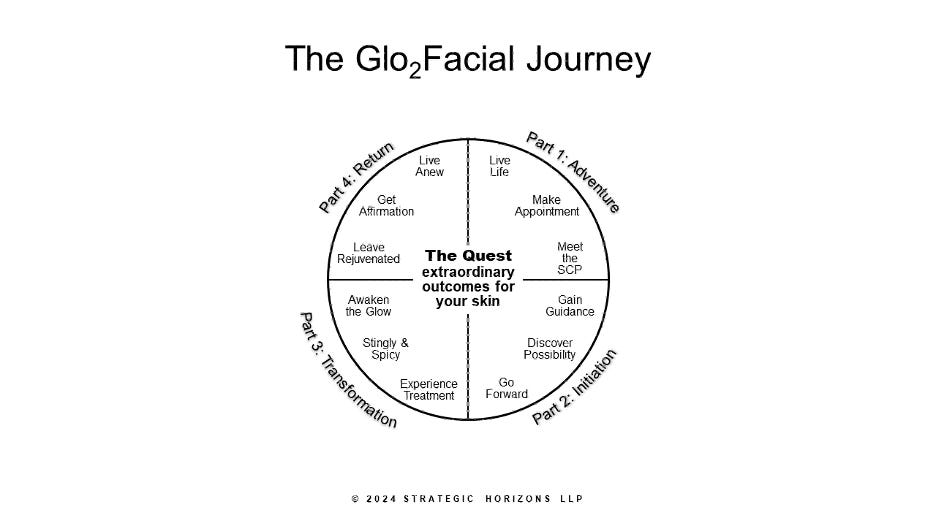
Glo2Facial states the quest for its consumers as “extraordinary outcomes for your skin”.
As with all such journeys, it spreads across four parts, which we named Adventure, Initiation, Transformation, and Return. Each of these was further broken down into three steps that collectively define the transformative Glo2Facial experience:
Adventure
Live Life: the consumer is living her life, unaware of the adventure about to begin.
Make Appointment: she encounters her own “call” to get a Glo2Facial treatment. This could be initiated by an ad, a search, an upcoming wedding, by seeing someone else aglow.
Meet the SCP: At the day and time of the appointment, she’s brought into the treatment room and meets the Skin Care Professional (SCP).
Initiation
Gain Guidance: The SCP becomes her guide through the process (and beyond).
Discover Possibility: If the first time, the consumer learns what Glo2Facial is all about. Subsequent visits focus on customizing the treatment through combinations including HydraFacial, the company Clint Carnell was the CEO of and led through its multi-billion-dollar valuation.
Go Forward: The consumer decides what she wants and purchases the treatment.
Transformation
Experience Treatment: The treatment begins, offering the medical proficiency of a doctor’s office and the experience of a spa.
Stingly & spicy: The first step often feels “spicy” in consumers’ words. Glo2Facial calls it “stingly” (stingy and tingly), as the consumer can literally feel the O2 bubbles come up from their body through their face. Despite the stingly feeling, the consumer is always shocked that the process results in no irritation or redness as with other suction-based treatments. This is why Glo2Facial says it is for everyone and goes with everything.
Awaken the Glow: The signature moment, she sees herself aglow in a mirror, amazed at the transformation of her face from minutes before.
Return
Leave Rejuvenated: Treatment done, the consumer leaves the place and heads out, perchance to catch another peek or two of the glow in a mirror or window.
Get Affirmation: Her friends, family, sometimes complete strangers notice the glow, and tell her how good she looks.
Live Anew: She spends the coming weeks feeling more healthy, upbeat, and buoyant, due to the extraordinary outcome for her skin.
And, of course, ready to make that appointment again when the time comes.
Interestingly, there is a parallel journey for estheticians.
Clint, Eddie, and the team realized that she (they are customarily women) may be the wise guide to her customers, she’s in fact the hero of her own story.
At face value, it may seem like she doesn’t have a high-valued job since she often doesn’t have an advanced degree, gets paid hourly, and may not even have health insurance. However, to the skincare superconsumer, the esthetician is the most influential and credible expert. She actually gets close to your face, is very knowledgeable, and makes thoughtful recommendations.
She’s often a superconsumer herself, so when she recommends something it feels much more “missionary” (eg, for the consumer’s benefit) than when a doctor does so, which can come across as “mercenary” (for the doctor’s benefit).
Clint and Eddie built training not just for the treatment but for running the business itself, including marketing and pricing.
They rebranded estheticians as “Xtipreneurs”, a combination of “esthetician” and “entrepreneur” (perhaps with a nod as well to the esthetic experience they have, and the engaging experience they stage). More than a rebranding, this transformed them from mere estheticians to full entrepreneurs running their own businesses. The Glo2Facial offering combined with the business training helped these Xtipreneurs go from making mid-to-high tens of thousands of dollars to hundreds of thousands.
These dual transformations had a massive impact on the Glo2Facial business. When Clint and Eddie took the US operations over, it was an unhealthy business. Half the customers were dormant. They were scared of the market leader and sold at half the price.
Marketing spending was out of control at 75% of sales.
Within a hundred days they rewrote the master plan.
They didn’t shy away from the market leader, but helped their Xtipreneurs create combinations with both brands. They doubled the price while taking marketing down to 10% of sales. They created a new brand from scratch in 4 months. And in their first year, they quadrupled sales, going from the #3 to the clear #2 player.
The Hero’s Journey is only one way to approach guiding transformations, and it’s certainly not appropriate everywhere for everyone.
But when it is, this dramatic structure framework modeled on the journey of a quest can be a powerful tool for designing & depicting, staging & operating your transformative experiences.
Here’s how to continue to explore Joe’s work in the experience economy category:
• Read some of his legendary books
Arrrrrr,
Category Pirates
P.S. - Share your thoughts on this mini-book style.
We have a legendary lineup of Category Designers who can’t wait to share their experience and knowledge with you. We want to make sure it gives you a ton of value. So, let us know your thoughts and/or questions in a comment below.


