


Arrrrr! 🏴☠️ Welcome to a 🔒 subscriber-only edition 🔒 of Category Pirates. Each week, we share radically different ideas to help you design new and different categories. For more: Audiobooks | Category design podcast | Books | Sign up for a Founding subscription to ask the Pirate Eddie Bot your category design questions.
Dear Friend, Subscriber, and Category Pirate,
Dr. Dre is a billionaire.
And most people have never seen him live.
This is the man who gave us “Still D.R.E.,” “Nuthin’ but a ‘G’ Thang,” “Forgot About Dre,” and “The Next Episode.” He was one-fifth of N.W.A. The Chronic sold nearly 6 million copies. 2001 sold almost 8 million. He could have focused on his consumers, ridden the performer track for the rest of his career, toured arenas, and collected checks.
He chose to build a B2B business after his B2C career as a performer.
Dre discovered Eminem from a demo tape that had been rejected by every label in the country. He pulled 50 Cent out of Queens. He signed a skinny kid from Compton named Kendrick Lamar when no one knew who he was.
He didn’t just produce their albums. He designed their futures. He built artist development, sonic identity, marketing, distribution, and a machine that took unknowns and turned them into (mega music) categories of one.
But he didn’t stop there.
He built a B2B2C business called Beats.
Most think of Beats as (just) headphones. But Beats was a streaming service. Beats Music launched in 2014 with a thesis that Spotify thought was insane: human curators over algorithms.
While Spotify built a machine that talked directly to consumers. Dre and Jimmy Iovine put tastemakers and music editors in the middle. Tastemakers who understood artists AND listeners. The people with the judgment, experience, and taste to connect the right music to the right ears. In ways no algorithm could replicate.
(Just like DJs back in the day.)
They trusted and empowered the intermediary. Let human taste do the marketing.
Apple paid $3 billion. Not for 250,000 subscribers. Not for headphones. For the B2B2C platform, which became core to Apple Music. (Which now has over 100 million subscribers.)
Dre could perform. Dre could find talent. But Dre’s real genius? His ability to design and dominate a new category of music ecosystem. That became a powerful flywheel.
Dre is the category designer of B2B2C of hip hop.
(And one of the category designers of the genre.)
Now consider Snoop Dogg.
Snoop is a genius. A cultural icon. His coverage of the Olympics or National Geographic is the stuff of legends. He has a cooking show with Martha Stewart, a wine label, and a weed brand.
Pirate Christopher would love to hang with Pirate Snoop.
Here’s what most people forget: Snoop tried to be Dre.
He launched his own label. Signed artists. Tried to build a machine that discovers and develops talent. It didn’t work.
None of his signings became stars. Not one. Because performing and architecting are fundamentally different muscles. Snoop’s gift is being Snoop. And that’s a spectacular gift. It’s just not the gift that builds systems.
Dre made Snoop. Without Dre producing Doggystyle, there is no Snoop Dogg. The B2B2C created the B2C. The B2C could never create another B2B2C.
(If you’re a board member who just hired a celebrity CEO to run a platform company, go ahead and read that last paragraph again. We’ll wait.)
Now let’s go to Abbey Road.
George Martin is the most important name in rock and roll that (most) people don’t know. He’s called the “Fifth Beatle” because he arranged the strings on Eleanor Rigby, figured out how to record Strawberry Fields Forever backward, and turned four lads from Liverpool into the most sonically innovative band in history.
George Martin was a technical genius.
The greatest studio engineer who ever lived. He took what the Beatles brought him and made it sound like nothing anyone had ever heard. He made great records. He didn’t build the machine that made the Beatles the Beatles.
George was one of the OG B2B CEOs of rock and roll. He was essential, excellent, and invisible to the end consumer.
Snoop, George Martin, and Dre are all incredible talents. All legends. All rich.
But Snoop couldn’t be Dre. Neither could George Martin.
But Dre could be Snoop and George Martin.
Said differently…
A B2C or B2B CEO likely can’t run a B2B2C business model
A B2B2C CEO is more likely to succeed in any of the above.
Context is King.
The category of CEO matters.
The category of business model matters.
The combination of context, category of CEO, and category of business model matters most of all.
🔊 Want to listen to this mini-book instead? Head to the audiobook.
Back to Business: Pirate Clint as a B2B2C CEO
Pirate Clint Carnell is the Dr. Dre of Medical Aesthetics.
He is the rare success both as an executive and an entrepreneur.
He was one of the youngest VPs at Bausch & Lomb at the age of 30. At the same time, he simultaneously started, scaled, and sold a renal care business. He’s been a CEO and founder more than a half dozen times.
When the Wall Street Journal showcased the new category of medical aesthetics, it listed 10 brands.
Botox
Fraxel
Dysport
ADVATx
Sofwave
Ultherapy
Thermage
Morpheus8
Hydrafacial
Clear + Brilliant
40% of the brands bolded above were built by Pirate Clint. From scratch.
Category designing dominant brands is one of his superpowers.
The vast majority of CEOs inherit the brands they run.
And the risk is similar to a trust fund kid. Will they build or waste what they inherited?
Pirate Clint uniquely builds or brings…
POVs that are easy to remember and repeat, yet pierce through the noise.
Categories that feel expensive, but are on marketing budgets at ~6% of sales.
The creativity of marketing with the clarity required by sales.
Did he have great marketing teams and partners along the way? Yes.
But Pirate Clint’s success is in large part because he’s a B2B2C CEO.
That’s the category of CEO he is.
Fraxel, Clear + Brilliant, Thermage, and Hydrafacial were all bought by physicians, spas, or other retail businesses (B2B), but that ultimately served end consumers (B2C).
He also had experience in B2B (Bausch & Lomb surgical) and B2C (OrangeTwist), so he had those clubs in his bag.
But like many great B2B2C CEOs, he knew which playbook to use when.
B2B2C Brands Are The Most Valuable
Some of our B2B or B2C CEO friends might get butt-hurt at this assertion.
So sit down and take a swig of rum.
Interbrand publishes a list of the top global brands.
The analysis is both rigorous and subjective at the same time. It is not perfect, but an imperfect metric that is consistently executed can still be very useful on a relative and directional basis.
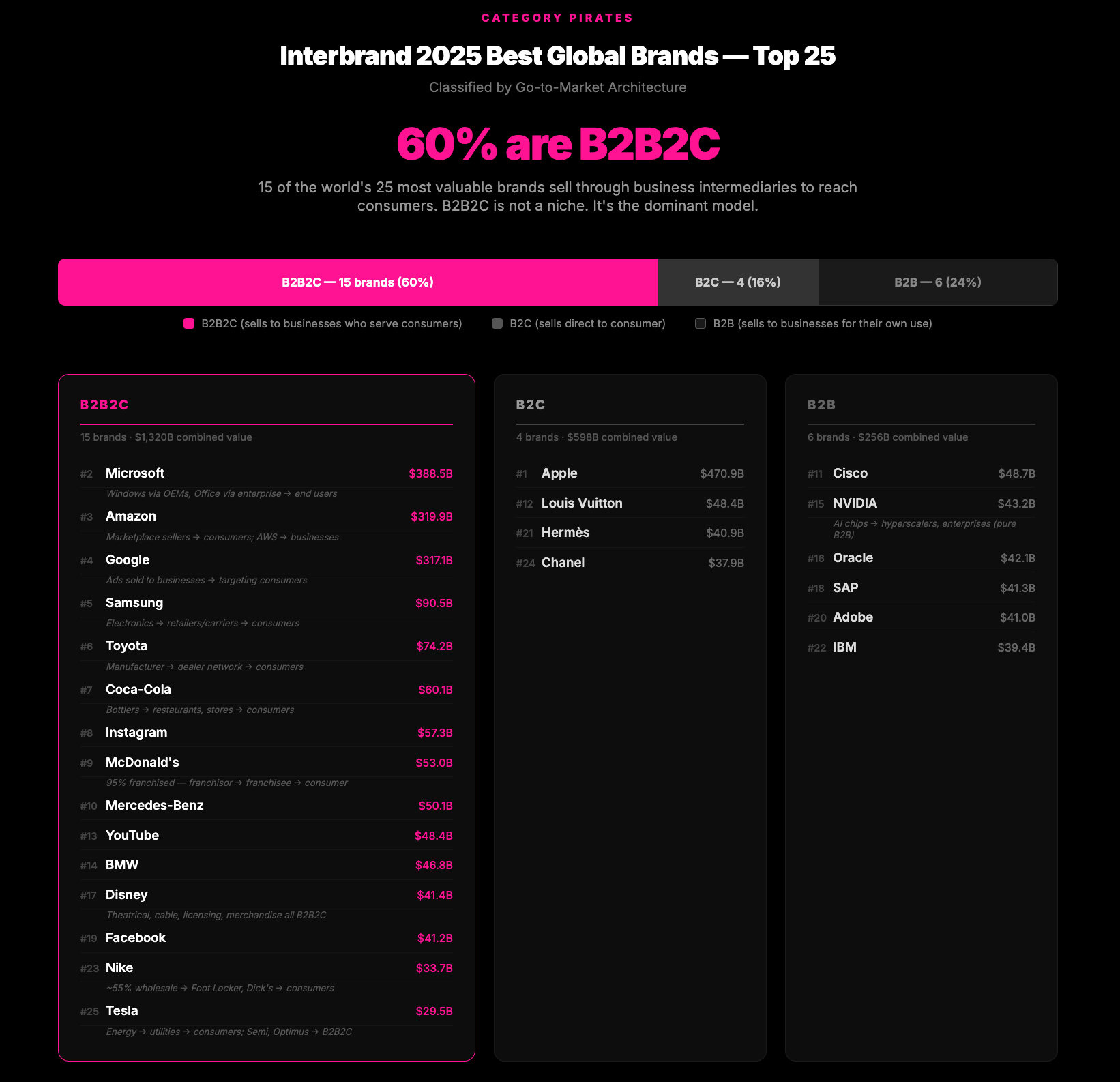
We re-swizzled the data and grouped the top 25 brands into B2B2C, B2B, and B2C categories.
Among the top 10 most valuable global brands, B2B2C brands are 90%.
Among the top 25 most valuable global brands, B2B2C brands are 60%.
B2B2C brands in the top 25 are worth $1.3 trillion dollars
B2C brands in the top 25 are worth $0.6 trillion dollars
B2B brands in the top 25 are worth $0.3 trillion dollars
Four Reasons Why B2B2C CEOs are Legendary
Are B2B2C CEOs inherently superior to B2B or B2C CEOs?
Not necessarily, but…
You can more easily put a B2B2C CEO into a B2B or B2C company
But putting a B2B or B2C CEO into a B2B2C CEO is often a mistake
Especially if they don’t realize the business is a B2B2C business model.
We haven’t done a super-ding-dong academic study robust enough to assert this.
But here’s what we know. From decades in the arena.
B2B CEOs put marketing at the kiddie table.
They worship at the altar of their product and tech. They’d rather spend an incremental dollar on R&D than on marketing. They know they can make the dial ‘go to eleven’ and tell the world that their carbondigulator is 17% faster, cheaper, and better.
Marketing gets told to market the features, throw parties, make leads, and give sales pretty decks to do their jobs.
Nobody gets excited about enterprise demand gen at the CMO Forum. It’s important work, but when was the last time a B2B campaign made you feel something? “Wow, that SAP marketing is legendary”, said no one. In enterprise B2B Marketing is (mostly) a non-strategic service bureau.
That is why we wrote the Big Product Lie.
B2C CEOs let the marketing inmates run the asylum.
They worship at the altar of their brand. CMOs rule the roost and happily spend money on building “brand awareness”. There are plenty of agencies and academics who tell B2C CMOs what they want to hear about brand awareness, so there is plenty of money in the trough for the pigs to feed.
(Brand awareness is an almost useless metric. The good people at SAP pay $3.35 million annually to sponsor the San Jose Shark Tank. Most people who go there have zero idea what they do, will never buy their software, and think the company’s name is about tree sap.)
Marketing departments that operate like in-house entertainment studios. They love bragging about the awards their creative has won, like their own version of the Oscars. (Real CMOs think dominating categories and driving revenue matter).
Most live for the opportunity to give celebrities millions of dollars so they can post selfies with their favorite Kardashian on their own social media. We’ve seen employees in fear that they didn’t put a like on their CEO’s Instagram or LinkedIn post fast enough. Marketing is a major line item on the P&L.
That is why we wrote the Big Brand Lie.
There are four reasons why B2B2C CEOs avoid these traps.
One: B2B2C CEOs must be more curious.
The category and business model are more complex.
Having customers and end consumers means there are many more stakeholders to understand and serve. If a B2B2C CEO is not curious about both customers and end consumers, they will lack the empathy to understand their problems. And they won’t have a clear and compelling POV to bring to the table.
Curiosity leads to empathy. Empathy leads to trust. Trust leads to success.
Two: B2B2C CEOs must share the marketing spotlight and resources.
Back in the day, when Anheuser-Busch was Pirate Eddie’s client, he asked if he could ask a dumb question: “Do we really need to buy 10 Super Bowl ad spots? Do the Clydesdale commercials really work?”
Former head of sales and CMO Keith Levy told him that more than half the spots were to motivate the 800 independent wholesale distributors. They weren’t owned or controlled by Anheuser.
They could distribute any brand of beer they wanted. They could choose to mail in a great in-store display or do a legendary job. The Super Bowl spots made the distributors proud and part of the team. The distributors were older and still had great affection for the Clydesdales, even if the younger consumer didn’t.
The ads, brands, and innovations were all a sign that Anheuser-Busch was committed to the category and to them. It was a sign that Anheuser-Busch would never stop thinking about how to make them successful. And in response, the distributors did all they could to make Anheuser successful, too.
That’s not about brand awareness. That’s demonstrating category commitment.
B2B2C CEOs are acutely aware that marketing is multi-purpose, for partner customers (B2B), end consumers (B2C) and employees. Unlike B2B CEOs, they spend money on marketing because they know it matters. And unlike B2C CEOs, they don’t let marketing go hog wild and blow up the P&L.
Three: B2B2C CEOs must have POVs that are both simple and substantial.
B2B customers lure CEOs to make things more complicated and technical, because they love to nerd out on features. B2C end consumers need things to be simple, otherwise they don’t know what choice to make. B2B2C CEOs are forced to simplify the marketing so that it is compelling enough to the customer, but concise enough to repeat to the end consumer.
Amazon Prime simplifies the choice for the end consumer, making Amazon marketplace the best place for resellers.
Google made search so easy and effective for consumers, and made the search ROI decision easy-peasy for advertisers. (Make no mistake. Google is an ad business.)
Four: B2B2C CEOs must deliver double the outcomes for partner customers and end users.
In most B2B businesses, when a customer buys, the end user doesn’t have much say. When a company buys Workday, even if the end user hates Workday, they aren’t likely to quit the company just because they use Workday.
Great B2C businesses do deliver outcomes for their end users, but not always for anyone else. Does Best Buy make a ton of money selling iPhones? Not really, but they need them to keep up with their competitors.
Remember when AT&T had iPhone exclusivity from June 2007 to early 2011? AT&T paid Apple approximately $425 per iPhone, then sold it to consumers for $199. By 2009, the Wall Street Journal reported AT&T had spent $1.3 billion just on iPhone discounts. AT&T Mobility’s operating margin dropped 50 basis points, and operating costs rose 3.8%.
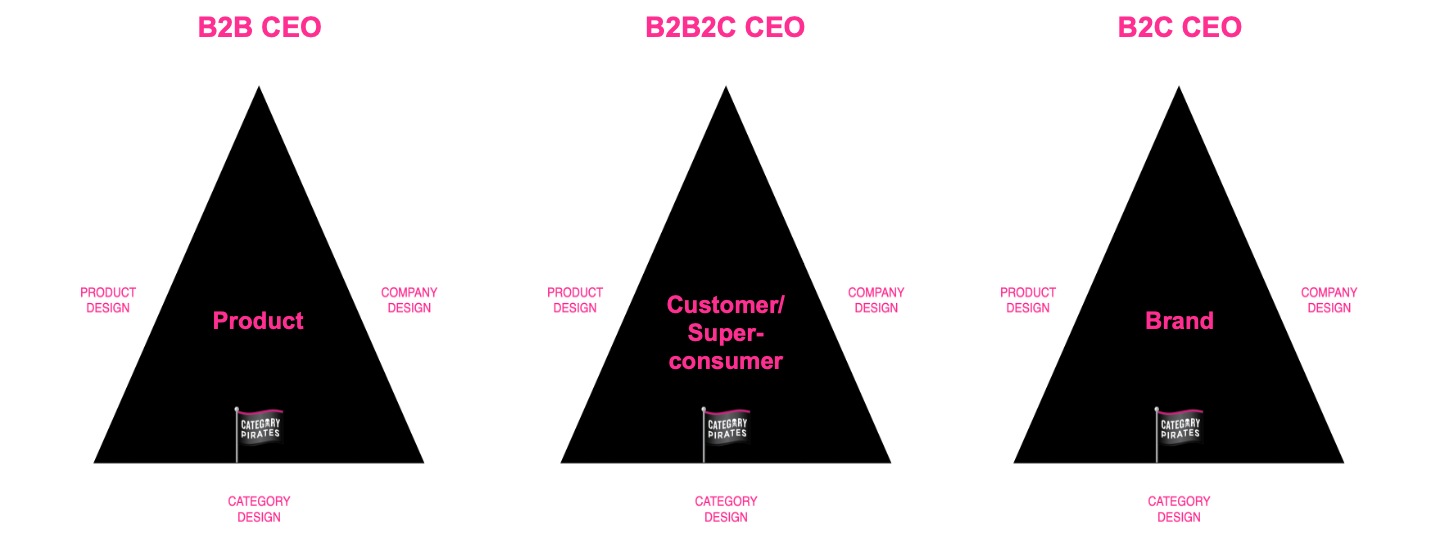
Remember the magic triangle? This is how B2B2C CEOs deploy the Magic Triangle vs. their counterparts.
The Rise and Fall of Hydrafacial
First things first.
We’re going to tell you a story using all public data. We kept it to the facts, because we know we are biased. We love Pirate Clint. He’s been a long-time client and friend of Pirate Eddie. We know him personally and his track record.
We admit all of it.
And here are just the facts.
And they are undisputed.
In December 2016, a private equity firm hired Clint Carnell to be CEO of a medical aesthetics company called Edge Systems.
At the time, Edge Systems was doing about $48 million in annual revenue with $16 million in adjusted EBITDA. The company sold hydradermabrasion delivery systems to aestheticians, dermatologists, and med spas.
Pirate Clint knew the customer mix was weird.
He also saw the same pattern that was true from every hotshot plastic surgeon, famous dermatologist, and the everyday day spa.
The esthetician.
The esthetician delivered the treatment.
The esthetician was more trusted than the doctor.
The esthetician was herself the superconsumer…and she was overlooked.
Most B2B CEOs ignore the esthetician to focus on the doctor. Most B2C CEOs would walk past the esthetician to talk to the consumer.
Clint niched down on the esthetician. Made her feel seen. Educated her through continuing education programs. Gave her platforms and put her on stage at Estipalooza in Las Vegas.
He made her the center of the B2B2C strategy.
Clint rebranded the company as The HydraFacial Company in May 2017.
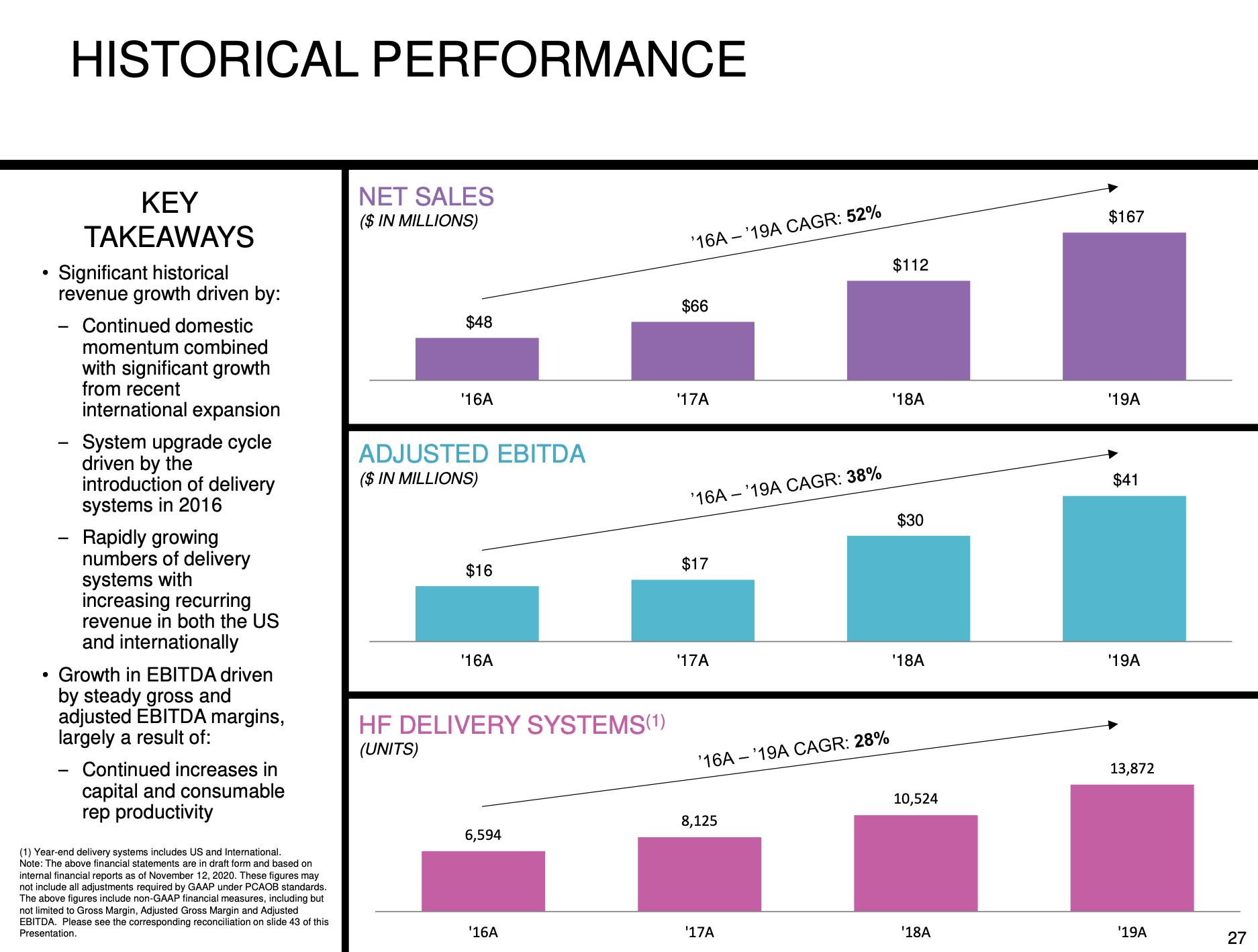
Here’s what happened next. This is from the 2020 Investor Deck.
Over 4 years, Pirate Clint grew…
Revenue at a 52% CAGR from $48MM to $167MM.
EBITDA at 38% CAGR from $16MM to $41MM.
Installed base (B2B) 28% from 6,594 to 13,872.
EBITDA margin ranges from 25% to 33%
What’s even more amazing was that in 2020(during COVID), revenue dropped to $119MM in revenue and 6% EBITDA. Clint stayed on as CEO. Half his management team left.
Revenue rebounded to $260MM in 2021 and EBITDA to 13%.
Q4 2021 revenue of $78 million put the company on a $312 million annual run-rate.
In December 2020, HydraFacial announced a SPAC merger with Vesper Healthcare Acquisition Corp. Enterprise value of $1.14 billion. Share price: $10. The company began trading on Nasdaq under the ticker SKIN.
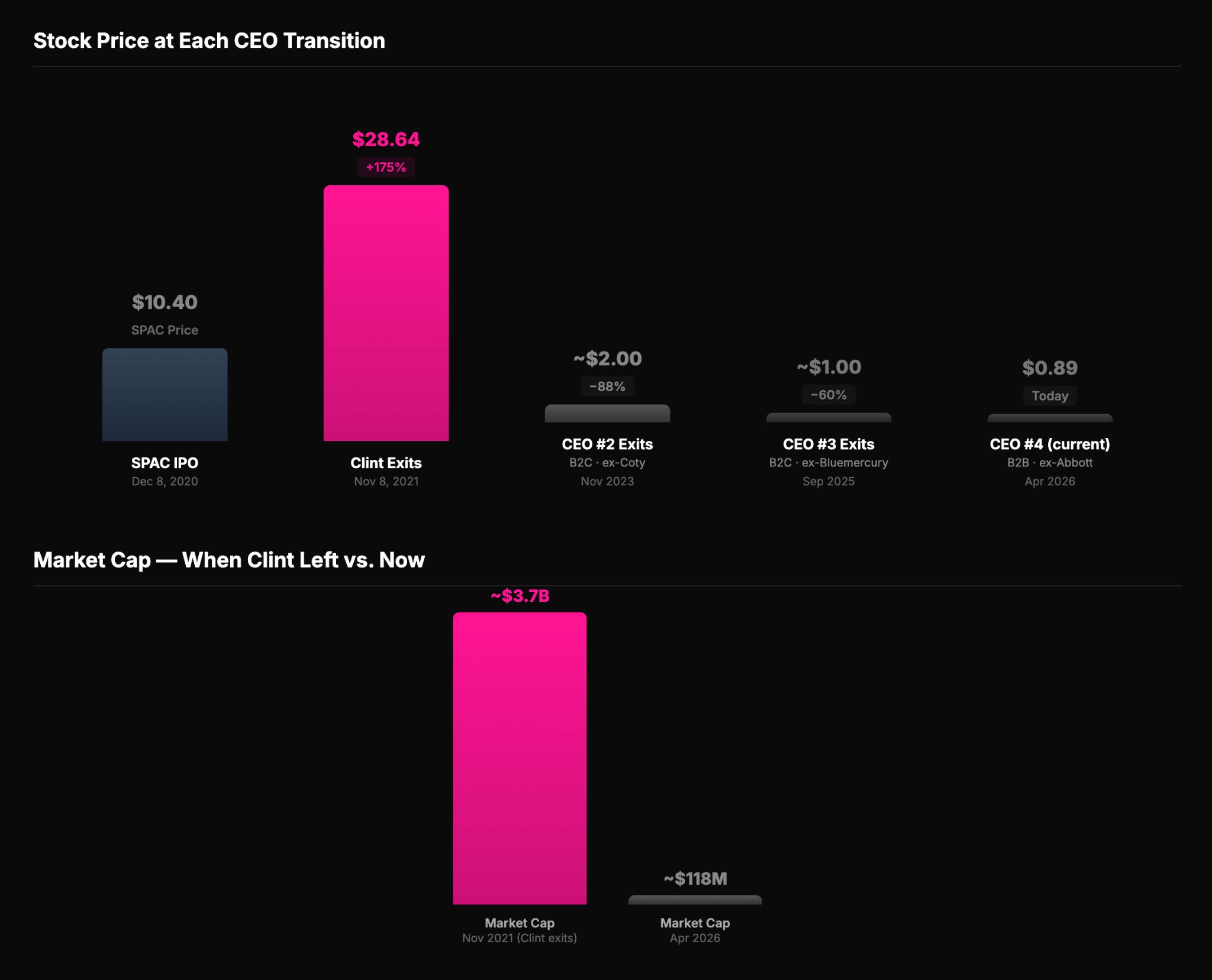
The stock hit $29.49 on November 2, 2021. That’s 175% appreciation from the SPAC price in under a year.
On November 9, 2021, HydraFacial announced Clint Carnell’s departure as CEO and from the Board of Directors. The stock was at $28.64 the day before the announcement.
That is a story for another time. Here’s what happened after.
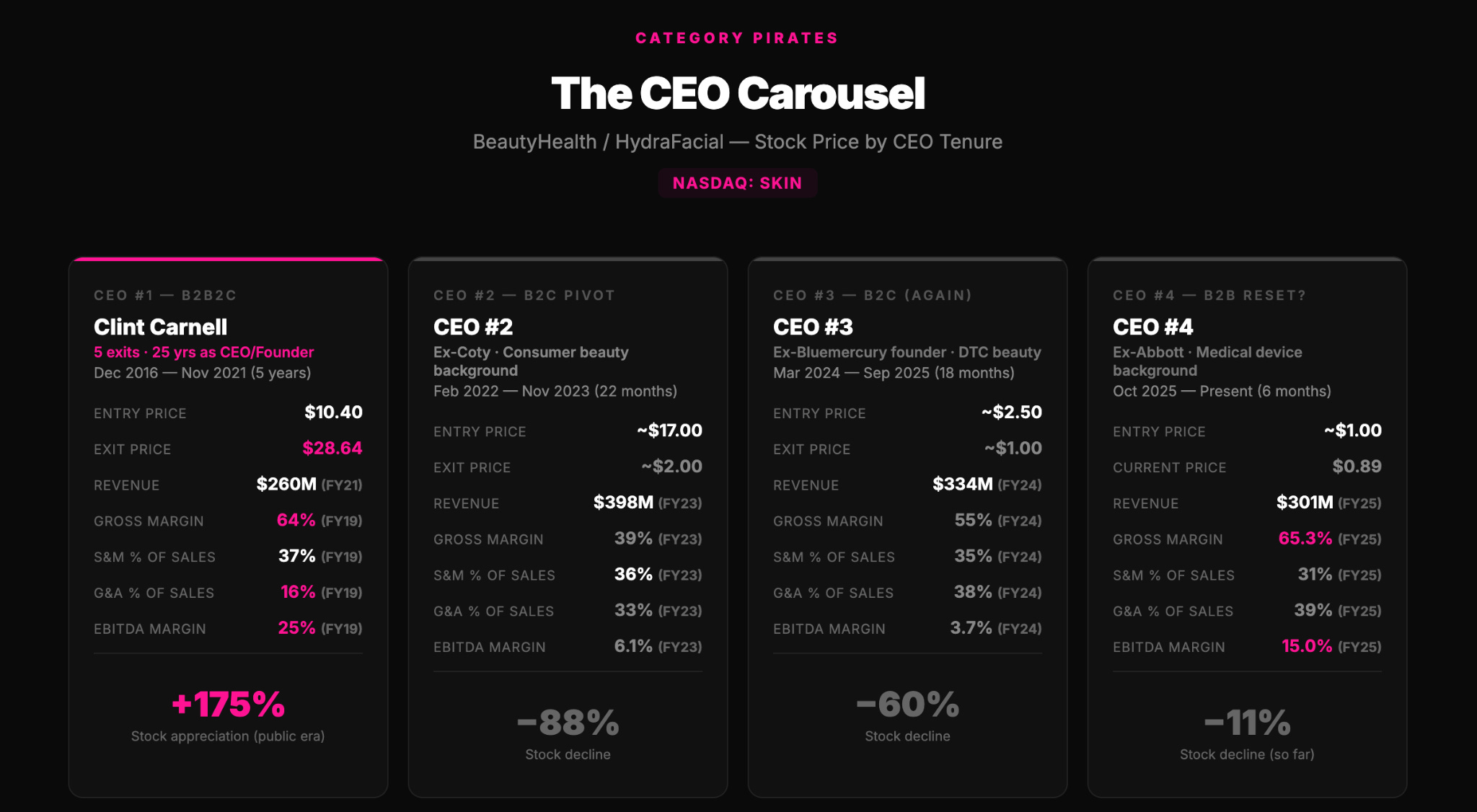
Post Pirate Clint, revenue did go up.
But in Clint’s last quarter, ARR was already $321 million dollars.
The second CEO largely inherited the strong tailwind and B2B2C momentum. The next three CEOs all inherited the massive $900 million dollar cash balance war chest Clint raised in the PIPE (Private Investment in Public Equity) and secondary debt.
Today, the cash balance is $232 million dollars for a business that is in decline, and 97% of market capitalization has evaporated.
How did that happen?
CEO #2 came from Coty, a B2C beauty conglomerate.
He came straight from running Kylie Cosmetics and KKW Beauty at Coty. Coty paid $600 million for 51% of Kylie Cosmetics (valuing it at $1.2 billion) and $200 million for 20% of Kim Kardashian’s KKW Beauty.
The math didn’t check out.
By March 2025, Coty dumped its Kardashian stake entirely, and Forbes had already blown up the Kylie revenue numbers, tanking Coty stock 13%.
CEO #2 elevated celebrities at the expense of the esthetician.

He launched the JLo Beauty Booster partnership within months of arriving (May 2022). This was the classic celebrity-licensing playbook: borrow someone else’s fame, slap it on a product, and hope the halo effect does the work.
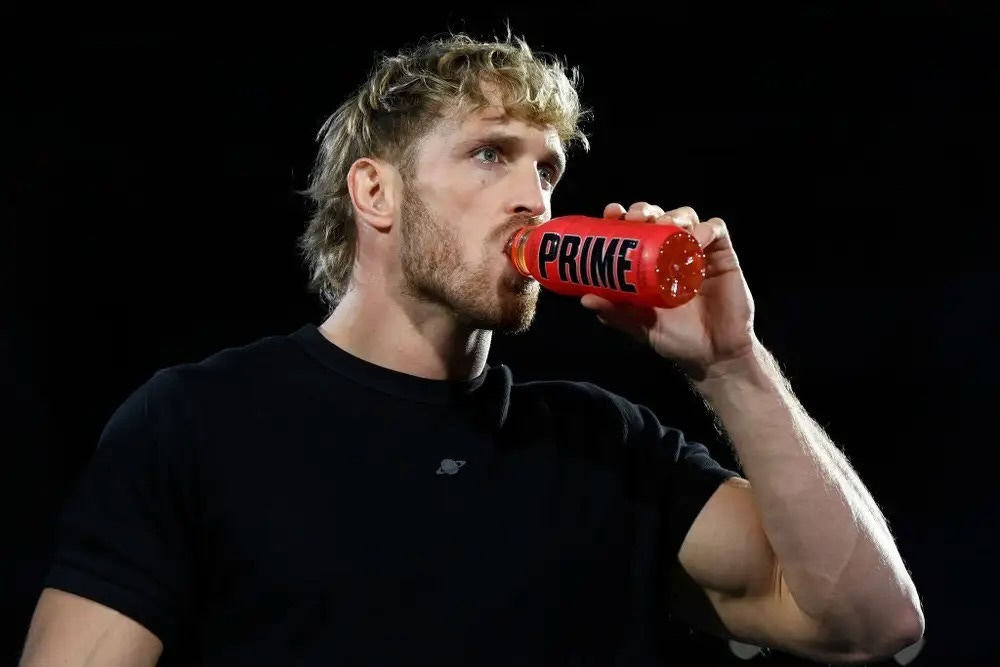
This can work in the short term. BUT If the celebrity is not tied to a new category design, this move fails. Every time. Logan Paul’s energy drink Prime, had a huge launch. Big success. Now profits are down 92%.
This is the opposite of what Clint built.
Clint’s entire thesis was that the estheticians were the core of the business. And the marketing engine. Clint was creating demand through a committed community. CEO #2 was renting temporary attention with a celebrity.
In CEO #2’s first year, selling and marketing expenses spiked to 44% of revenue, up from 37% under Clint. That’s what a B2C influencer strategy looks like on a P&L. The company was burning cash on celebrity partnerships, brand campaigns, and consumer-facing marketing that bypassed their providers entirely.
Then the floor fell out.
In March 2022, HydraFacial launched Syndeo, a new digitally connected delivery system. It had frequent treatment interruptions and quality issues.
Estheticians lost enthusiasm. Churn increased. New system sales cratered. In 2023, the company took a $20 million inventory write-down. Gross margins collapsed to 39%.
Nearly half of what they’d been four years earlier.
A B2B CEO would have likely caught the quality issue before launch.
Under Clint, G&A was 16% with one VP of marketing. Post Clint, G&A ballooned to 33% with four VPs of marketing, per LinkedIn.
In June 2023, the stock was dropped from the Russell 3000 index. By September, it was trading at $1.90. In November 2023, CEO #2 resigned.
CEO #3 arrived in March 2024 with another B2C background. Co-founder of Bluemercury, a direct-to-consumer beauty brand acquired by Macy’s.
FY2024: Revenue fell to $334 million. Gross margins recovered somewhat to 55%. But here’s the number that should haunt every B2B2C executive reading this: G&A hit 38% of revenue. S&M was 35%.
General and administrative expenses exceeded selling and marketing expenses. The bureaucracy overtook the marketing. EBITDA margin: 3.7%.
In September 2025, CEO #3 departed.
CEO #4 arrived in October 2025. This time, the board went the other direction: a B2B background from Abbott, a medical device company.
The income statement for FY2025 shows the continued trajectory: S&M dropped further to 31% of revenue, and G&A climbed again to 39%. The gap between bureaucracy and marketing widened to 8 percentage points. In dollar terms, the company spent $117.9 million on G&A and $93.6 million on S&M. Twenty-four million dollars more on overhead than on reaching customers.
Gross margins recovered to 65%, and EBITDA improved to 15%, but revenue kept declining to $300.8 million. The 2026 guidance: $285 to $305 million.
But the stamp of the B2B CEO was most deeply felt when the company just rebranded.


Bye bye consumer. Bye bye esthetician. The stock went down 8%
The stock trades under $0.90 as of April 23, 2026. Market cap: just over $100 million.
Combined S&M and G&A went from 53% of revenue under Clint to 73% under CEO #2. Twenty points of margin destruction. And it never came back.
Even as the strategy was abandoned and gross margins recovered, the overhead stayed. That is the permanent scar tissue of a B2C pivot in a B2B2C business. You can change the strategy. You cannot unwind the cost structure.
This is an even worse visualization from an investor’s POV.
A Customer’s Reaction to CEO Carousel
Pirate Alexis is the owner and landlord of Best Ever Skin in Clarendon Hills, Illinois.
When Pirate Eddie first met here in 2023, she had one facial device and a quarter of a million dollars in revenue.
Three years later, she has three facial devices and triple the revenue. Plus four treatment rooms and five team members. She bought the building she works in. All of this was bootstrapped by herself.
She’s the very definition of the American Dream.
The sad part for Hydrafacial is that they only have one of her three facial systems. Why does the Category King only have one-third of the market share of a customer that has had massive success?
They forgot to dance with the one who brought them.
If HydraFacial had done its job, if they had remained the provider-first B2B2C company that helped aestheticians like Alexis build their businesses, she should have had three HydraFacial devices in four treatment rooms. Instead, competitors filled the gap.
This is what abandoning your Supers looks like at the provider level. Alexis is not an edge case. She is the median outcome. Multiply her story by thousands of aestheticians making the same calculation, and you begin to understand where HydraFacial’s revenue went. Not to a competitor’s superior product. To a competitor’s superior relationship.
7 Steps to Become a Legendary B2B2C CEO
Good news, Pirates! We’re going to share how a B2B or B2C CEO can build a B2B2C strategy.
One: Admit you have a knowledge gap
