


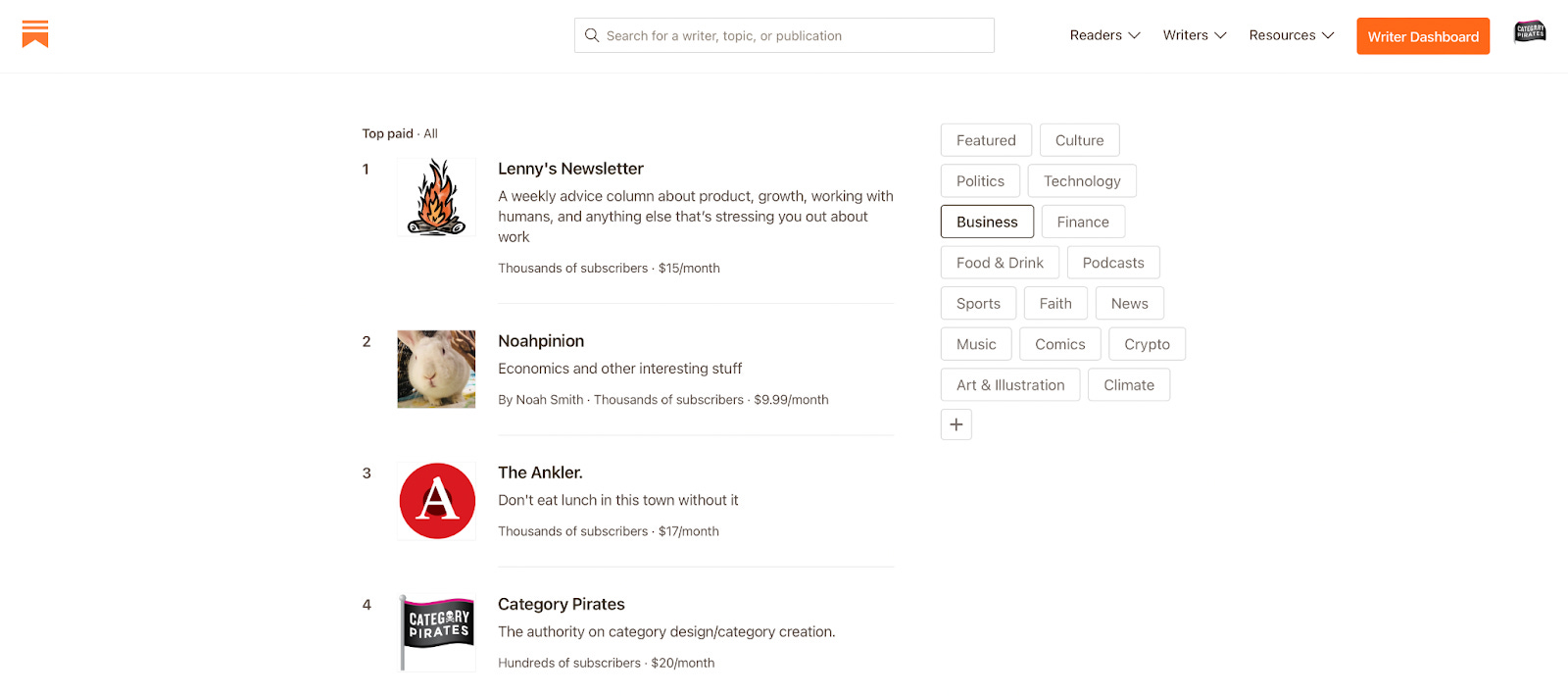
ARRRRRRRR!!!!!!! You Pirates have made Category Pirates the #4 most-popular business newsletter on all of Substack. Absolutely pirate-booty-licious. How long until we loot the #1 spot?
Arrrrr! 🏴☠️ Welcome to a 🔒 subscriber-only edition 🔒 of Category Pirates. Each week, we share radically different ideas to help you design new and different categories. For more: Dive into an audiobook | Listen to a category design jam session | Enroll in the free Strategy Sprint email course
Dear Friend, Subscriber, and Category Pirate,
This is a love letter to inventors, engineers, product designers, scientists, creators and innovators.
To people who reject the way it is, in a commitment to create a different future.
We believe one of the biggest tragedies in business (and life) is when a legendary breakthrough fails to succeed, or fails to make the difference it could have, because of a failure to make its place in the world. Nothing crushes innovation like a lack of category design. If people don’t understand what problem the breakthrough solves, or opportunity it creates, why it is different and how it fits into the landscape of their thinking, the breakthrough dies. And when a breakthrough dies, the world is deprived of its outcomes, benefits, and transformation—until someone else can come along and reframe the opportunity in a new and compelling way.
This is why the discipline of Category Design is so valuable.
Category Design increases the innovation success rate—and decreases the 90% startup failure rate.
The Big Product Lie
There is a lie perpetuated from Silicon Valley and San Francisco all the way to “startup alley” in New York, and everywhere in-between (Los Angeles, Austin, Portland, Miami, Chicago, etc.), as well as startup hubs all over the world.
And the lie goes like this:
“The best product wins.”
The goal of every entrepreneur, then, is to build the best product. How? Put the incumbent of the industry you want to “disrupt” in your sights, funnel tens (or hundreds) of millions of dollars into your scope, and build a “monster” product. Wipe them off the face of the earth. Show their customers how much better you are than them. And when you’re done? Hire a new CEO, bump yourself up to Chairman, and go on a speaking tour spreading the good word: “The best product always wins.”
There’s just one problem.
The best product does not always win.
And in order for the world to “get” what you’re doing, building, and trying to invent or change in the world, building a legendary product is only one side of The Magic Triangle.
Just because it’s a beautiful, stunning, complex, brilliant product, doesn’t mean it matters.

As human beings, we want to believe WE make ourselves successful.
“I’m successful because I made a technology platform millions of people use.”
“I’m successful because I made a brownie recipe people love.”
“I’m successful because I wrote an algorithm that sets people up on dates.”
“I’m successful because I create videos people can’t help but share.”
Product = Me.
Company = Me.
In fact, for thousands of years, human beings were so self-centered that we actually thought the ENTIRE SOLAR SYSTEM revolved around us.
Until Copernicus figured out, no no, whoops: we revolve around the sun.
(He was fiercely opposed by many for his theory… we can relate!🏴☠️)
We wrote about this phenomenon in our mini-book, The “Me” Disease. It’s human nature to believe we are the main characters of the show, we are what matter, we control our fate and destiny, and we are the geniuses behind all the greatness in our lives. And sure, to some degree, that is true (you are the captain of your soul). But it’s a dangerous place to root your thinking. Because the truth is, WE are not what makes us successful.
FANS are what make us successful.
CUSTOMERS are what make us successful.
OTHER PEOPLE are what make us successful.
What’s the difference between Bruce Springsteen and Pirate Christopher playing guitar on the beach?
They both have guitars.
They both love music.
They both write songs.
They both play in public.
The difference is the fans.
Bruce Springsteen has 250 billion of them.
Pirate Christopher has 5.
The response to this, of course, is always, “Yes but Bruce Springsteen’s songs are better.” The best product always wins, right? But if that were true, then all those talented singers on American Idol should have massive record deals too. The American Idol singers are clearly better, no? Drake has more streams than Adele. How come? Adele is clearly the better singer, no?
The “best” product does not always win.
More times than not, it’s the DIFFERENT product that wins (at a new and different game it invented). And what causes that new and different product to win isn’t “itself.”
It’s the FANS (aka the category) that make it successful.
(And at any moment, the fans can take its success away.)
Unfortunately, startup founders, executives, investors, and even artists like to believe the opposite:
“Our product is so good, we don’t even have to do marketing.”
It’s very common for startups (especially SaaS platforms) to brag and boast about how they don’t have to spend a single dollar on marketing. “It’s all Product-Led Growth. Our users market for us.” The idea here is that, as soon as people see how awesome the product is, they’ll use it. They’ll buy it. Most importantly, they’ll talk about it. As a result, “Marketing is stupid. All we need to do is have a web app or a website with a demo on the home page. And once people see how much better, faster, cheaper, smarter, rounder, sharper, sexier our carbadingulator is, we will win.”
Our favorite example here, of course, is the wheel—arguably the most impactful “product” invented.
How come the wheel couldn’t speak for itself?
Because the category makes the product, not the other way around.
Furthermore, if you want word-of-mouth marketing to spread like wildfire, you need to give your customers / users (ideally your Superconsumers) the language you want them to use when describing your product. It’s a big problem if one of your customers calls it a “service platform” and another calls it a “support portal” and another calls it a “client CRM” and another calls it a “faster version of QuickBooks.” When you leave it up to the customer to articulate your product for you, you run the risk of them accelerating the wrong message. Or a confusing one.
What you want is for your Supers to speak the name the new category and evangelize your POV:
“No, no, no—it’s not a sales platform. It’s a [category] Sales Enablement System that [POV] gives salespeople just-in-time information to increase close ratios.”
2 out of every 10 customers sharing the same message = no word-of-mouth virality.
10 out of every 10 customers sharing the same message = parabolic growth.
Product Design Is ⅓ Of The Magic Triangle (Company Design & Category Design are the rest of the magic)
A legendary product alone is necessary, but not sufficient.
If you truly believe “the best product always wins,” are you really saying:
Company, team, and business model get zero credit?
Naming & Claiming a new & different category gets zero credit?
Data flywheel (inside The Magic Triangle) gets zero credit?
Of course not.
So then what’s the right ratio?
Does the product deserve 50% of the credit? (And Company, Team, Business Model, Category, and Data Flywheel can share the remaining 50%?)
Or isn’t it fair to say, at a minimum, all 3 sides of The Magic Triangle take equal credit?
The product matters
The company and team and business model matters
And the category matters
If this is the case, it’s irrational to believe “the best product wins,” and more realistic to say, “The product is of equal importance to the company, the category, and the team’s ability to leverage its data flywheel to anticipate the future.” They all matter. And while building legendary products is one (crucial) side of The Magic Triangle, it is far from “the whole thing.”
Which is why we believe it’s important to say: myopically building “the best product” is a mistake.
When you set out to “build the best product,” you make the assumption the product will FIND its place in the world.
We want to be very clear here:
We love legendary products. And we love legendary product people—who dedicate their lives to inventing, creating, designing, engineering, and operating products that change human history (in ways big and small).
But the reason we love the products we do, and the reason YOU love the products you do, is because we were taught how to value them. We learned what the product “is,” does, and means for the outcomes we desire. Maybe most importantly, we learned where to place the product in our minds, and in our lives. We know what it “is,” in a way that is new and different from anything else we’ve seen before.
And the reason we know is because someone told us.
We didn’t just “see” the product and come to that conclusion on our own.
(Everything we value we’re taught to value. Everything. Including human life.)
When you assume “the best product wins,” you are making the assumption the product will FIND its place in the world. But why take that chance? If you’re going to invest years (or decades) of your life building a product you believe will lead to a legendary outcome, if you’re going to raise money, hire employees, and ask other people to go on that journey with you, why wouldn’t you give your product the best chance for success? Why wouldn’t you invest as much time, energy, and resource into Framing, Naming, and Claiming what your product does for the world as you do building the product itself? Why assume customers are just going to “get it?”
Unfortunately, entrepreneurs do this every single day.
They design a beautiful website. They launch a demo video. And then they sit back.
“We’ve built an unbeatable product,” they say. And then they wait for customers to “get it” on their own.
They assume their product will find its place in the world.
When, in reality, you have to MAKE a place in the world for your product.
This is no different than how many entrepreneurs turn to entrepreneurship because the world did not have a place for them. They looked, and they looked, and they could not “find” where they fit in. So, instead of accepting their fate as a next-best alternative, they took it upon themselves to MAKE their place in the world.
And that place is called: a category of one.
In this mini-book, we are going to dispel the myths of the 3 most repeated “product” phrases in the business world—specifically the startup world.
Product-Market Fit
Minimum Viable Product
Product-Led Growth
These 3 product phrases are repeated by everyone: from the smartest, most financially successful CEOs, investors, and founders in the world to the business school students in Intro To Entrepreneurship and the interns working at the advertising agency down the street.
But remember: thinking about thinking is the most important kind of thinking.
