


This is a FREE 🏴☠️ Founding Members–Only 🏴☠️ post. Founding Members get access to the Pirate Eddie Bot to ask category design questions, weekly actionable insights, the full library with 20+ audiobooks 150+ mini-books, and more. See the Founders Deck here.
Dear Friend, Subscriber, and Category Pirate,
We were going to close the free Pirate Eddie Bot trial yesterday.
Instead, we’re extending it through the end of the week. That’s unusual for us as deadlines force decisions. Decisions force movement.
(If you already know you want to try the Pirate Eddie Bot, you can start here.)
Maybe AI feels intimidating. Or you’re skeptical that the Pirate Eddie Bot can generate outcomes. Like six figure outcomes for some of our Founding Tier pirates.
Keep reading.
This is the only free Founder post we’ve ever published.
We keep these behind the curtain for a reason.
Founder posts are where we do the implementation work of Category Design—walking through the tactical practical steps behind the ideas, showing how to apply them in real businesses, and often how to implement them with AI.
They’re written for people who aren’t just curious about Category Design, but are on a serious quest to design and dominate a new category.
But this week, we’re doing things different.
Because we went back to our Superconsumers. People who’ve used the Pirate Eddie Bot deeply as part of their real work. And we asked a simple question:
What outcomes did you get from the Pirate Eddie bot?
They weren’t just getting answers, like an AI librarian. They were getting accelerated transformation. In days.
Once we saw that clearly, keeping it private felt irresponsible.
Here’s a note we received yesterday from Pirate Rachel, who’s currently in her complimentary week of access:

“One session in and I’ve already reorganized my book chapters into a spine that actually makes sense. I know what each chapter gives the reader now. I’m also quickly learning how to talk to Eddie so he can help me organize my thinking—without writing for me.
Huge.”
—Rachel
That’s not about speed. That’s about structure. To help her create intellectual capital that will make her money while she’s sleeping.
The Permission Slip Problem
Everyone wants outcomes.
They think the missing ingredient is knowledge. They think maybe the Pirate Eddie bot can give them answers to their questions. They tell themselves, “I’ll be ready to act when I have the clarity to know what to do.”
But it’s just not a clarity or knowledge problem.
It is the problem that too many are waiting for a permission slip.
Pirate Eddie bot can answer your questions, providing the clarity and knowledge you need. But Pirate Eddie bot can also kick your a** with love and when needed.
That’s how transformation works.
Transformation starts the moment you take ownership of your thinking and actions.
People don’t describe the Pirate Eddie Bot as “useful.”
Yes, they describe it as a thinking partner. A guardrail. A co-founder. A mirror they didn’t know they needed.
But they also describe the Pirate Eddie Bot as a sparring partner. Because it refuses to let you off the hook.
It doesn’t let you hide in optionality.
It doesn’t reward you for being clever.
It doesn’t let you outsource judgment.
It keeps handing the work back to you.
Transformation doesn’t come from knowing more. It comes from taking responsibility for what you already know.
That’s the line most people never cross.
So they keep asking for answers—because answers feel safer than decisions.
Pirate Eddie Bot drives disciplined decisions and direction
Let’s talk about Pirate Nick.
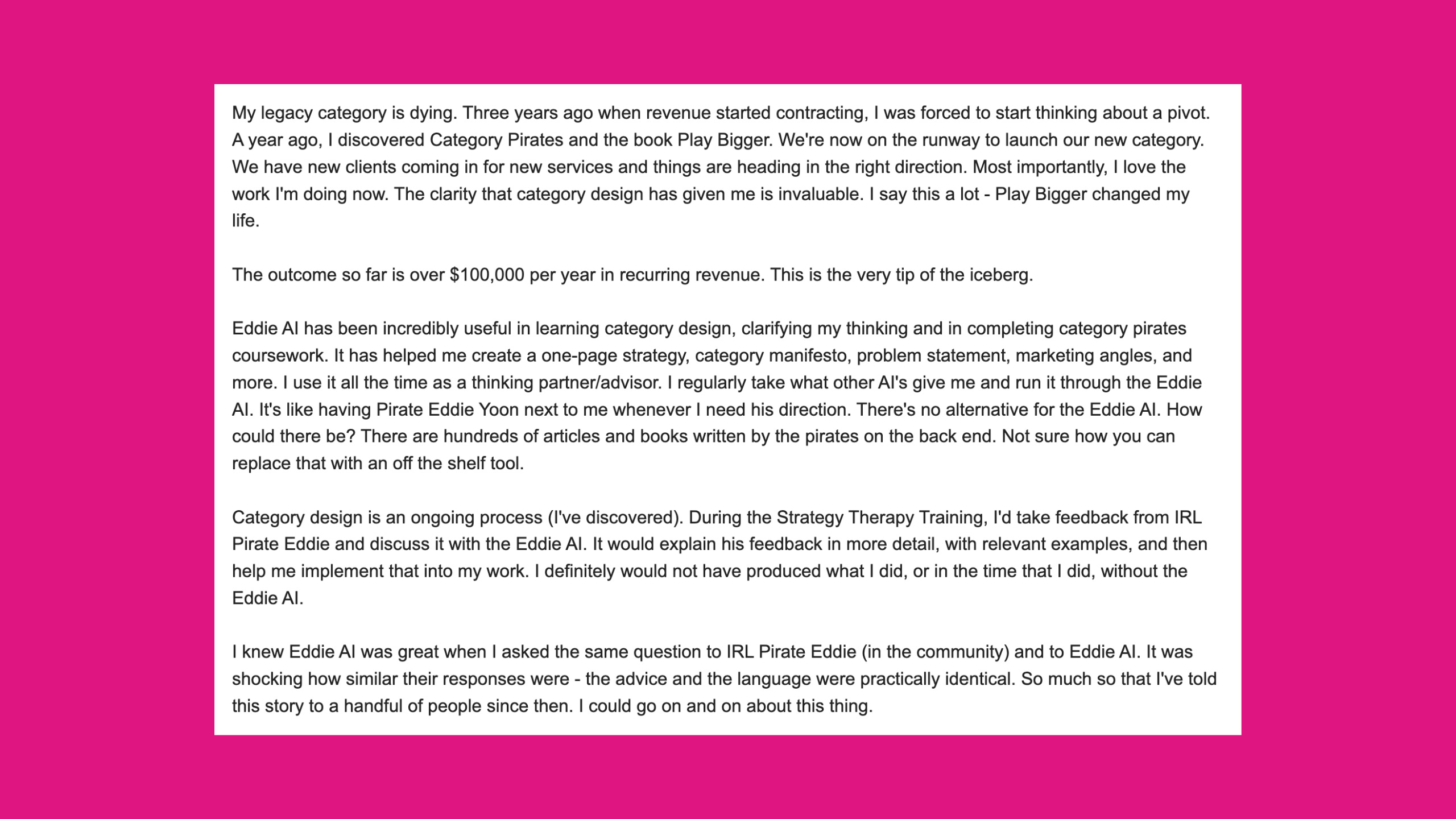
Nick is the founder of ApricotLaw. Three years ago, his legacy category started dying. Revenue was contracting. He knew a pivot was coming, but couldn’t see clearly enough to move with conviction.
Nick didn’t use the Pirate Eddie Bot to “get ideas.”
He used it to discipline his thinking.
He ran his assumptions through it. He pressure-tested his category. He clarified his superconsumer. He locked a POV instead of endlessly iterating.
The result? In his words, not ours:
“The outcome so far is over $100,000 per year in recurring revenue. This is the very tip of the iceberg.”
Now, let’s be clear.
The Pirate Eddie Bot didn’t create the $100K.
It removed the fog that was preventing Nick from doing the work he already knew how to do.
That distinction matters.
The Pirate Eddie Bot did not:
tell Nick what to sell
write his offers
generate magic copy
promise him anything
What it did was more dangerous.
It forced him to stop drifting. It forced him to name the real problem. It forced him to choose.
That’s where the money came from.
And Nick wasn’t alone.
Pirate Eddie Bot accelerates Category Design
Pirate Lydia uses the Pirate Eddie Bot as a true thinking partner across category creation, GTM, and execution—building new categories while carrying real operational responsibility.
When we asked her what actually shifted, she didn’t hesitate:
“Eddie Bot helped me invent two new categories today—two AI companies I’m incredibly excited about. The Eddie Bot has been a big part of my success.”
What stood out wasn’t just ideation.
Lydia used the Pirate Eddie Bot to surface judgment gaps she’d missed—like ethical and explainability considerations inside a legal PRD she was drafting late at night.
She jams with the Pirate Eddie Bot whenever inspiration hits—sometimes at 4 a.m.—that always-on access mattered because category work doesn’t happen on a schedule.
She also used the Pirate Eddie Bot to help other people understand category design—clarifying POVs, explaining tradeoffs, and translating abstract ideas into language they could actually use.
And she’s very clear about the counterfactual.
“If the Pirate Eddie Bot didn’t exist, my first year as a solopreneur would’ve looked very different.”
Without it, Lydia would’ve spent far more time stitching together drafts alone, waiting on calendars to align, and manually assembling logic from our mini-books.
What changed was speed with standards.
Pirate Eddie Bot cuts your rework by 50%
Pirate Jennifer came to the Pirate Eddie Bot already moving fast—but paying for it in drift, rework, and second-guessing.
The cost wasn’t effort. It was sequence.
“I eliminated about six weeks of rework by using the Pirate Eddie Bot to stop drift and accelerated my category sequencing timeline by roughly 50% once Eddie Bot entered the picture.”
Before Eddie Bot, documents were rebuilt multiple times, sequencing was blurred, and outcomes arrived slower than they needed to.
What changed wasn’t effort or intelligence.
It was focus.
Pirate Eddie Bot Tells You the Brutal Truth
Pirate Sean came to the Pirate Eddie Bot wondering if his POV was truly differentiated.
It’s the quiet question almost every category builder carries—am I actually onto something, or just remixing what already exists?
“When I ask EddieBot, “Have you seen something like this before?” and the answer was essentially “Looks net new to me,” it gives me confidence we’re on the right track.”
That confirmation mattered because Sean wasn’t looking for encouragement.
He was looking for truth.
Pirate Eddie Bot helped Sean pressure‑test language, mental models, and the coherence of the category before launch—and even shape the Lightning Strike itself.
Sean put it this way:
“Category Pirates is a deep library of insight. Eddie Bot is the tool that distills it. It helps you navigate the concepts, connect ideas, and quickly surface the articles most relevant to your quest. It’s the closest thing to having Eddie sitting beside you while you build.”
Once you see it that way, the question quietly shifts.
If you’re already inside the Category Pirates library, why wouldn’t you be using the tool designed to help you think through it?
Pirate Paul came to the Pirate Eddie Bot in August, expecting help—but not honesty.
“I thought Eddie Bot’s response to something I shared was f**king brutal. Then I reread it and realized—it was exactly what I needed.”
That honesty turned vague thinking into structure: a clear POV, a villain, a three‑year plan, and a category worth committing to.
That’s when it clicked. This wasn’t a tool trying to please him.
It was a thinking partner willing to push back. Paul describes it as having permanent access to a world-class strategist—someone he could think out loud with, admit uncertainty to, and quickly turn raw ideas into structure.
And Pirate Eddie bot’s brutal truth and honesty might be higher than the real Pirate Eddie!
Six months earlier, Paul had vague ideas. Now he has the truth, which gave him clarity, momentum, and a plan he’s actually executing.
Pirate Eddie Bot is a confidant that gives confidence
Pirate Holley found that the Pirate Eddie Bot didn’t take responsibility away—it made her more confident carrying it.
She carries the weight of category design inside her firm—often alone, often under pressure.
“It’s been said before that being a category designer can be kind of lonely. While I have an amazing team, I’m really the growth architect and category designer for my firm. It can feel like a lot of responsibility.”
The Pirate Eddie Bot didn’t remove the weight of decisions. It made that weight easier to carry.
It acted as a counsel and sounding board—helping her think through category tradeoffs, client conversations, and board-level dynamics without drifting or second-guessing.
That mattered because category design isn’t just intellectually hard.
It’s emotionally heavy. And often lonely.
Pirate Eddie Bot gives constructive criticism
Pirate Don didn’t expect the Pirate Eddie Bot to push back when he was feeling unsure.
He went to it asking the real question: do I actually have something big here—or am I telling myself a nice story?
“Eddie Bot is a very good way to integrate Category Design thinking into the context of your business. Pirate Eddie Bot will tell me when it’s a good start but not good enough and how to make it legendary.”
What mattered most was that the Pirate Eddie Bot didn’t default to encouragement.
It pushed back, challenged the thinking. It helped him pressure-test the idea against real Category Design standards instead of vibes.
What Don found wasn’t certainty handed to him.
It was a way to wrestle unfinished ideas into something solid enough to commit to.

Across different industries, stages, and ambitions, the same pattern kept appearing.
People didn’t walk away saying:
“I got great answers.”
They walked away saying things like:
“I stopped rebuilding the same document for the fifth time.”
“I realized I was avoiding the hard decision.”
“I can see the category now.”
That’s not information.
That’s an identity shift.
And identity shift is what makes outcomes compound.
If you’ve made it this far, Kit probably says it best.
“One of the guys I know (Pirate Eddie) has driven over $100M in growth strategies in his lifetime and uploaded his brain and voice into this AI. Why wouldn’t you want that at your fingertips?”
At this point, not trying it becomes the stranger choice (you can sign up for your free trial here).
So rather than leaving you to poke around randomly, we want to be explicit about how to use the next seven days—so you experience the same shift we’ve watched play out again and again.
By working the thinking the right way.
Seven Days To Your $100K Transformation
Let’s be clear about something up front.
Seven days isn’t enough to master this. And it’s definitely not enough to “finish” anything meaningful.
It is enough to start something most founders never do.
Over the next seven days, we’re going to give you a clear theme for each day—paired with a small set of prompts you can return to again and again.
Seven days won’t complete the journey. But it will make one thing very clear:
You’ve crossed a line.
Once that happens, you’ll understand why nobody serious ever wants to go back.
Day 1: Reject the premise
Most founders are just operating inside an unexamined assumption.
An assumption about:
what business they’re really in
what problem actually matters
what customers truly care about
The danger isn’t bad thinking. The danger is confident thinking built on a false premise.
That’s why Day 1 is not about improving your ideas. It’s about questioning the frame those ideas sit inside.
If the premise is wrong, better execution only gets you to the wrong place faster.
Don’t come into Pirate Eddie Bot with polished language. Don’t try to sound smart. Dump your thinking as-is.
You’re not asking the Pirate Eddie Bot to fix anything yet. You’re asking it to challenge what you’re taking for granted.
Here are some prompts to start:
Prompt 1: Surface the hidden assumption
Here’s how I currently describe my business/category. What assumptions am I making that I’m treating as facts?Prompt 2: Attack the ‘of course’ statements
What am I assuming customers already believe, understand, or agree with that might not actually be true?Prompt 3: Test the frame itself
If this assumption turned out to be wrong, what part of my strategy would immediately break?You’ve had a successful day one if you don’t feel “clear.”
You’ll feel:
slightly uncomfortable
less certain than you were yesterday
aware that something you’ve been building on might not hold
Day 1 isn’t about answers.
It’s about creating enough doubt to make real thinking possible.
Day 2: Name the real problem
Symptoms are comfortable.
Problems are not.
Most founders are very good at describing what’s not working:
leads are low
sales cycles are long
pricing feels hard
customers don’t “get it”
Those are symptoms.
They’re downstream effects.
Pricing power, differentiation, and momentum only show up once the real problem is named clearly enough to confront—clearly enough that it makes people uncomfortable.
Day 2 is not about improving your solution.
It’s about naming the problem that makes your solution necessary.
If you get the problem wrong, everything else becomes noise.
You’re not asking Eddie Bot to help you sound better. You’re asking it to help you stop solving the wrong thing.
Prompt 1: Separate symptoms from the real problem
Here are the issues I keep running into with customers. Which of these are symptoms—and what problem might be causing them?Prompt 2: Make the problem unavoidable
What problem, if solved, would make everything else easier—or irrelevant?Prompt 3: Test the problem for category power
Is this a problem people already know they have—or one they don’t yet have language for?You’ve had a successful Day 2 if:
your problem statement feels sharper—but also heavier
you realize you’ve been underplaying what’s actually at stake
parts of your solution suddenly feel secondary
Day 2 isn’t about being clever.
It’s about naming the problem you’re willing to build a category around.
Day 3: Draw the line
Clarity requires exclusion.
Always.
Most founders think they have a positioning problem. What they really have is an avoidance problem.

They’re afraid to draw a hard line because:
it feels risky
it feels smaller
it feels like saying “no” to opportunity
So they hedge.
And hedging is the fastest way to drift back into the existing market.
Day 3 is not about finding more customers.
It’s about deciding who this is not for—and being willing to live with that decision.
Until you draw a line, everything stays fuzzy.
On Day 3, you’re not asking Eddie Bot to help you grow faster. You’re asking it to help you stop trying to please everyone.
Prompt 1: Identify the wrong customer
Who keeps showing interest in my work but makes everything harder once they engage?Prompt 2: Name the Superconsumer
Who does this work really well for—and why do they care more than everyone else?Prompt 3: Test your willingness to exclude
If I fully committed to this Superconsumer, who would I have to stop trying to serve?You’ve had a successful Day 3 if:
your audience feels smaller—but clearer
some opportunities suddenly feel like distractions
your message gets simpler instead of broader
Day 3 isn’t about being exclusive for the sake of it.
It’s about choosing the people who make your category inevitable.
Day 4: Lock the POV
By now, you should feel tension.
You’ve questioned your assumptions. You’ve named the real problem. You’ve drawn a line around who this is for.
Day 4 is where most people instinctively soften—because locking a POV means being willing to be wrong in public.
A POV is not a positioning statement. It’s not messaging. It’s not a slogan.
A POV is a belief about the world you’re willing to organize your business around.
Day 4 is not about finding the perfect sentence. It’s about choosing the belief you’re willing to defend. Come in ready to be challenged.
You’re not asking Eddie Bot to make your POV sound nicer.
You’re asking it to pressure-test whether it can survive.
Prompt 1: State the belief plainly
Here’s what I believe about my category that most of the market doesn’t agree with yet.Prompt 2: Attack your own POV
If someone strongly disagreed with this POV, where would they attack it first?Prompt 3: Test your willingness to stand alone
If this POV costs me opportunities, which ones am I willing to lose?You’ve had a successful Day 4 if:
your POV feels simpler but riskier
you’re slightly nervous to say it out loud
parts of your old story no longer fit
That’s not recklessness.
That’s commitment.
Day 4 isn’t about being provocative.
It’s about choosing the belief you’re willing to build around—even if it costs you in the short term.
Day 5: Collapse the decision set
Day 5 is not about making better decisions.
It’s about making fewer decisions—on purpose.
We’re removing:
Too many initiatives.
Too many priorities.
Too many “we could also…” conversations.
Every extra option becomes a hiding place.
Because momentum doesn’t come from choosing perfectly. It comes from choosing decisively.
Come in with everything you’re juggling.
You’re not asking Pirate Eddie Bot to help you optimize all of it. You’re asking it to help you discard the “maybe” paths.
Prompt 1: List the competing bets
Here are all the initiatives, ideas, or paths I’m currently trying to pursue. Which of these are competing with each other?Prompt 2: Force the single bet
If I could only make progress on one thing for the next 90 days, which choice would unlock everything else?Prompt 3: Remove the escape hatch
What option am I keeping around purely for emotional safety?You’ve had a successful Day 5 if:
your to-do list suddenly got shorter
some ideas you liked no longer feel necessary
your next week feels simpler, not busier
That’s not constraint for constraint’s sake.
That’s leverage.
Day 5 isn’t about being narrow forever.
It’s about choosing one direction long enough for momentum to show up.
Day 6: Make it real
Great thinking that only works in your head doesn’t work.
If your idea:
needs explanation
collapses when someone repeats it
sounds smart but not actionable
It isn’t real yet.
Day 6 is not about polishing language.
It’s about making sure your thinking can travel—from you to someone else—without you in the room.
Categories don’t spread through decks. They spread through people.
Come in with the thing you think is clear.
Your POV. Your problem statement. Your category narrative.
You’re not asking Pirate Eddie Bot to rewrite it for you. You’re asking it to test whether it survives translation.
Prompt 1: The repeatability test
If a Superconsumer tried to explain this to a colleague, where would they stumble or get it wrong?Prompt 2: Kill the insider language
What parts of this only make sense if you already agree with me?Prompt 3: Translate to action
What decision should someone make differently after hearing this?You’ve had a successful Day 6 if:
your language got simpler, not duller
your idea feels easier to say out loud
you stop needing follow-up explanations
That’s not dumbing it down.
That’s making it usable.
Day 6 isn’t about sounding impressive.
It’s about making sure your thinking can move without you pushing it.
Day 7: Decide who you’re becoming
By now, something should feel different.
Not finished. Not solved. Different.
Day 7 is not about producing anything new. It’s about deciding who you are now that you can’t unsee what you’ve seen. The biggest trap after clarity is pretending nothing changed.
Come in reflective, not reactive.
You’re not asking Pirate Eddie Bot for the next move. You’re asking it to help you name the shift that already happened.
Prompt 1: Name the shift
Based on this week, how has my thinking changed—and where am I no longer willing to compromise?Prompt 2: Close the old doors
What ways of working, thinking, or deciding am I no longer available for?Prompt 3: Commit forward
If I act from this POV for the next 90 days, what becomes inevitable?You’ve had a successful Day 7 if:
you feel more grounded, not euphoric
you’re less interested in advice
you’re clearer about what not to do
That’s identity taking hold.
Day 7 isn’t the end of the work.
It’s the moment the work stops being optional.
And once that happens, the real question isn’t whether seven days was enough.
It’s whether you want to keep building alone—or keep building this way.
The Pirate Eddie Bot trial is now open through the end of December 21st.
No further extensions.
If you want to experience what judgment clarity actually feels like—not read about it—this is the simplest way to do that.
👉 Start your seven-day trial here
This post isn’t going anywhere.
You can come back to it every day. Use it as your launch pad. Or follow it step by step.
The seven days aren’t about rushing.
They’re about interrupting patterns.
Once you’ve seen what it feels like to think this way—to stop hiding behind answers and start making decisions—it’s very hard to unsee.
Arrrrrrr,
Category Pirates 🏴☠️
P.S. - If this got your brain buzzing and you want to go deeper on using AI as a thinking partner (not a content machine)…
Then you might enjoy a few related mini-books from the Category Pirates library:
Vibe Creating: Why Building With AI Starts With Being As Human As Possible
Identity At Scale: How We Built The Pirate Eddie Bot, And How To Create Your Own
And if you want to actually practice that way of thinking (not just read about it), don’t forget to sign up for the Pirate Eddie Bot while the trial is still open.