



Arrrrr! 🏴☠️ Welcome to a 🔒 subscriber-only edition 🔒 of Category Pirates. Each week, we share radically different ideas to help you design new and different categories. For more: Audiobooks | Category design podcast | Books | Sign up for a Founding subscription to ask the Pirate Eddie Bot your category design questions.
Dear Friend, Subscriber, and Category Pirate,
A few weeks ago we dropped Motherhood 3.0.
Motherhood 1.0 stayed home. Motherhood 2.0 tried to do everything at once and got penalized for it. Motherhood 3.0 uses the Four Capitals to separate income from time, so a mother can integrate her career and her family instead of compromising between them.
So the obvious question is, what about fathers?
So we did what Category Designers do. We went to the data, we went to our own scars, and we went looking for the false choice nobody was naming.
You don’t have to read Motherhood 3.0 first. But you should read it second, since we all have mothers and know mothers.
Three versions of fatherhood are on the table. Each one solved the previous one’s problem and created a new one.
🔊 Want to listen to this mini-book instead? Head to the audiobook.
Fatherhood 1.0 was the provider. Powerful at work, mostly absent at home. He paid for the house, married his career, and his kids barely saw him.
Fatherhood 2.0 was the corrector. He looked at what 1.0 cost him and resolved to be there. He coaches the team, runs the carpool, and shows up to every recital. And he is exhausted, stretched, and quietly unsure whether any of it is working.
Fatherhood 3.0 refuses the trade. He uses the Four Capitals of the Creator Capitalist, Financial, Reputation, Relationship, and Intellectual, to break the chain between time and money. He is present and powerful at the same time. Because he designed his life on purpose instead of inheriting someone else’s blueprint.
The cost of getting this wrong is not theoretical. In 1.0, the cost is the kid. In 2.0, the cost is you. In 3.0, the cost is the courage to design a life nobody handed you.
(P.S. Courage is one of the most legendary things an adult can teach a kid. Especially in a world so lacking in it.)
Fatherhood 1.0: The Cost. The Fall Of The House Of Busch
Pirate Eddie was serving Anheuser-Busch as a consultant starting in 2006.
August Busch IV became CEO of AB in November 2006. However, the shadow of his father August Busch III, also known as The Chief, loomed large.
The Chief ran Anheuser-Busch from 1975 to 2002. Under his leadership, AB share of the US beer market grew from roughly 25 percent to 48 percent. Bud Light became the largest beer brand in the world. His team designed the wholesaler incentive plan that turned 800 independent distributors into a powerful beer salesforce that stacked pallets of Bud Light high and watched them fly. Then funneled the distribution muscle into a billion-dollar marketing budget that produced the most iconic commercials of the 80s and 90s.
The Chief was a force.
Meetings did not start when they were scheduled. They started when the Chief walked in. Senior executives showed up forty-five to sixty minutes early to every meeting because nobody wanted to be the person not in the room when the Chief arrived, often by a helicopter he was flying.
He was also a Fatherhood 1.0 dad.
The Chief divorced his first wife when his son August Busch IV was five. The Fourth was raised by his mother. The public record on the father-son relationship is brutal in its brevity: “His time with his father was mostly spent at the brewery, and their relationship was, for the most part, professional.”
The Fourth spent his whole career trying to climb out of that shadow. He ran AB’s marketing in the 1990s and won ten consecutive USA Today Super Bowl Ad Meter awards. He led domestic beer operations. He was the president of the company by 2002.
And still the Chief made him wait. The Chief broke with tradition and installed a caretaker CEO, Patrick Stokes, for the next four years, because The Fourth was not deemed ready. The unspoken price of admission to the top job, according to people inside the company at the time, included settling down. So on August 5th, 2006, at age 41, The Fourth married a 25-year-old woman from Vermont named Kathryn Thatcher.
To win back market share from rising imports like Heineken, The Fourth invited InBev into a US distribution partnership. That gave AB Stella Artois, Beck’s, and Bass. He thought he was solving a sales problem.
He was letting the fox into the henhouse.
InBev’s CEO Carlos Brito is an OG of 3G.
3G is one of the most effective LBO teams in the history of the world. It was founded by Jorge Paulo Lemann, Marcel Telles, and Carlos Sicupira. They niched down into beer, where they were the most effective. In 1989, they bought a Brazilian brewery, Brahma, for $52MM with mostly debt.
Two decades later, they bought Anheuser Busch for $52 billion dollars.
At that point, they had perfected their playbook. They ran the most ruthlessly effective LBO playbook in the world. Buy breweries with mountains of debt, apply zero-based budgeting to strip costs to the bone, load the top 200 leaders with options, and watch everyone get rich on the squeeze.
Brito got inside Anheuser-Busch on a sales partnership, saw the bloat from twenty feet away, and submitted what amounted to a hostile takeover within two years.
When the offer came, the Chief was Chairman of the Board. He had a choice. Back his son, the CEO he had spent forty years grooming
Or back the Brazilians who proved their ability to unlock billions over 20 years.
He backed Brito.
The board approved the sale in November 2008. The same month, The Fourth filed for divorce. The company his great-great-great-grandfather founded, an American icon, became a subsidiary of a Belgian-Brazilian holding company. The Fourth took a board seat on the merged entity and stepped out of public life. The years that followed were the saddest stretch of a public life this country has watched in a long time.
The Chief did not give his son too little professionally. He made The Fourth work his way up. He made The Fourth settle down.
The Chief showed his son his power more so than his presence.
The Fourth tried to wield the power in order to get his father’s presence.
And in the end, The Fourth ended up with neither the power of his father, nor his presence.
This is the cost of Fatherhood 1.0. Not absence in the simple sense of not being home. Absence of the only relationship currency the son was trying to earn. The Chief built a $52 billion company and could not give his son the one thing his son wanted. The Fourth received everything except agency, and the moment the real test came, he had no scar tissue to draw on.
A father who only knows how to be powerful will sometimes lose the only thing power was supposed to protect.
Fatherhood 2.0: The Well-Meaning Trap. Steve Martin In Parenthood
In 1989, Ron Howard made a movie called Parenthood.
Pirates Christopher and Eddie love this movie.
It’s hilarious, awkward, and truthful.
Steve Martin plays Gil Buckman, a marketing guy at a consumer-goods company who is trying very hard to be a different kind of father than his own. His father, played by Jason Robards, is a Fatherhood 1.0 man: distant, hard, mostly absent, occasionally cruel. Gil has decided he will not do that to his son.
So he does the opposite of everything his father did.
He coaches the Little League team. He shows up to the school plays. He puts on a cowboy costume at the birthday party and turns himself into a balloon-animal entertainer when the hired clown does not show. He bends his entire life around being present for his kids, especially his oldest, who is struggling with anxiety. He is doing every single thing his father did not do.
(He turned himself into a donkey.)
And he is dying inside.
There is a scene where Gil’s wife, played by Mary Steenburgen, finds him sitting on the bed mid-meltdown. He is exhausted. His career is stalling because he refuses the relocation that would advance it. His marriage is strained. He is convinced his kids are going to come out broken anyway. He gave up the part of his life that made him most himself, told his kids it was love, and slowly became unrecognizable to himself.
Steve Martin says, “My whole life is ‘have-to’.”
This is a man without any agency in his life. He’s present, but not powerful.
That is Fatherhood 2.0 in a single character.
The data on real-life fathers confirms it. Net-net, fathers spend less time at work and more time caring for kids, driving kids and housework.
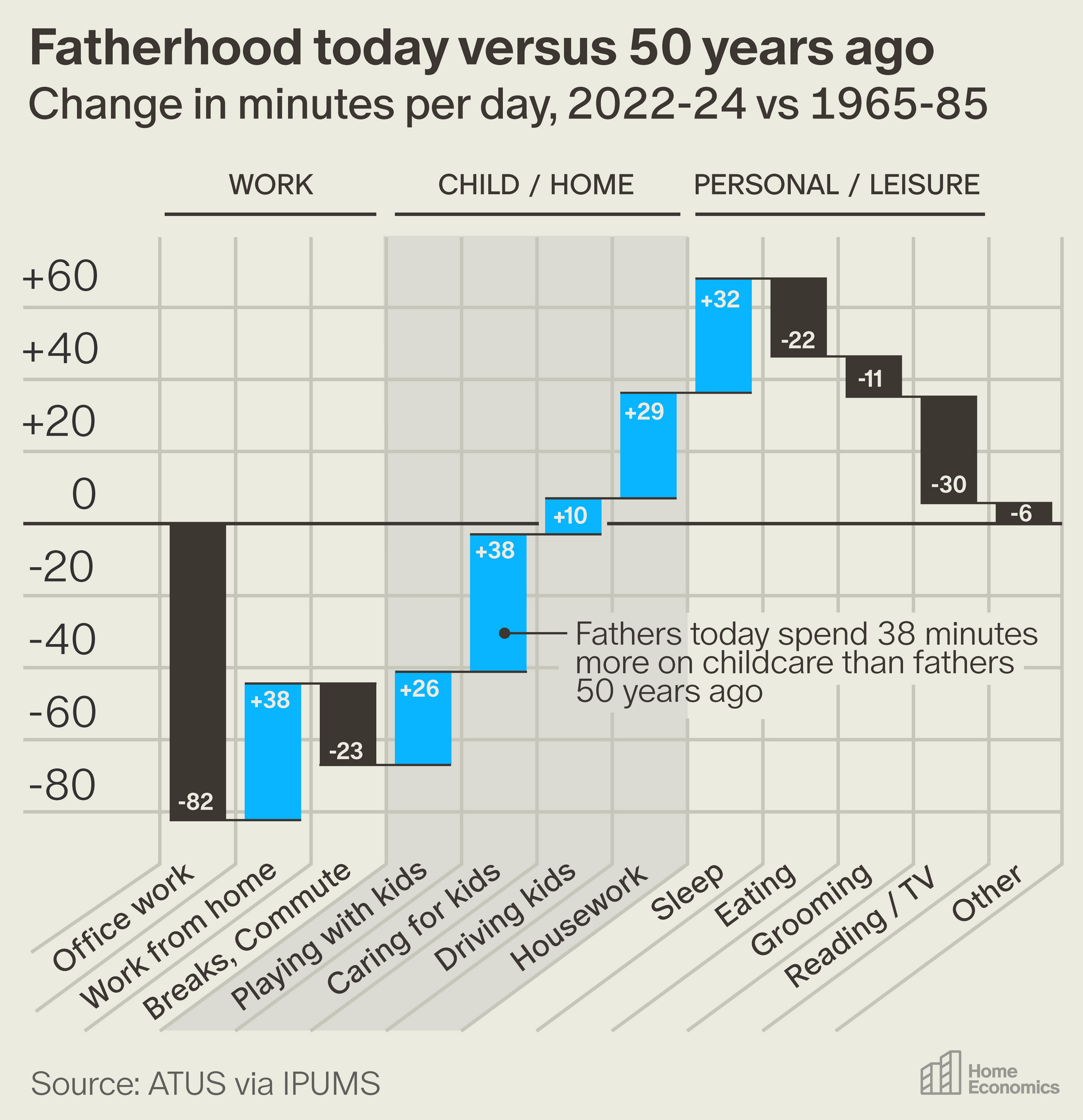
Fatherhood 2.0 dads are working hard and parenting hard, and feeling like they are failing at both.
Because presence by itself was never the whole answer.
Kids used to watch their fathers work. The farmer in the field. The shopkeeper behind the counter. The tradesman at the bench. They saw their dads creating value. Doing work they were good at. Successful at. They saw their fathers being a man’s man.
Then fathers went to offices, and what kids saw came home with the lights off. The work happened somewhere they could not see, and what they got at the dinner table was a tired man with very little left.
Fatherhood 2.0 corrected the absence and lost the witnessing.
That is the cost to fathers and families.
When a man’s wife rarely sees him performing at his best, that’s not good for the marriage or the children. Gil Buckman (Steve Martin) in his bedroom is the icon of the generation. A man who showed up to everything and quietly disappeared from his own life.
What is the point of showing up, only to vanish from the room?
Men without power and agency are never right in the head. Men who fall short of their potential are devalued by themselves and the world. It causes a man to spin out.
Harsh, but true.
Men who over-rotate on being powerful at the expense of being a great father are also judged harshly by the world. They may say they don’t care, but there are massive unintended consequences that lead to regret and loneliness.
Both are problematic.
Fatherhood 3.0: The Way Out
The 3.0 father makes three moves, in this order.