


Arrrrr! 🏴☠️ Welcome to a 🔒 subscriber-only edition 🔒 of Category Pirates. Each week, we share radically different ideas to help you design new and different categories. For more: Audiobooks | Category design podcast | Books | Sign up for a Founding subscription to ask the Pirate Eddie Bot your category design questions.
Dear Friend, Subscriber, and Category Pirate,
You might be wondering what right two dudes have to write about motherhood.
That’s a legit question.
Pirates Christopher and Eddie are Category Designers, which makes us time travelers from the future.
We already see the future of millions of Creator Capitalists who use their different, to make a massive difference for others and get paid to create at scale. Creator Capitalists no longer trade time for money anymore, but monetize their Four Capitals while they sleep.
This includes mothers.
Mothers to be. New mothers. Empty nest mothers. Grandmothers. Great-Grandmothers.
What happens if abundance from your career is no longer tied to time?
What if you get paid for the value you create?
Not the time you donate.
Would that change the equation for motherhood? Should you have kids? When should you have kids? How many kids should you have?
These are all personal questions. Life design questions.
We believe everyone should have the agency to make their own decisions.
We are saying more than one thing can be true.
(When you start noticing. You’ll discover that we’re presented with many false choices. Who says you can’t have it all? Who says you can’t live your definition of a legendary life?)
Careers are incredible.
Children are awesome.
Work can be wonderful.
Motherhood is majestic.
Women should have agency.
The woman can/do create new value.
The declining birthrate is a societal concern.
Few things are more important than when a child needs their mom.
Children need to see their mother make massive dents in the universe.
Our goal is to write with courage.
We love our mothers. We love our wives. And the many legendary women in our lives.
And. We also did our homework.
We gave the Category Pirates platform to six legendary women on the Pirate Ship. Five in a roundtable, one in a deep-dive podcast. What follows is their wisdom and wishes, their stories and scars, mapped onto the Creator Capitalist framework.
These are women who have built businesses, raised children (including kids with Down syndrome, autism, and cancer), navigated divorce, managed elder care, traveled the world for consulting engagements, and walked their kids to elementary school, sometimes in the same week.
Most are Category Design Academy alumni. They are moms. And they are incredible Creator Capitalists.
This is the future we co-wrote all together.
A different lens on motherhood.
And (we think) it looks beautiful.
You be the judge of that.
🔊 Want to listen to this mini-book instead? Head to the audiobook.
Evolution of Modern Motherhood
In 1950, about one in three American women worked outside the home. By 1999, it was nearly three in five. Economists called it the most significant labor market shift of the 20th century.
That was Motherhood 2.0. The promise was that women could have careers AND families. The system would adjust. Everyone would benefit.
The system did not adjust.
Instead, it asked women to do two full-time jobs simultaneously, career and household, while paying them roughly 82 cents on the dollar for the first one and nothing for the second.
Zebra hole alert!
We’re going down an academic zebra hole! Follow us at your own peril. Just know that none of us are PhD academics, and while economics is a valuable field, it is still part of social science.
Pirates should have a swig of skepticism with social science.
“Any field that had the word ‘science’ in its name was guaranteed thereby not to be a science”, Frank Harary, a mathematician.
There’s a reason why Physics is called Physics and not Physics Science.
But hey ho, let’s go!
There are two types of wage gaps: uncontrolled and controlled.
Uncontrolled data is what it sounds like. It’s the raw data without adjustments. It is comprehensive, but it can be noisy.
Controlled data is where you calibrate the data to be apples to apples (e.g., same qualifications, same life circumstances, same job).
Imagine if Pirate Christopher and Eddie were both at a business meeting and wore recorders around their necks, and we counted the number of words said per day. It would show that Pirate Christopher is a lot more talkative than Pirate Eddie.
That is uncontrolled data.
Now let’s adjust the data from words per day to words per hour. What you’d find is Pirate Eddie basically stops talking around 4 pm, when he runs out of words. He’d sit at dinner, listen intently, smile and react, but say very little. The words per hour before 4 pm are probably the same. Words per hour after 4 pm is where the difference is.
That is controlled data.
Academics looked at controlled data regarding the wage gap for the same job with the same qualifications, and women earn 99 cents on the dollar.
It’s basically parity. The number you usually hear, 82 cents, is the “uncontrolled” gap. Both numbers are real. But they’re measuring completely different things. The 82-cent number doesn’t mean employers are paying women less for identical work. It means women end up in different work.
The research on why is led almost entirely by women.
Claudia Goldin at Harvard won the 2023 Nobel Prize in Economics for proving it. Ruth Thomas at Payscale runs the annual reports that track it. Heidi Hartmann at the Institute for Women’s Policy Research quantified it.
The data isn’t some dude’s opinion.
Motherhood is the simplest explanation for the 17-cent canyon between the controlled and uncontrolled numbers.
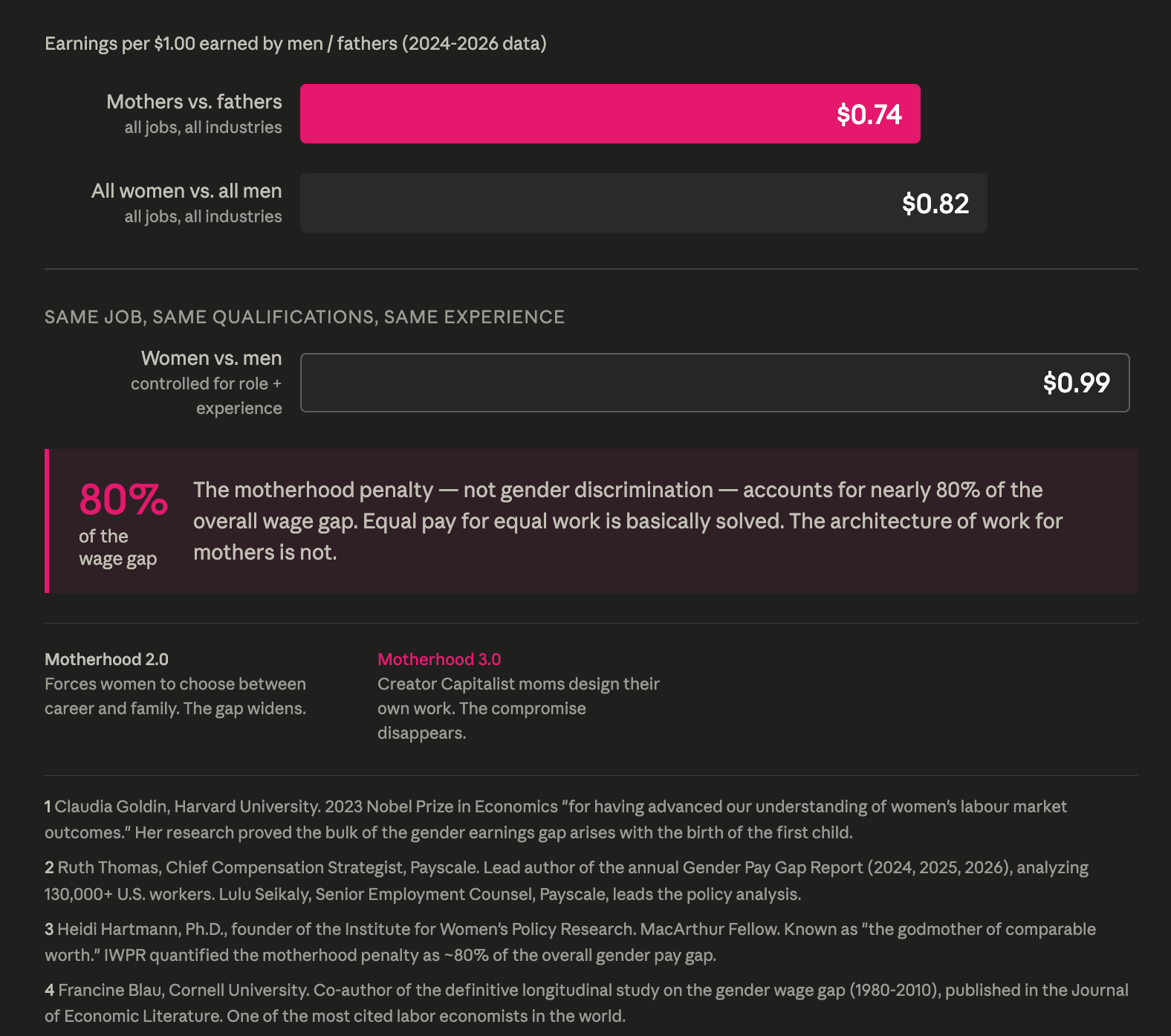
Statistically, the motherhood penalty accounts for nearly 80% of the entire remaining wage gap. Motherhood changes which jobs women take, how many hours they work, when they get promoted, and whether they stay in the workforce at all. Pay transparency tools like Glassdoor and state-level disclosure laws have helped close the controlled gap to near-parity.
Both data points prove Motherhood 2.0 is structurally broken.
It asks women to choose between compounding their career or raising their family, and then penalizes them for whichever one they pick. The controlled gap closing to 99 cents is proof that the “equal pay for equal work” fight is nearly won. The uncontrolled gap widening to 82 cents and getting worse in 2026 is proof that the real battle was never about paychecks.
The gap is in the design of work.
The gap is in the design of motherhood.
This is called life design.
Going forward, we will use the uncontrolled numbers.
Because the controlled data, for all its precision, hides the very thing we’re trying to see. Controlling for job title and experience is like measuring the speed of runners who made it to the finals and concluding that everyone runs about the same pace. Technically true. But it completely ignores the thousands who never made the starting line.
The uncontrolled gap captures the full picture: who’s in the workforce, who left, who downshifted, who never got promoted, who took seven years off, and couldn’t get back in. It captures the mothers.
That’s the gap Motherhood 3.0 is designed to close. Not the paycheck gap, which is nearly solved. The participation gap. The ambition gap. The compounding gap. The gap between what mothers could build and what the 2.0 system allowed them to build.
The earnings hit women take after having children accounts for nearly 80% of the entire gender pay gap. Working women see their incomes drop sharply, on average, after having kids. That gap never fully recovers.
Now, some strange things are happening all at once.
The U.S. fertility rate hit a record low of 1.6 births per woman in 2024, and dropped again in 2025, well below the 2.1 replacement rate. Talented women are looking at the math and saying: no thanks.
455,000 women left the workforce in early 2025 between January and August 2025, the steepest decline since the pandemic. Return-to-office mandates nearly doubled. It looks, on the surface, like Motherhood 1.0 is making a comeback.
But here’s the number nobody is talking about: women launched 49% of all new businesses in 2024. Up from 29% in 2019. A 69% increase in five years. The highest share ever recorded. 14.5 million women-owned businesses generating $3.3 trillion in annual revenue.
And yet, not all the business numbers are up and to the right. Pirate Lydia says, “I gave a talk at Extraordinary Women in Tech. My dream is that in five years, women will receive 50% of the investment. At the time, it was 9%. Today, it is less than 2%. So we are going very, very backwards.”
Women are not going back to 1.0. But 2.0 isn’t working.
They’re building something new.
Let’s call it Motherhood 3.0.
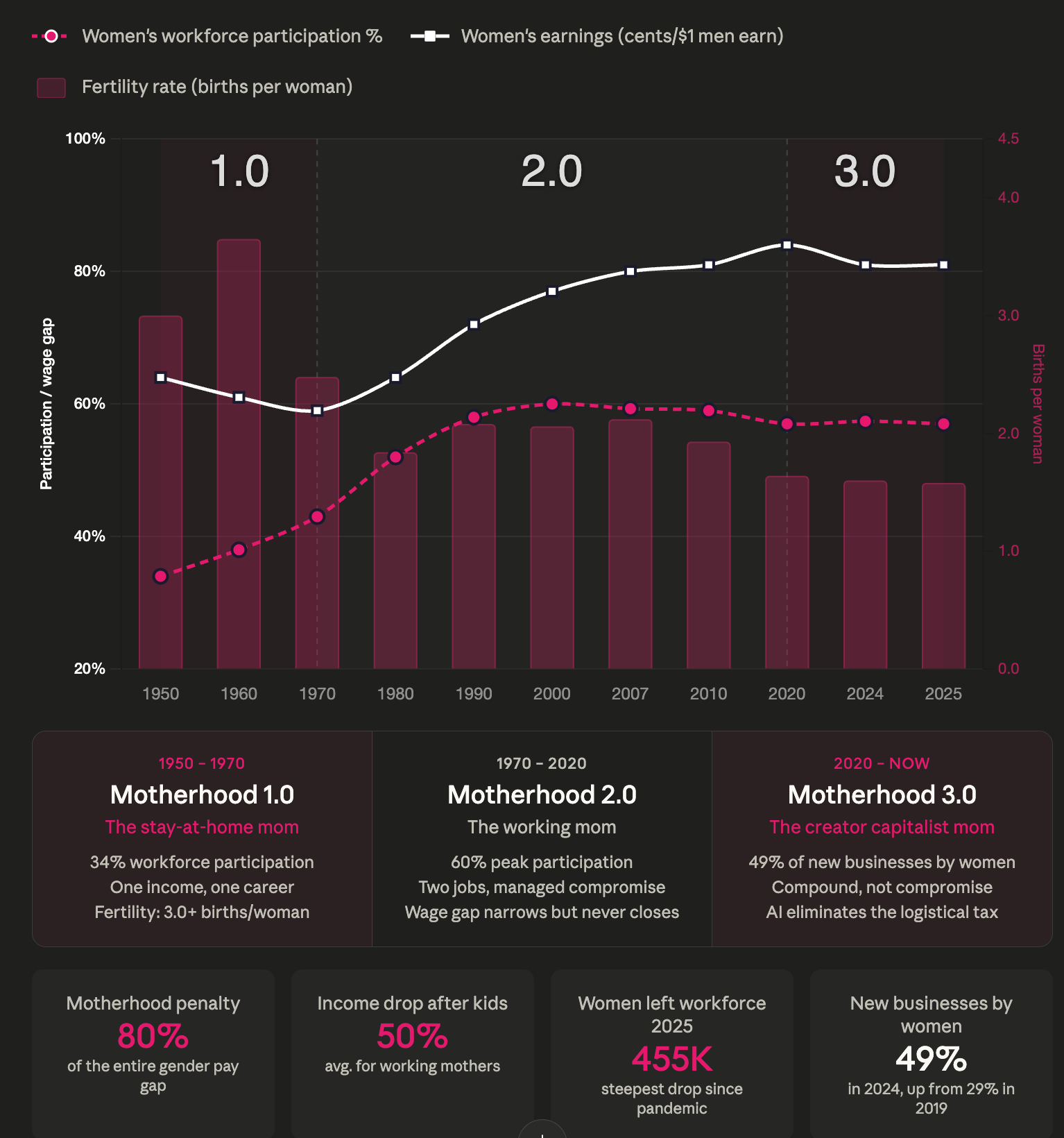
Motherhood 1.0 was the stay-at-home mom. One income, one career, mom stays home. The “good mom” is defined by presence.
Motherhood 2.0 was the working mom. Two incomes, managed compromise, the second shift. The “good mom” is defined by her ability to juggle everything and never drop a ball.
Motherhood 3.0 is the Creator Capitalist mom. She designs her own career. She builds four compounding capitals: Financial, Reputation, Relationship, and Intellectual. She deploys AI to eliminate the logistical tax that crushed the 2.0 generation. And she integrates motherhood and career instead of compromising between them.
She does this by prioritizing Relationship and Intellectual Capital ahead of Financial and Reputation Capital.
Motherhood Prioritizes Relationship Capital
Motherhood is the choice of elevating Relationship Capital as first among equals.
Getting pregnant is a choice to put the Relationship Capital with your unborn child ahead of your Reputation Capital (e.g., your career), your Financial Capital (earnings), and your Intellectual Capital (pregnancy brain fog is real).
Women are often asked to put relationship capital first all the time.
In high school, Linda Deeken got into Stanford.
Most teens would be doing cartwheels. But Pirate Linda was the youngest of five children. Her mom had her later in life, in her early 40s. Pirate Linda knew Stanford had a price tag with ramifications.
The University of Wisconsin at Madison was a financial no-brainer.
Her father told her, “The Lord will always walk with you. And so the opportunities that are in front of you, the gifts that you have been given. He will actually take it right with you to its fullest expression. And so that can happen at Wisconsin. It can happen at Stanford. Make the choice that is the best choice for you.”
Linda made the choice that was the most loving to her family.
She chose Wisconsin.
She chose Relationship Capital over Reputation Capital.
It wouldn’t be the last time she made that choice.
Just like many women.
Linda said, “Have I had moments in my life where I’ve looked back and said, I wonder what, I wonder if? Sure. But I have been blessed and things have worked out swimmingly. And frankly I think it made me a harder worker. It made me invest deeper in myself because I felt like my dreams were my dreams, and I needed to make them happen.”
The Enduring ROI Of Relationship Capital
Relationships that stand the test of time have an odd power that perseveres.
Pirate Eddie has friends from junior high that have incredible meaning in his life. They were there for him when Pirate Eddie was a noob and a nobody. They’ve known him at his lowest and his highest. And those feelings compound as they age.
The other three Capitals are different.
Financial Capital can be volatile.
If invested well, Financial Capital compounds over time. But market bubbles, Madoff fraudsters, and excessive leverage/debt have destroyed many fortunes. As the late, great Charlie Munger put it, “There are only three ways a smart person can go broke: liquor, ladies, and leverage.”
Reputation Capital has a half-life.
Sadly, you are only as good as the last thing you did, and you are only as valuable as what you can do for others.
Pirate Eddie once spoke at a conference, where he met Jim Donald, who was next up after him. Jim was a three-time CEO of Starbucks, Albertson’s, and Extended Stay Hotels. He’s had an amazing career, but he noted the odd experience of the last day of being a CEO and the next day. Everyone wants your time when you are CEO, but the day after, it’s like you become invisible and never existed.
That’s why they call it a hamster wheel.
Intellectual Capital has staying power until it is trumped by new Intellectual Capital.
Pirate Aristotle was the man, until Pirate Galileo contradicted him on inertia, gravity, and astronomy and was tried, convicted of heresy, and arrested for life.
Blockbuster laughed Netflix out of the room when Reed Hastings asked Blockbuster to buy them for $50 million dollars. The great Tim Cook didn’t return Elon’s call when Tesla was about to go bankrupt, and he was ready to ask Apple to acquire them. Pirate Eddie was dismissed on CNBC for saying Tesla Model 3 supers were weird, in that they weren’t luxury car owners switching, but they were Prius, Camry, and Corolla owners trading up.
You should, of course, invest in and grow all the four Capitals.
But women and mothers who prioritize Relationship Capital have an edge that endures.
Let’s go back to Pirate Linda.
Pirate Linda’s dreams came true.
She studied Chemical Engineering because it was the hardest challenge.
She became an analyst at Oliver Wyman (then, Mercer Management Consulting), where she did amazing work for 5 years optimizing direct store delivery distribution, organizational design, and brand work.
She niched down in growth strategy at The Cambridge Group, where she met Pirate Eddie. She later became CMO at The Cambridge Group, then co-authored a piece on Category Design with Pirate Eddie that was featured in the HBR magazine.
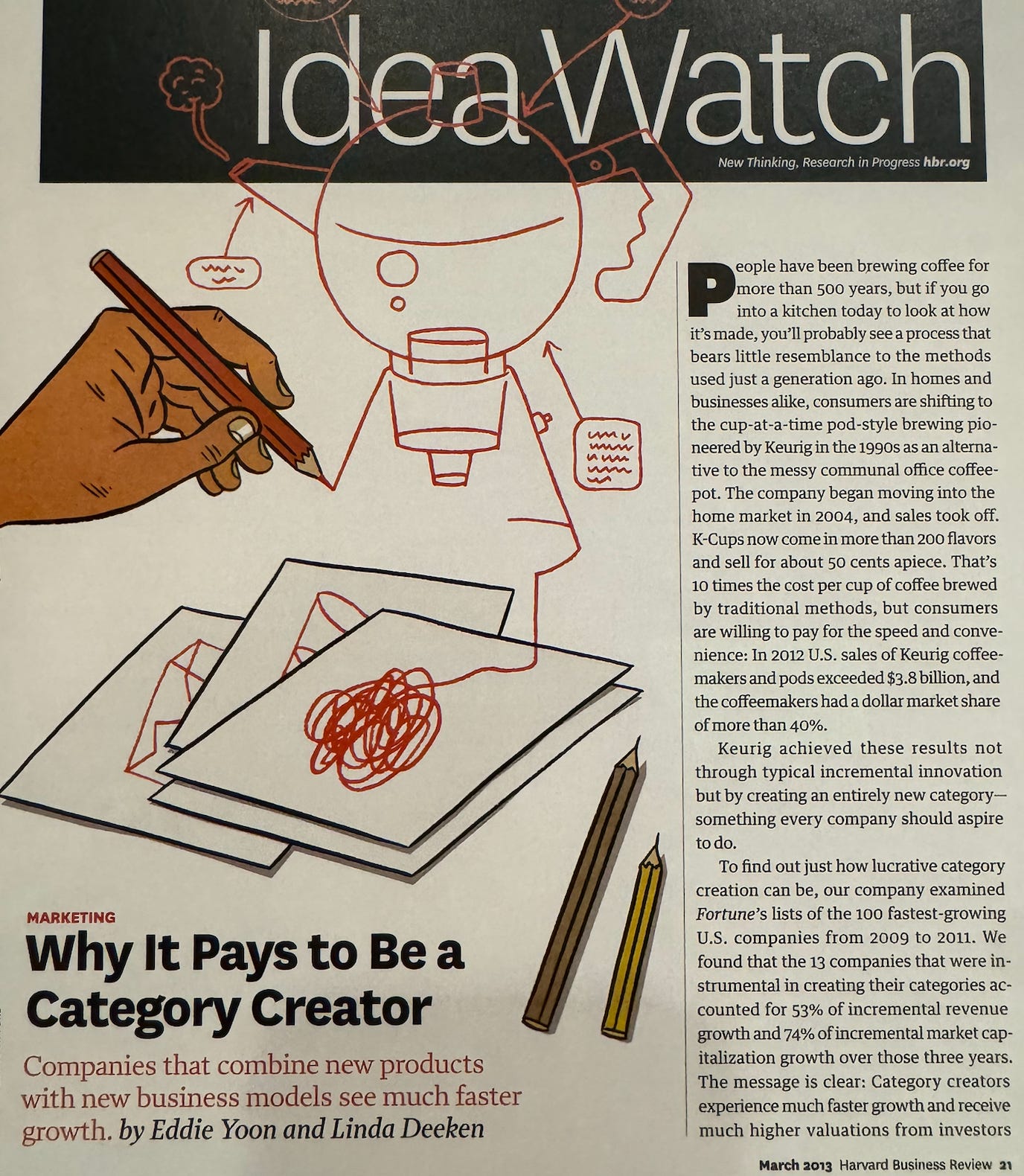
Getting into HBR is <1%. Getting into the HBR Magazine is exponentially harder.
Now Pirate Linda runs a solo consulting practice that is more lucrative and rewarding than any role she has ever held.
Her clients, when asked why they hire her, say three words: “You make me better.”
Said differently, she built her Reputation Capital via the strength of her Relationship Capital.
Too many consultants better themselves first, before bettering their clients.
What is more remarkable is that she and her husband raised five children, including two sets of twins, one of whom has Down syndrome and survived cancer. Not to mention serious elder care for her parents.
It’s not just her clients who say, “You make me better.” It’s her kids and family.
“You make me better” is the integrated POV that Linda lives by.
Relationship Capital builds trust.
Trust unlocks opportunities.
Opportunities lead to outcomes.
Motherhood is an Incubator for Intellectual Capital
The conventional wisdom says women stopping work to have children hinders producing Intellectual Capital.
In reality, moms are forced to create massive amounts of Intellectual Capital.
We just don’t call it that.
What’s the difference between pets and livestock?
Names.
Languaging.
Moms are constantly learning as they navigate new, unexpected challenges with raising children. Moms are managing more people with the same 24 hours in the day. Moms work feverishly to produce outcomes (e.g., is my child gaining weight? Is my child in the right school?)
Constant learning. Time management. Outcome orientation.
Sounds like a ton of Intellectual Capital to us.
Meet Pirate Mimi Klosterman.
She was a Strategy Therapy pirate. Pirate Mimi homeschooled her eight children over 27 years. Most people would call that mothering. Mimi calls it R&D.
She watched parents flood out of traditional schools as kids got hammered by anxiety, bullying, and one-size-fits-all curricula that ignored autistic, dyslexic, ADHD, and gifted learners. She saw the same parents drowning in 100 curriculum options with no map.
But she’d already built the map over twenty-seven years.
So she productized it. Best School Options is Mimi’s Skool community, where parents stop guessing and start designing the education their kid was always meant to have. The free tier is the Explorer Roadmap, a $297 course given away to get parents in the door. The Collective is the $397/month live Q&A layer for parents who want guidance on their real situation. Underneath is her bigger play, Deschooling Hub, the “Netflix of learning” she’s building with tiered access, expert-led video, and TERA, an AI assistant that profiles each child’s strengths and learning style to design a personalized plan.
Mimi did not pause her career to mother. Her mothering was her career.
She compounded Intellectual Capital for 27 years before she ever charged a dollar for it. Now she’s monetizing it while she sleeps, helping the next wave of parents skip the part where they feel lost. If you’re a parent staring at a blank calendar wondering what comes next, here is her website and email her at mimi@bestschooloptions.com.
And if you’d like a free Scooby Snack, you can get it here!
As Pirate Tom Schwab says, what is ordinary to you is extraordinary to others.
These seem like routine acts of mothering. In reality, moms are constantly creating Intellectual Capital.
What’s not always happening is the conversion of Intellectual Capital into a digital asset that makes them money while they get what little sleep they can get.
Intellectual Capital Integrates Your Career and Motherhood
The conventional wisdom says career and motherhood are a zero-sum trade-off.
We reject the premise.
The Four Capitals, Financial, Reputation, Relationship, and Intellectual, don’t compete across these domains.
They compound.
For moms, they compound in a different sequence.
Relationship Capital first. Then Intellectual Capital. Then Reputation and Financial Capital.
Consultant Linda and Mom Linda are not two different people.
They’re the same person with the same superpower.
As she put it, “I view my children almost like a consulting experience. I can at all times tell you what their strengths are, what their weaknesses are, because in each of these cases, you are a real-life consulting project as it were to maximize what gives you joy, to maximize your outcomes, to leverage your skills and refine them, and then just smooth out the edges of your challenges.”
Her husband laughs about it. Her kids joke about it. But it works. Because the same posture that makes her invaluable to clients (smart, humble, your outcomes ahead of hers) is exactly what makes her the kind of mom whose children are thriving.
“That which I am learning and refining on a parenting and a home basis is that which I can deploy in a business setting as well. And that which I’m learning in the business setting, I redeploy back again to my family life.”
The Three Traps that Cause Smart Women to Stall
If moms already have the four capitals to be extraordinary Creator Capitalists, then why aren’t more of them?
Why isn’t Motherhood 3.0 already a thing?
Because three traps keep them stuck.
Let’s go through each one at a time.