


Arrrrr! 🏴☠️ Welcome to a 🔒 subscriber-only edition 🔒 of Category Pirates. Each week, we share radically different ideas to help you design new and different categories. For more: Audiobooks | Category design podcast | Books | Sign up for a Founding subscription to ask the Pirate Eddie and Christopher Bot your category design questions.
Dear Friend, Subscriber, and Category Pirate,
Someone owes Pirate Christopher a lot of money.
In his last Silicon Valley CMO role, at Mercury Interactive, he helped frame, name, and claim a new category: Business Technology Optimization.
BTO.
HP bought Mercury for roughly $4.5 billion. Then HP reorganized its entire software division around BTO. After the deal closed, the head of HP Enterprise told her executives that BTO was half the reason they bought the company.
Half.
Of $4.5 billion.
Pirate Christopher’s response: “Someone owes me a lot of money.”
You know what the marketing dashboard said about BTO?
Nothing.
There was no impression count for “we changed what the acquirer believes this company is.” There was no MQL field for “the board now sees a bigger future.” No attribution model on Earth could see the most valuable thing a CMO ever does.
Drive enduring market cap growth.
The gap between the value a great marketer creates and the credit the company can count, is the oldest injustice in the profession.
Pirate Christopher became a publicly traded tech company CMO at 28. No playbook. He figured it out, by reading, seeking out mentors and doing. He taught himself to drive the kind of outcomes that show up in enterprise value, and got asked to do the job two more times.
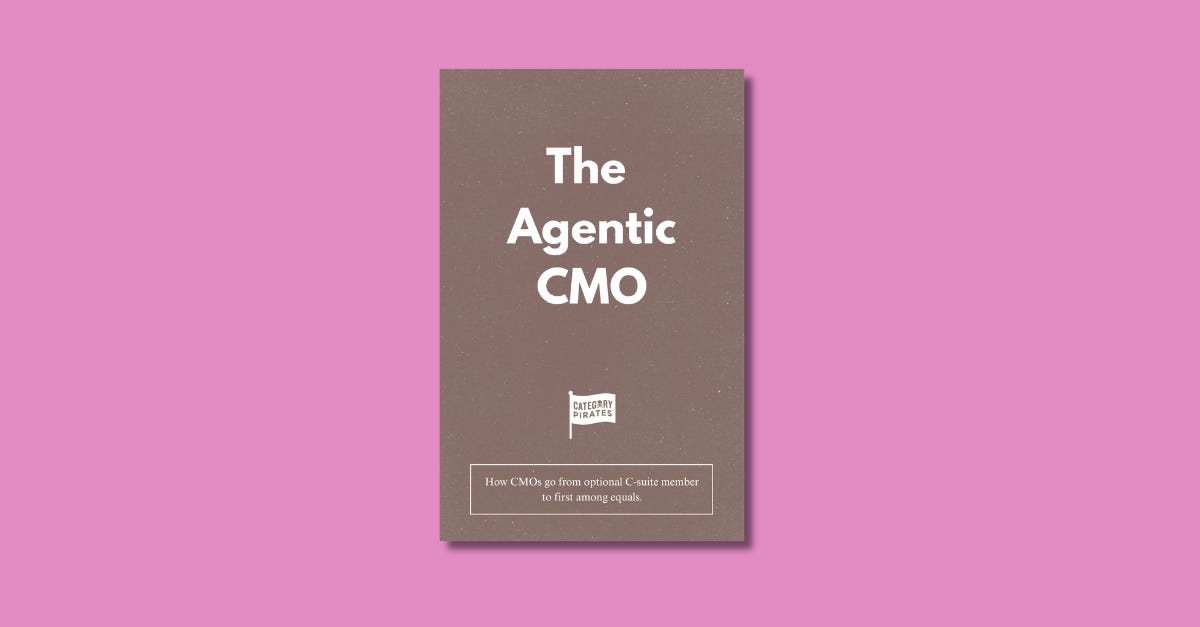
This is the mini-book he wishes someone had handed him back then.
Being a first-time CMO is, was, and always will be hard.
But today there is an enormous difference. Today’s CMOs get to do the job with an AI co-founder. And a squadron of agents. An unfair advantage no marketer in history has ever had.
Before you say it, we know the argument. “If everyone has access to the same AIs, it’s not a material advantage.”
Please hear this with love: you have no idea what you’re talking about.
First, most people and most companies are way behind on AI. Second, even if they catch up, who cares. Every F1 driver has a legendary car. Some win a lot more than others. It’s not just the car. The driver matters.
Capisci?
The only question is whether you use agents to become indispensable, or to generate prettier versions of the reports that get CMOs fired.
In this mini-book, we’ll jam on:
Why CMOs get deleted from the C-suite.
The currency switch that makes the company build around you.
Why AI agents make category design mandatory to fight the Obvious Onslaught.
Three legendary CMOs who drove massive market cap upside, not marketing metrics.
The seven levers of the Demand P&L, including why every CMO needs a bot, and how to war-game products, pricing, categories, and Lightning Strikes with AI clones of your Superconsumers before you spend a dollar.
This is the best moment in history to be a CMO.
🔊 Want to listen to this mini-book instead? Head to the audiobook.
Grab your pirate flask.
Hey Ho, Let’s Go!
CMOs Count the Wrong Currency
Roughly a third of the Fortune 500 has no CMO at all.
Read that again.
What should be the most strategic driver of growth, with the most exciting metrics, the most AI-forward, and therefore the most powerful function in business is the one a third of America’s biggest companies decided they can live without.
It gets worse.
In 21% of larger tech companies, the head of marketing reports to the Chief Product Officer. CEOs disrespect marketing’s ability to drive the business so much, they actually believe marketing belongs inside the product team.
This is as dumb as making Sales report to Finance. But it happens.
CFOs aren’t optional. Chief Commercial/Revenue Officers aren’t optional. CHROs aren’t optional. CTOs aren’t optional.
CMOs are.
And even when CMOs get invited to the party, they don’t survive it. CMO tenure at S&P 500 companies now stands at 4.1 years, against 7.6 for the CEO. Most will be handed the budget, and the blame, and be gone before any of it compounds.
Why?
Because marketing is measured in a currency the boardroom does not spend.
Impressions. Reach. Awareness. Engagement. All real. And all like trying to spend Canadian dollars at an American cash register. Your CFO, CEO, board, and investors can’t put legacy marketing currency in the bank. You can’t pay a dividend with reach. You can’t buy back shares with engagement. You can’t reinvest awareness into R&D.
And it’s not enough to run your metrics through a currency exchange at the end of the quarter. You get hit with a massive discount and walk away with a lot less than you thought you earned.
Most marketers speak marketing bullsh*t.
Not the currency of business.
Marketing must generate investable dollars, not impressions. Marketing returns must flow frictionlessly back into the P&L, not the slide deck. Marketing must drive enterprise value.
Let’s be clear about what we’re NOT saying.
We are not talking about becoming a stock-hyping, pump-and-dump, shady shyster. We’re talking about building enduring enterprise value by delivering material outcomes, while educating investors, customers, and employees on the category potential of your market over time.
The CMO measured in KPIs is trivial.
The CMO measured in market cap is transformational.
The moment you switch currency, AI stops being a productivity tool and becomes the most valuable co-founder you’ve ever had.
Why Agents Change the Currency, Not Just the Speed
Francesco Federico, the global CMO of S&P Global, wrote an entire book called The Agentic CMO.
Legendary title!
He argues an agent is a colleague the CMO leads, not a tool the CMO uses. That marketing leadership is now the practice of organizing intelligence, human and machine, toward a single point of view.
Pirate Francesco’s right.
Wharton’s Ethan Mollick argues that management itself is the new superpower. Specifying goals, outputs, and evaluation criteria. Delegating to agents the way a legendary executive delegates to people.
Also right.
The AI search crowd says you have to show up when the machines do the answering.
Right again.
Every one of them is teaching you how to organize intelligence.
None of them can tell you where the point of view comes from.
So put on the category lens. Once you see this, you can’t unsee it.
Fact one: agents make execution close to free.
Customer interaction, content, media buying, campaign ops, lead scoring, personalization, on-going optimization, reporting. The entire execution layer of marketing is being agentified right now.
Tasks that require headcount are being handed to agents that work in parallel, around the clock, at near-zero marginal cost.
Fact two: left alone, AI will spawn the Obvious Onslaught.
LLMs are probability machines. They predict the most likely next words for the broadest possible audience. Which means the default output of the entire technology is the obvious answer.
“Drop the price.”
“Make the logo bigger.”
“Copy what’s trending.”
The AI Obvious Onslaught is like carbon dioxide. You can’t really see it or smell it. By the time you notice it, you’re nearly dead. When every CMO has a fleet of agents at the same generic inputs, every company converges on the same marketing.
Flawless. Instant. Identical.
The sea of sameness, industrialized.
Fact three: Different will become more rare than rare earth minerals.
Different by definition is non-obvious.
Different is low probability, which is why AI will never choose it.
Different is the moat. Write that down. On a post-it-note. Put that note on your laptop. Different is the moat. Do it now. We’ll wait ;-)
Deciding what’s different. Naming it. Framing the category around it. That was always the real job of marketing. Agents didn’t change the job.
They exposed it.
Think about every classic marketing excuse. The economy. The competition. The campaign. The agency. Creative took too long. We didn’t have enough budget (our favorite.)
Every one execution excuse.
But execution will become an abundant commodity. Not executing will be like saying, I don’t have enough air to breathe or water to drink.
Results ≠ No Results + An Excuse.
Results = Results.
What’s left, when the excuses are gone, is the quality of your decisions about what to build and why it’s different.
Fact four: your next buyer is an agent too.
Gartner projects that machine customers will influence $30 trillion in purchases by 2030.
AI agents researching, comparing, negotiating, and buying on behalf of humans and companies. Agents don’t feel brand affinity. Agents don’t get moved by your Super Bowl spot. Agents answer with the default.
And the default is the category king.
Category Science says the king earns 76% of the category’s economics. That was the human-buyer number. When machines do the buying, it’s likely even more than 76% goes to the Category King.
She who frames the problem becomes the solution.
Literally at the model layer.
Your digital footprint gets embedded (or not) in the LLMs. If your category, brand, and product are not legendary in the digital world. You run the risk of being AI invisible. Because the AIs train on your digital reputation, digital POV content and category leadership.
Which is why AI can’t be a feature of your marketing plan.
AI must be your co-founder.
Not a tool under the table. A note-taker. Or co-pilot. AI is a co-founder who coaches you, cheers you on, and confronts you. It pressure-tests your POV at midnight. It reads ten thousand customer reviews while you pour a coffee. It never gets political, never protects turf, and never confuses activity with outcomes.
AI should not be an adjective on your LinkedIn profile.
AI should be a proper noun on your org chart, right next to the CMO.
The Measuring Stick That Matters
“The cure is sometimes worse than the disease.”
That’s V.F. Ridgway, writing in 1956, in a paper called Dysfunctional Consequences of Performance Measurements. Fifty years later, Simon Caulkin summarized Ridgway’s warning in one line: what gets measured gets managed, even when it’s pointless to measure and manage it.
Pirate Christopher lived this.
Early in his CMO life he was at Vantive, a CRM company locked in an epic 18-month category battle with Siebel for all the marbles. Siebel focused on leading the category. Vantive’s first-time CEO responded by turning inward. He mandated a draconian Kaizen measurement system. Document everything. Measure everything. Meetings multiplied. The Monday exec staff meeting moved to 3 p.m. and reliably devolved into beatings that ran until 9.
During one of those sessions, Pirate Christopher turned to the Head of Product and asked, “What do you think we can do to beat Siebel?”
The answer:
