


Arrrrr! 🏴☠️ Welcome to a 🔒 subscriber-only edition 🔒 of Category Pirates. Each week, we share radically different ideas to help you design new and different categories. For more: Audiobooks | Category design podcast | Books | Sign up for a Founding subscription to ask the Pirate Eddie Bot your category design questions.
Dear Friend, Subscriber, and Category Pirate,
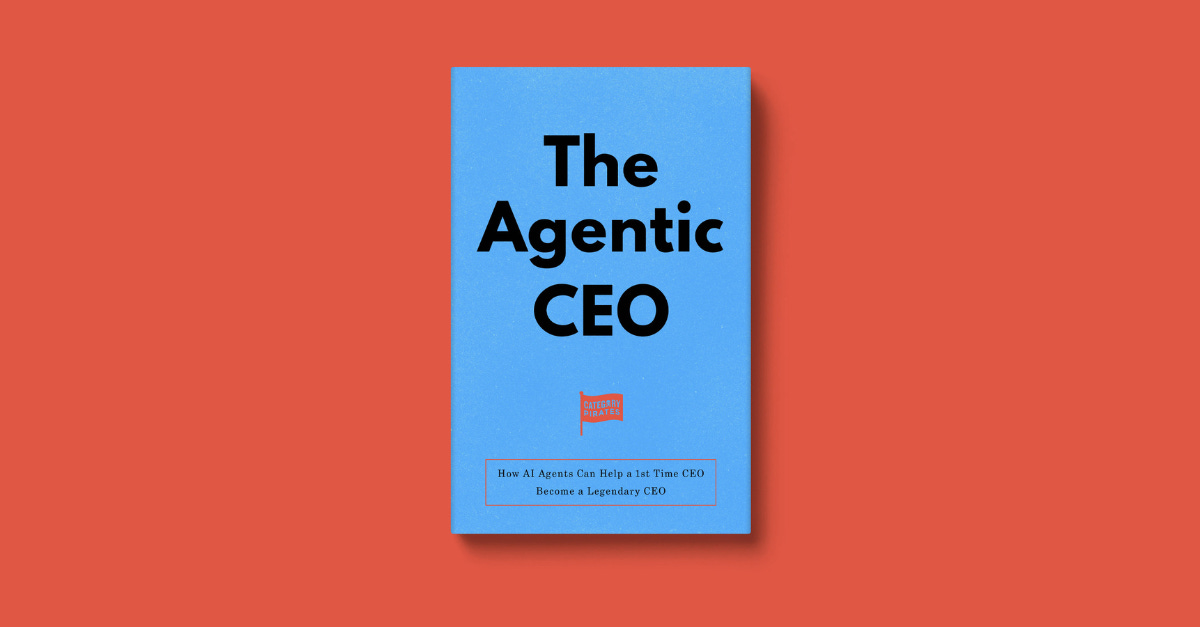
This mini-book is for aspiring, up-and-coming first-time CEOs.
We want you to succeed and create massive abundance.
AI Agents can help get you there faster, easier, and safer.
But you must navigate a few key problems & pitfalls with a piratey POV.
Demand for seasoned CEOs is growing significantly:
In 2022, 13% of the S&P 1500 had prior public CEO experience
In 2025, 21% of the S&P 1500 had prior public CEO experience
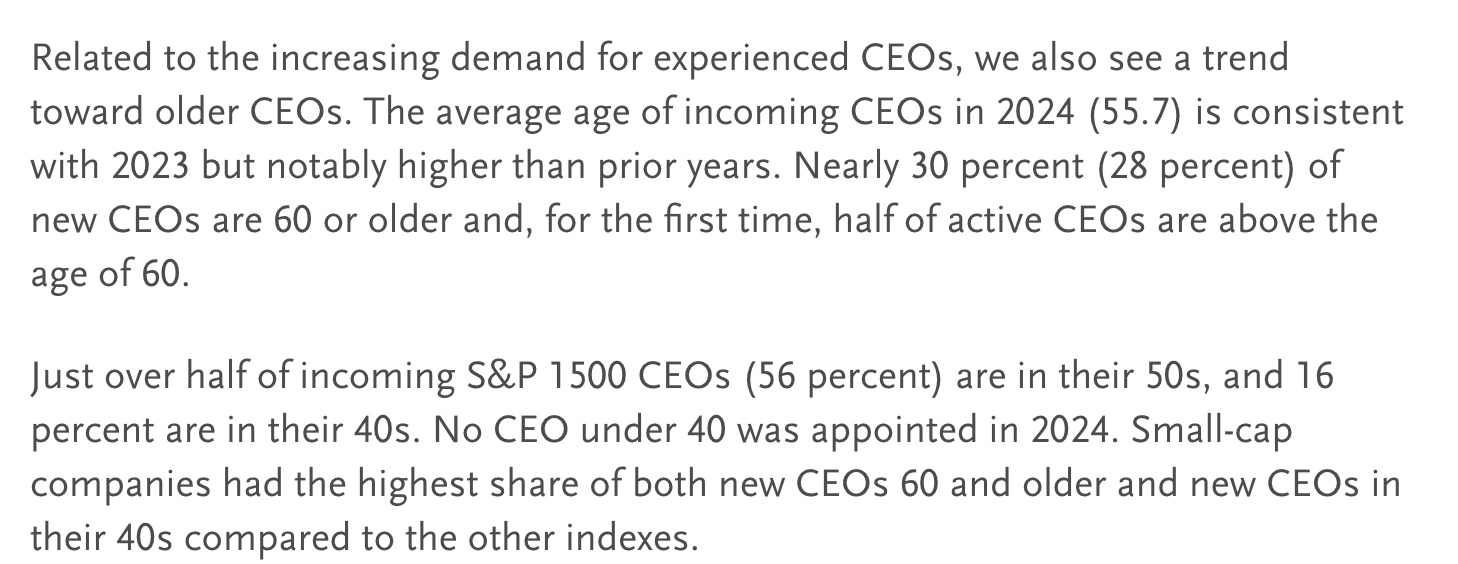
Boards of directors increasingly believe seasoned CEOs are a safer bet than a first-time CEO.
Of course, there are many legendary first-time CEOs like Mark Zuckerberg at Meta, Patrick Collison at Stripe, and Brian Chesky at AirBnB.
(They are founder/CEOs.)
Many first-time CEOs flame out, from Travis Kalanick at Uber, Adam Neumann at WeWork, and Andrew Mason at Groupon.
But none are more famous than Steve Jobs.
Jobs founded and took Apple public at 25.
He was famous for parking lot firings and belittling teams.
Jobs was ousted at the age of 30 and replaced by John Sculley, who was 44.
Jobs would later say, “I didn’t see it then, but it turned out that getting fired from Apple was the best thing that could have ever happened to me.”
(Never forget. People who create the different categories of the future. As often despised by people who profit from the status quo.)
He founded NeXT. The hardware failed, but the software that became the core of iOS emerged. He bought Pixar and learned how to trust and delegate since he wasn’t an animator or storyteller. But not even Pixar could imagine what happened next:
11 years later, Apple bought NeXT for $429MM.
Apple reported a $700MM loss and installed Jobs as CEO.
Jobs called his arch nemesis, Bill Gates, humbly asking for a $150MM investment.
Without Bill Gates’ investment, Apple would have been liquidated. No Macbook Airs, iPhones, iPads, or AirPods. Four trillion dollars of market cap. Gone.
Because Jobs became a seasoned CEO.
He traded in complexity and chaos for simplicity.
He avoided Competition Derangement Syndrome to work with an enemy.
He owned three crucial things: The strategy, the people, and the numbers.
It took 10 years of pain and suffering for Jobs to get there.
Today, you can use AI Agents to get there in 10 months.
Dodge The 1st Time CEO Complexity Trap
1st time CEOs today aren’t failing because they lack intelligence or commitment.
They fail because they are insecure. They get convinced to use complexity as a mask for confidence.
We know executives who were (actually) taught to speak in complexity to create the air of being smarter than everyone.
It’s natural to feel insecure when you do something for the first time. But too many 1st time CEOs rely on complexity to boost their confidence. A CEO who grew up in sales might talk about how sales is more art than science. A CEO who came from finance will create 200+ dashboards.
They’re failing because complexity creates a system that becomes too heavy to move. They operate inside a constant swirl of dashboards, data, meetings, updates, requests, and decisions. Every department needs attention. Every channel produces signals. Every executive has a different interpretation. Instead of leading, the CEO becomes a full-time processor of noise.
Instead of doom scrolling the Internet, CEO’s fall into the “fire-fighter-by day, arsonist-by-night” wack-a-mole of the urgent instead of dealing with the important.
Not the important.
Or the strategic.
This is how complexity takes over.
It accumulates through well-intentioned additions that no one ever subtracts.
A new initiative. A new approval loop. A new dashboard. A new “quick sync.” Each one is small and justified. But together, they form a system of stupid, where simple decisions feel slow and where no one is sure what actually matters.
Early in Pirate Christopher’s CMO life he was at an early and failing CRM company, Vantive. Competitor Siebel was kicking their asses. And instead of committing to a category design strategy to lead the market, Vantive’s first-time CEO decided he needed more control over “his” company.
He mandated a draconian version of Japanese Kaizen controls while Siebel’s focus was leading the category.
Vantive focused internally. Documenting and measuring as many business processes as possible. You know what happened next.
Siebel continued to kick Vantive’s ass.
Our Monday exec staff meeting used to be a civilized two hours in the morning. After Kaizens (a “continuous improvement” system designed to expose issues in real time), the CEO moved it to 3 p.m.—where it reliably devolved into CEO whippings that ran until 9 p.m.
After a few quarters.
Vantive’s demise was accelerating.
During one of these beating sessions, Pirate Christopher turned to the Head of Product and asked, “What do you think we can do to beat Siebel?”
To which he responded.
“Give them Kaizens.”
Siebel became the fastest-growing software startup in US history.
Vantive became a large, sad, economic crater.
When the CEO is the only person who can untangle a complex system, the business stalls.
Most CEOs respond by doing more.
As do most execs.
They stay in more meetings, personally referee misalignments, and carry the invisible burden of uncertainty for everyone around them. But more effort magnifies complexity. Because the more meetings you have, with more and more people, the more nothing you get done.
Everyone wants a part of the CEO. And the CEO loves it. In Silicon Valley today, they call it going into “founder mode.” When the CEO proactively buys into the idea that they are so smart, so legendary, they have to be everywhere.
And as the company scales, the CEO tries to gain more control.
When everyone sends problems upward, the CEO becomes the clearinghouse for decisions the system can’t make on its own.
The company starts running on escalation.
Instead of execution.
This is the Complexity Trap—the accumulated cost of unclear priorities, bloated workflows, and cognitive overload that slows execution and destroys enterprise value.
It shows up in slower decisions because people hesitate.
It shows up in talent misalignment because no one has a shared definition of success.
It shows up in the CEO as exhaustion from the constant work of separating signal from noise.
The real tragedy is that no one teaches CEOs how to avoid this trap.
The default advice is “communicate more,” “be more visible,” or “trust your instincts.”
The answer to every problem is not more of the same.
It’s often different, not better, that works. Because more of the same will get you the same.
None of these solve for complexity. They only force the CEO to absorb more of it. The only way out is to redesign the conditions that create complexity in the first place.
Now that you see the trap, it’s time to learn the new responsibilities required to escape it.
Avoid Competition Derangement Syndrome (CDS)
CDS is like cancer.
If you catch it too late, it is deadly. If you catch it early, you can treat it but it can come back. If you have a family history of cancer, you must be extra vigilant.
The best companies fall prey to it.
Zuck created Threads to compete with X.
Ballmer launched Zune to compete with the iPod.
Bezos tried the Amazon Fire Phone to compete with iPhone.
CDS is, at best, a distraction.
Need more proof? When was the last time you enjoyed a RedBull cola? Or picked up something from the Microsoft store?
Chasing existing competition in existing markets is arguably the biggest career mistake CEOs make.
Just ask Vantive shareholders.
But at worst, CDS imprisons you in the past and present. It prevents you from creating the future. And the future needs you. Now.
1st time CEOs fall prey to CDS all the time.
They hire too many people from the competition. They waste resources reverse-engineering existing products. They focus obsessively on matching and blunting competitor moves.
They dumb down the strategy to monkey see, monkey do. That’s when monkeys start flinging sh*t at each other.
They train themselves to be followers, not leaders. They lose sight of the superconsumer.
Ron Johnson became CEO of JCPenney, fresh off his success creating the Apple stores within Apple. But he didn’t realize he was taking an ultra-expensive solution to a low-profitability company. Sales dropped 25%, and he was fired in 17 months.
Not to mention. Ron went from category designing the future of retail, to saving JCPenney, a (former) category in free-fall. People whose strategy is to cling to the past (as long as possible) almost always fail.
Terry Semel was brought in to save Yahoo, the leader in the Internet portal category.
At the exact time, Google was category designing the future as Search.
You know how that movie ended.
7 Smart CEO Tips to Drive Simplicity, Smash Complexity, and Leave CDS Behind
Clint Carnell is an ‘old, young guy.’
(Don’t tell him we said that.)
He’s at the age when most people get their first CEO gig, but he’s been a CEO more than a half dozen times.
Including two companies he founded from his garage, two private companies backed by venture capital/ private equity, and two publicly traded companies. One of which he took public at $1.1B to over $4B market cap when he left.
He’s made a lot of people a lot of money.
That is important because CEOs have one job above all others: to increase (enterprise) value.
(That’s it. Success in business is easy. Create massive value for others. Take a small percent of the value for yourself. And today. You have to create value with AI.)
His investors love Pirate Clint because of the outcomes he delivers. Employees follow him like a Golden Retriever because he helped them achieve heights and wealth beyond their dreams. Most founders can’t scale their business like Pirate Clint. Most large company CEOs can’t create new categories like Pirate Clint.
Which is why everyone wants Pirate Clint to be their CEO.
But what makes Pirate Clint truly legendary is that he was often running multiple companies at the same time as CEO, Elon Musk style.
Does Pirate Clint work hard? Yes.
Is he smart? You bet.
But four things truly set Clint apart.
He simplifies strategies onto one page to accelerate execution.
He executes a 2-hour per week process that forces action and accountability.
He instills belief in his teams to drive 10x breakthroughs that bend time and reality.
He is a CEO who can build, buy, and manage all at the same time, when most CEOs do only one.
One-page strategy. 2 hours per week leadership meetings. 10x business outcomes. Mixed martial artist CEO.
Most employees would love to work for a CEO who did just one of those things.
His teams don’t spend their days negotiating turf. Or debating priorities. They execute like a hall-of-fame championship team, or elite peacekeepers in a crisis.
Because their path is clear.
They drive towards goals that were so audacious they would dry heave, had it not been for Pirate Clint’s belief. They watch and learn as Pirate Clint flexes between Builder, Buyer, and Manager CEO. They achieve more together than they could have imagined.
This leads to some weird data about Pirate Clint.
People he has fired often come back to work for him again and again.
Pirate Clint fires people when they create confusion, unnecessary friction, or erode belief in ways that hinder the mission. He’s ruthless about outcomes—which, ironically, is kind to people—because it teaches that outcomes are what matter most. He doesn’t fire out of spite or politics.
When his people leave, they realize they crave the simplicity, accountability, and belief that Pirate Clint provides and seek to come back.
(It turns out A players love and want accountability. C players, not so much. Any time you see an executive pushing responsibility elsewhere, it’s a massive red flag.)
Today, companies and investors fight over who gets Pirate Clint’s time and talent.
In the age of AI and Agents, Pirate Clint can be available in abundance.
Pirate Clint can multiply himself and his impact across even more companies via AI and AI Agents. New CEOs can dramatically accelerate their learning with AI Pirate Clint, coaching them along the way. Investors can evaluate CEO candidates for their portfolio companies with AI Pirate Clint advising them.
How can a new CEO do this?
Per Pirate Clint, a legendary CEO owns three areas:
The strategy
The people
The numbers
All three have the same enemy. Complexity and CDS.
Here are seven things Pirate Clint does that you can use to crush complexity and CSD, simplify strategy, and accelerate execution to drive massive outcomes.
1. Focus On One Key Metric
Most CEOs think their job is to show command of their business to their teams, boards, and investors.
A CEO should, of course, know their business and their numbers. But far too often it leads to falling in love with complexity and minutia. So, they spend their days in meetings, reacting to 200+ page PowerPoint dashboards, approving plans, managing personalities, and trying to sound confident while sifting through endless noise.
The truth is, great businesses often have one metric that matters more than anything else.
Gillette’s is RPUPY, or revenue per user per year, pronounced ‘Ruppy’ like Puppy.
Southwest Airlines has a 10-minute turnaround between flights.
Slack is 2,000+ messages sent per team.
Costco’s is Executive Memberships.
Tesla is Miles Driven on Autopilot.
Facebook’s is Daily Active Users.
SpaceX is Cost Per Ton to Orbit.
Netflix’s is Total Hours Viewed.
Walmart is inventory turnover.
AirBnB is nights booked.
Some of these emphasize operational and cost leadership, like Southwest, SpaceX, and Walmart. But those tend to translate into lower costs, which benefits customers. Others lean on customer behavior, like Gillette, Slack, Costco, Facebook, Netflix, and AirBnB. But each of those customer behaviors also represents excellence at the operational level too.
But we love the weird and specific ones, like Slack and Southwest. Why is the magic number 2,000 messages and 10 minutes? We’re not sure, but we’re confident it was born out of a lot of Category Science and analysis.
This is what too many CEOs miss.
They leave an open seat at the leadership team table for complexity.
They expect their leaders to produce endless data and dashboards.
Leaders spend more time prepping for meetings than running the business.
Legendary CEOs go through the weird data and complex analysis in the first 100 days of taking the job, dramatically simplify it, and leave it behind.
The job is to reduce drag on the business and increase wisdom inside the business.
This might seem hard.
It is.

Pirate Clint can do it because he has cross-functional depth and breadth. He grew up in sales, but worked in finance doing M&A. He’s a brand builder/marketer like no other, which makes him a master communicator to his teams, customers, and investors. He’s taken companies public and in and out of bankruptcy, giving him great operational chops. He knows how to lead boards and investors, because he himself is an investor and board member.
The good news is AI and AI agents make this much simpler to borrow cross-functional expertise.
Here’s what you can do now:
Start with the size of prize. You have to know how high is high first.
Use AI superconsumers to turbocharge and improve your size of prize.
Ask AI to deconstruct your size of prize into simple variables that drive it.
Upload quarterly data about the financials of the business with those three variables.
Ask AI to run correlations to see which of those variables are most correlated with what financials.
Pick the metric that matters most and ask AI to make it stupid simple to measure, track, and share.
You might get it perfect right out of the gate. Or you might get it 85% right, and then someone five levels down says something so insightful you tweak it.
Either way, get started, don’t wait for perfection.
2. Put Your Strategy On One Page
Here’s the brutal reality.
A strategy is not a document, a deck, or a once-a-year planning cycle. That’s the annual strategy planning trap.
A strategy is a forcing function that drives the company to move fast with less effort. If execution doesn’t get easier, the strategy isn’t a strategy.
It’s a word salad.
Category Design teaches this clearly: categories are built by establishing a point of view, naming the problem, and aligning the entire system around a simple way forward.
Strategy works the same way.
When you name what matters, you make everything else irrelevant.
That’s why Clint doesn’t drown people in ideas. He reinforces and niches down on the category problem and a radically different POV until everyone marches in the same direction. The goal is to eliminate paths that drain resources and don’t build momentum. You want to clarify the problem you solve and the future you are building toward.
That means repeating the direction until it becomes the company’s default setting. Never forget that complexity is a cancer that spreads ruthlessly and relentlessly.
Complexity begets complexity.
If your strategy is complex, no one will remember it. We mean no one.
Complexity teaches your team that complexity is good. Numbers become complex. Communications become complex. Soon, no one knows what they are doing. Or why.
Why do we believe strategy is complex? Because an army of consultants and academics who depend on the quarter-trillion-dollar consulting industrial complex need you to believe you can’t do it on your own.
So they can do it for you at huge fees, also known as the Big Strategy Lie.
Pirate Eddie is guilty of this in his career. It’s also why he wrote Superconsumers to simplify strategy.
Simplicity begets simplicity. Simplicity is velocity.
If your strategy is simple. Every subsequent decision will be simpler still.
This is why Pirate Clint writes a one-page strategy for every business he runs. He jokes that if a salesperson sees a memo with a staple in it, they won’t even read the memo.
Remember, every idea, strategy, and plan you create has to compete with 10-second TikTok videos for brain space. Executives who write long emails or create long videos get ignored.
Jim Kilts was the CEO of Kraft and Gillette. He achieved massive outcomes in CPG, including selling the latter to P&G for $56 billion dollars. When his leaders would present to Jim, there was one sentence they hoped to never hear.
“You know, I’m a simple man…”
When they heard that, they were crushed because it meant their presentation was too complicated. Not that Jim wasn’t smart enough to understand it. But Jim was saying they hadn’t truly mastered strategy enough to make it crystal clear to the rest of the organization.
“Any scientist who couldn’t explain to an eight-year-old what he was doing was a charlatan.” Kurt Vonnegut, from his novel Cat’s Cradle.
Never forget. The average person in business is average. Warren Buffett reminds us:
“I try to invest in businesses that are so wonderful that an idiot can run them. Because sooner or later, one will.”
Your ultimate goal is to get a one-sentence strategy.
One of Clint’s companies is OrangeTwist, a top 5 medical aesthetics retail chain. OrangeTwist’s one key metric is revenue per hour per treatment room. It’s a blend of customer demand, pricing power, and productivity. Here’s how simplicity cascades more simplicity:
The provider wants to increase revenue per hour per room.
The best way to do that is to sell a super-premium bundle of treatments.
To sell a super-premium bundle, the provider must earn the customer’s trust.
To earn trust, the provider must have deep empathy for an important customer problem.
To express empathy, the provider must lead with listening and then with a great outcome.
To have a great outcome, the provider must lead with their best treatment with the most immediate outcome, least discomfort for the greatest price…a medical facial like HydraFacial.
Simple. Easy. How does a CEO figure out the one metric that matters?
You need a 100-day process to build a one-page strategy as Pirate Clint does.
Strategic Learning Process by Willie Petersen
SWOT analysis
FROTOs (from to’s)
Superconsumers/Super-Geos/Super of 1 = Super of 9
Value creation drivers
1-page master plan
Pirate Clint is not re-inventing the wheel, but instead borrows from the best of Category Design, Superconsumers and common sense.
AI can help you with each of these steps. Especially the superconsumers, super-geos, and super of 1 = super of 9 parts.
Pirate Clint shows what happens when a CEO removes complexity from strategy. And then permanently invites simplicity to the leadership table via one metric that matters and strategy on one page.
