


Welcome to Category Pirates. Each week, paid subscribers get one radically different framework for turning what you already know into a category you own, instead of a market you fight over. Sign up for a Founding subscription to ask the Pirate Eddie and Christopher Bot your category design questions and get complimentary digital copies of all 7 of our big books.
Dear Friend, Subscriber, and Category Pirate,
The legendary founder of Interview Valet, Tom Schwab joins us as a co-author for this mini-book, Part 3 of our Podcast Category Design Series (Part 1 and Part 2 are here.)
He’s helped over 1,500 clients book 75,000 appearances on Podcasts. Interview Valet is the Category King of podcast booking. Folks like the CEOs of super ding-dong consulting firms reach out to Interview Valet, just like Pirates Christopher and Eddie did for Play Bigger and Superconsumers respectively.
Pirate Tom has seen some amazing guests crush it on great podcasts.
And he’s seen some crash and burn. But it’s not really a loud disaster as it is a quiet whimper. When a legendary thought leader is lame on a podcast, they go quietly into the night.
They become forgettable.
Pirate Christopher knows this well, as the host of two top 0.5% podcasts in the world. He’s seen his share of fabulous to forgettable guests. He is sometimes called “one of the Godfathers of Category Design.” A guest on his podcast once asked him, “So, how did you get into design?” Christopher and every listener knew exactly how much homework she had done (none). The guest was smart, accomplished and had important POVs to share.
And the lack of preparation made the guest a donkey.
🔊 Want to listen to this mini-book instead? Head to the audiobook.
Media training is smart. Knowing your talking points is smart. Having a sharp sound bite ready is smart.
It doesn’t make you legendary.
The lack of prep makes you look at best flaky and at worst fake. The podcast’s superconsumers stop listening. No word of mouth happens so downloads stay low. And when the guest wants to come back in the future, the host says, “Who? I don’t remember that guest. No thank you.”
Pirate Christopher would not have that guest back on.
The truth is, long-form is a lie detector.
Are you happy to be on the show? Nope. Do you want to help the listeners with your wisdom? Or do you just want to sell your book and move on?
Anyone can fake a performance for a short TV segment.
Nobody can fake one for an hour. Somewhere in a long conversation, the talking points run out. And the real person shows up.
You can see it in Bill Maher’s work.
Real Time on HBO is highly produced. Practiced. Scripted. Edited. Time constrained. His podcast, Club Random, is loose, easy, and conversational. Both can be entertaining. Both can be informative.
But one is a manipulation and the other feels real.
That’s why podcasts are the last medium for authentic dialogue. So the question isn’t whether the audience will meet the real you. They will.
The question is whether the real you is worth meeting.
If you have, are going to or want to guest on a Podcast, this is a must read for you.
There are seven types of Donkeys you don’t want to be as a podcast guest. So we created the three things you must do before and the three things to do after a podcast to not be a donkey. And we end with an AI diagnostic you can use with the Pirate Christopher, Eddie AND Pirate Tom Schwab bot (never before offered in a special founding tier offer launching Monday) to build a feedback loop for your podcast appearances to help you be legendary and the talk of the town.
The Pirate Eddie and Christopher bot you can buy anytime for $375/year.
The Pirate Tom Schwab bot has never been available for sale. Tom may not decide to offer it again after that. But for a limited time only, you can buy a super ding dong bundle of the Category Pirates Founding Tier plus the Pirate Tom Schwab bot for $500/year. Keep an eye on your inbox Monday.
If you’re already a Category Pirates Founding member and want the Tom Schwab bot, ping us and we’ll make it available for you to buy.
The Seven Donkeys of Podcast Guests
If you’re a Podcast superconsumer, each of these types of Podcast Guests will be familiar.
Most of the time, this person in normal, real life situations is nothing like this. This is who they become when the recording starts. Sometimes this is because of the wrong media training. Or the guest can be nervous.
But sometimes the root cause is far more fundamental.
Some guests have never been told the truth. That you’re boring, confusing or not funny. Sometimes the guest can’t read the room and pick up on feedback.
These folks can fix the issue by just listening to your podcast after the fact.
Some guests don’t want to be there. They think the podcast is beneath them. They just want to sell books or promote their product. So they don’t prepare and do the bare minimum.
It’s really hard to convert mercenaries into missionaries.
This is why we’re sharing the seven donkeys of podcast guests. Because someone needs to tell you the truth. So we hope you hear this with love, as our goal is to help not hurt.
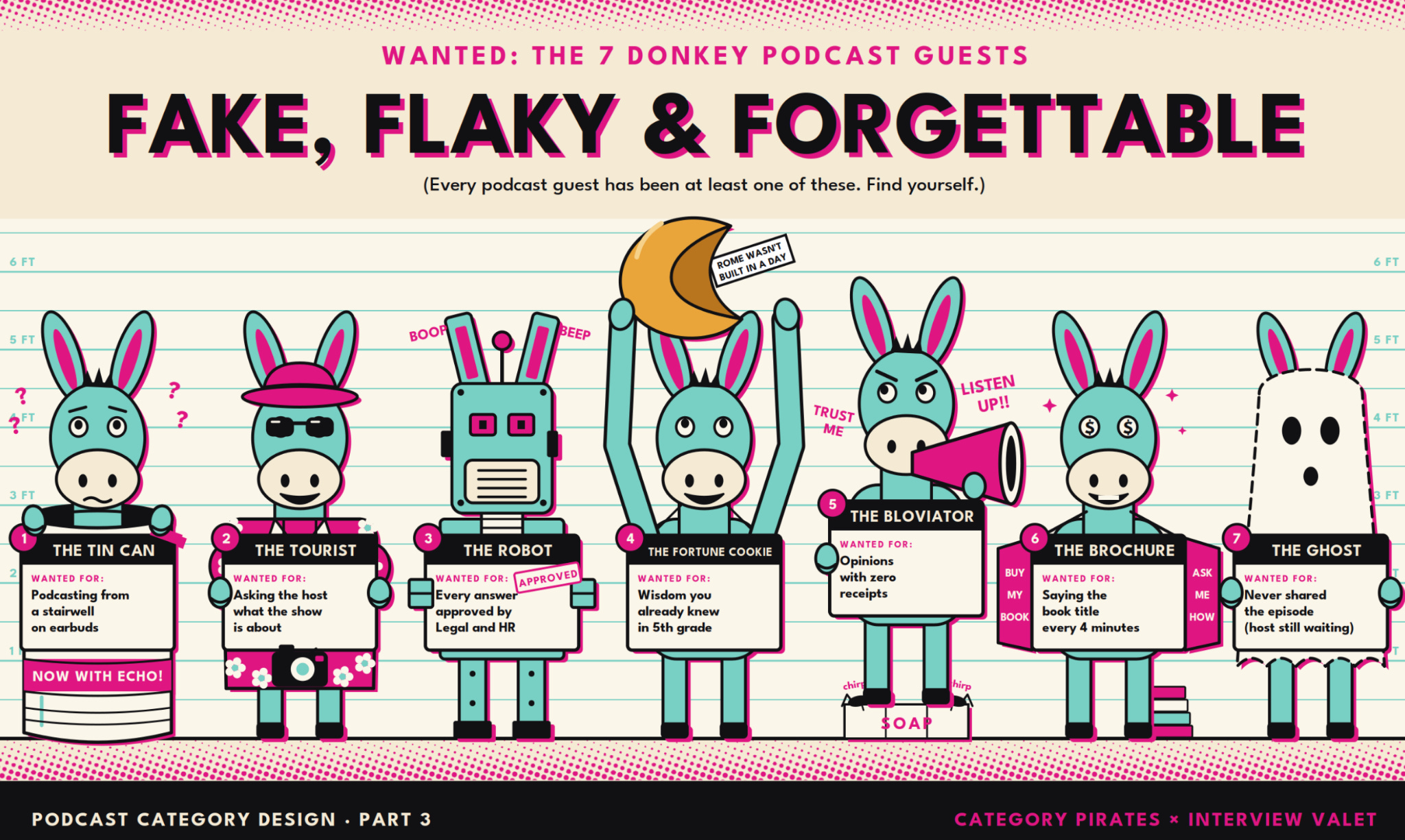
1. The Tin Can. This person has terrific ideas and terrible audio. Do the Pepsi challenge and listen to what audio sounds like with a great setup and listen to it with a lame one. This takes five minutes and you have to hear it to get it. Poor quality is one of the fastest ways to lose an audience, no matter how good the ideas are.
2. The Tourist. This guest shows up without doing the homework and wastes time asking for directions. Doesn’t know the host, the show, or the audience. Ask one lame question and you’ll lose half your audience. Ask two, and you won’t get asked back.
3. The Robot. This guest is PR/HR/Legal person’s dream and every podcast hosts’ nightmare. Every answer has to be approved. Every edge sanded off. This person is technically fine and instantly forgettable. If the listener closes their eyes, you can almost see the lawyer’s hand up their butt, moving their mouth.
4. The Fortune Cookie. This guest is mostly content-free-content. They drop one saccharine saying after another, as if they are playing obvious quote bingo. Their answers are an inch deep and a mile wide, all sizzle and no steak, and if you call them on it they simply smile and tell you Rome wasn’t built in a day, so you have to take it one day at a time. Are you asleep yet?
5. The Bloviator. This person is all feelings, no facts. They parrot a position, then build on it with adjectives, analogies and aphorisms that are the empty calorie diet of Doritos, drive through at McDonalds and a dozen donuts. If you probe them, they double down on bluster. A smart host will slice their POV to shreds, generating the wrong kind of word of mouth.
6. The Brochure. These are folks who don’t understand that the more you sell, the more you suck as a guest. They name drop their book, company or product/service as if they were playing a drinking game. They are masters at judo flipping every question into a chance to pitch their offer.
7. The Ghost. These are guests who forget that there is more work to be done post podcast. They have to share the episode and summarize it. They should slice and dice the episodes into shareable bites that go across LinkedIn, YouTube, X and Substack Notes. They have to get into the comments and engage. They should re-listen to the episode to improve for the next time.
How to Flip the Script and Be a Legendary Guest
For every Joker, you have a Batman.
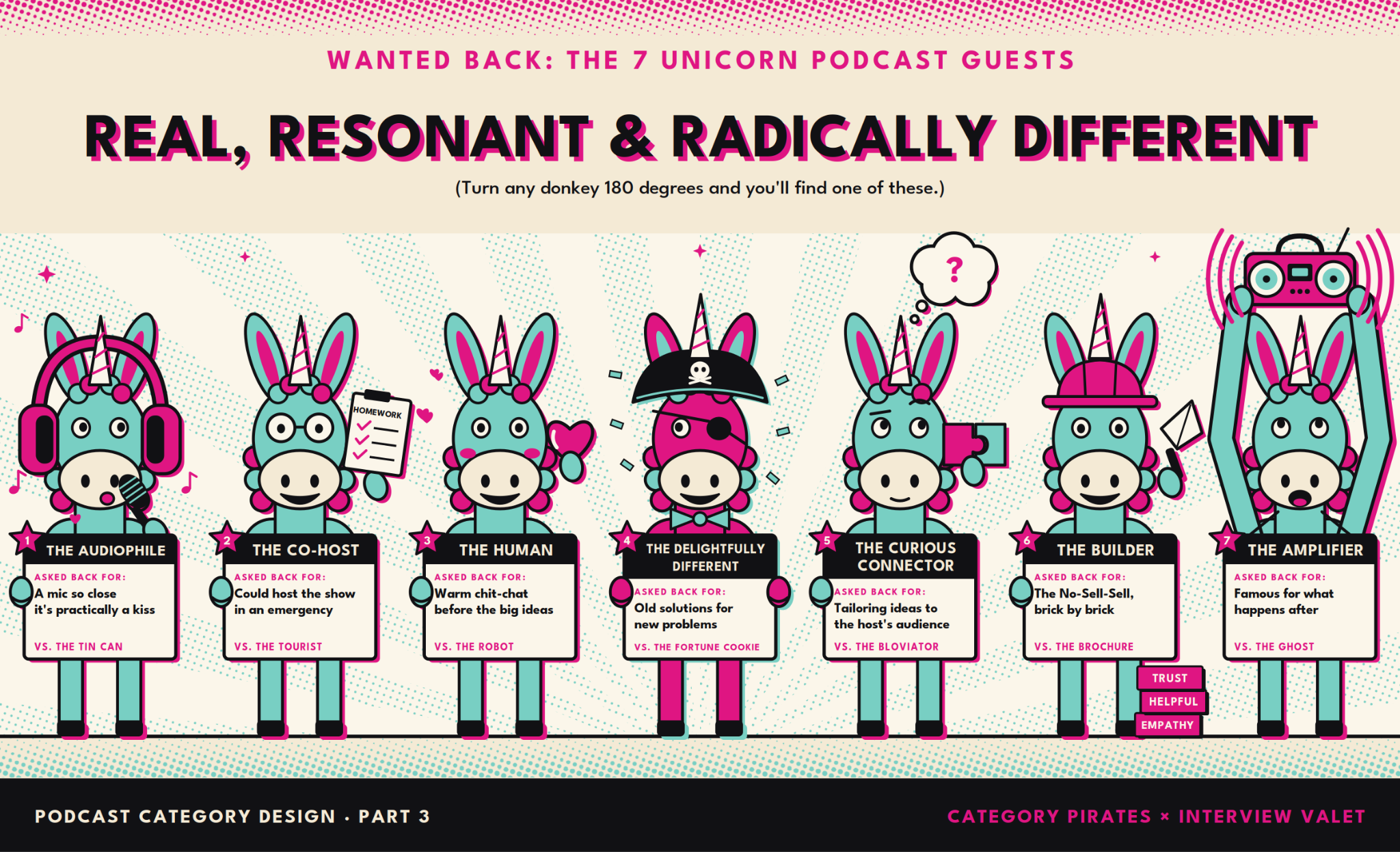
If you want to be legendary, take each of the Donkeys and do a 180 turn and you’ll find what an amazing podcast guest looks like. Here are each of the 7 podcast guest heroes, not zeros.
1. The Audiophile (vs. the Tin Can). You don’t have to spend a fortune to get a quality microphone, so your voice sounds as smooth and rich as it is in real life. You want it to feel like you’re sitting in the same room. Keep the microphone so close it’s like you’re kissing it. Wear headphones so there is no echo.
2. The Co-Host (vs. the Tourist). Aim to know the host, the show, and what the audience already knows so well, you could actually host it in an emergency. Homework is a form of respect. Listen to one of their top episodes. Hosts notice. So do listeners.
3. The Human (the Robot). Show up as a real person, not a press release. Most guests on Pirate Christopher’s pod loosen up around the 20-30 minute mark. Don’t be afraid of a bit of chit-chat at the outset so you build some warmth and shared connections and experiences. People want to eavesdrop on a conversation.
4. The Delightfully Different (vs. the Fortune Cookie). To be a thought leader, you can’t regurgitate the same thoughts. But the bar is not as high as creating a new element on the periodic table. Take an old solution and apply it to a new, non-obvious problem. Take an obvious POV and niche-down. Lean into your different, to make a massive difference for others.
5. The Curious Connector (vs. the Bloviator). You are there to provide your POV, but it doesn’t mean you can’t ask good questions yourself. Take your talking points that you’ve said a thousand times, and apply it to a specific part of the host’s audience. Connect your ideas with the hosts. There’s a reason why chocolate and peanut butter is the #1 chocolate in the US.
6. The Builder (vs. the Brochure). Do the No-Sell-Sell several times before you even consider pitching your wares. The host sells your book in the intro, when they tell listeners who you are and why they should care. Your job is to share your insights, wit, wisdom, and stories in a way that’s conversational and, dare we say, fun. The audience builds trust. Trust sells the book.
7. The Amplifier (vs. the Ghost). Be the guest that is more famous for what you did after the podcast than during it. Be generous with your audience and share it on social media. Amplify another episode that the host did, and connect it back to yours. Be radically generous, and be prepared to be surprised at how much more generosity comes back to you.
Aim to be one of these Unicorns, not a Donkey!
Five Crucial Questions to Answer Before You Podcast
Most podcast guests try to fix a bad interview by booking more interviews.
Pirate Tom Schwab has a Navy phrase for this: doubling down on stupid. He has done more than 500 interviews himself. When an activity isn’t working, doing twice as much of it gets you to the wrong place faster.
The good news is five questions will help you improve exponentially as a podcast guest.