


Welcome to Category Pirates. Each week, paid subscribers get one radically different framework for turning what you already know into a category you own, instead of a market you fight over. Sign up for a Founding subscription to ask the Pirate Eddie and Christopher Bot your category design questions and get complimentary digital copies of all 7 of our big books.
Dear Friend, Subscriber, and Category Pirate,
Pirate Shelly Rood wanted to start a podcast eight years ago.
She was eight months pregnant. A trusted mentor told her to wait. So she did.
But it became too hard to keep her wisdom trapped in her head. She said it was like, “lightning in my head.” She finally hit record in July 2025. It felt like swimming in mud. Then a friend told her about Category Design. And it freed Shelly to be Shelly.
She thought she was too late.
The US military community didn’t think so. They want Pirate Shelly to run their podcast for them. She couldn’t believe it at first, but then realized they wanted her because “they are watching me do it.”
Pirate Christopher was told he was too late to the Podcasting party.
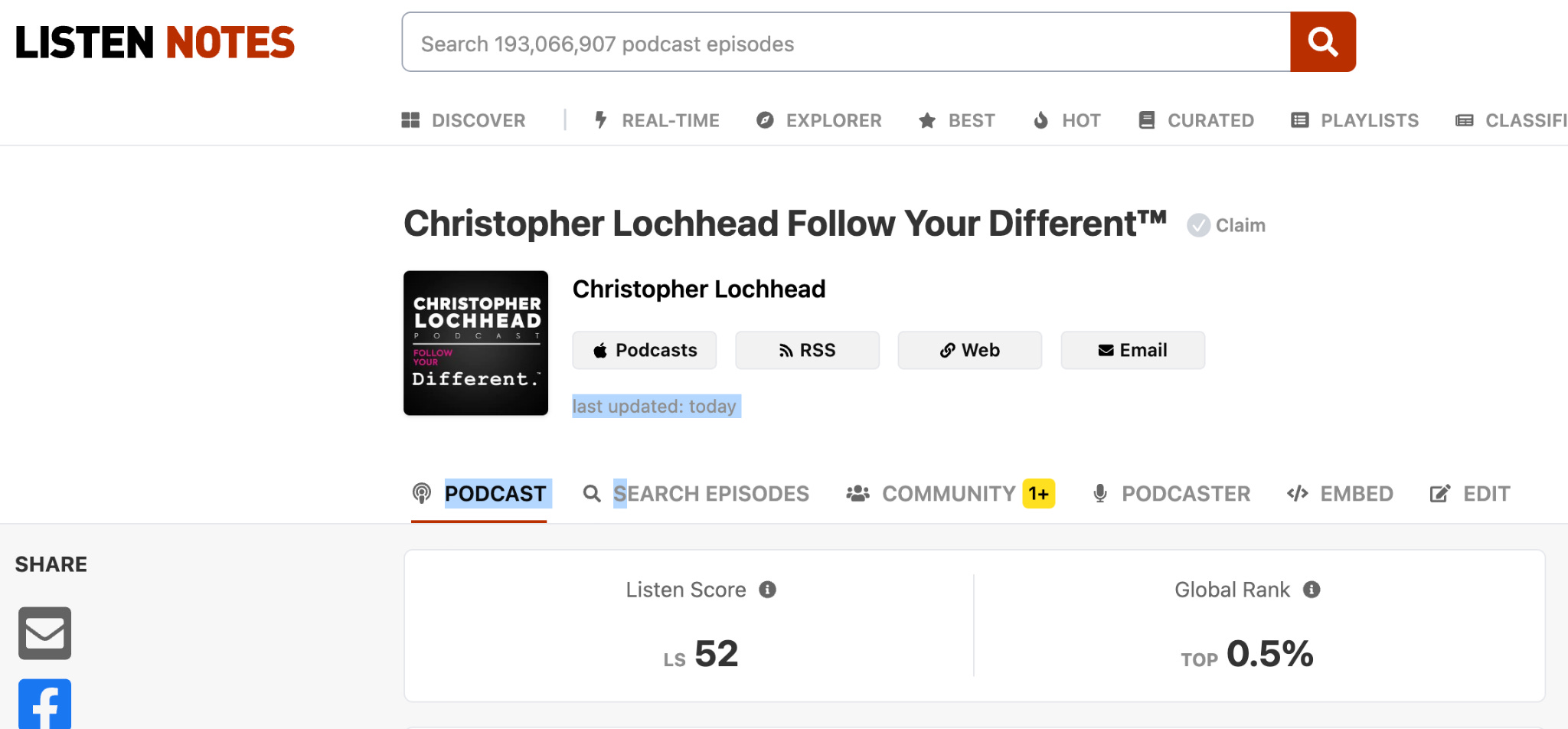
That was 9 years ago. He has two top 0.5% podcasts, Follow Your Different and Lochhead on Marketing. He’s been able to jam with powerful and prescient authors, athletes, leaders, and movers and shakers on a myriad of topics.
He receives love notes from listeners from over 180 countries.
Pirates he never would have met otherwise. People tell Christopher his podcasts changed their lives. Category Pirates would likely not exist without Pirate Christopher’s podcasts. So many of our Substack subscribers said they started out listening to his podcasts.
To think he nearly pooped his pants right before the launch of Lochhead on Marketing!
🔊 Want to listen to this mini-book instead? Head to the audiobook.
Podcast Category Design.
This is not the 4,327th how-to podcast guide.
This is the first deep discussion on podcast category design.
What makes my podcast different?
What category is my podcast?
What problem does it solve?
Who is the Super for this?
So what you’re about to read is podcasting through the category design lens, all based on the lessons learned and battle scars from Pirate Christopher as he built a Top 0.5% global podcast.
We’re going to answer five big questions about Podcasts in two mini-books.
Part 1: Strategy and Design
Why should I care about podcasts?
How do I design a different podcast?
How can I be sure I’m not a donkey?
Part 2: Execution and Practical Tips
What are the main traps to watch out for?
How can my podcast kickstart a nonstop flywheel of Intellectual Capital?
Question 1: Why Should I Care About Podcasts?
If you want your own Intellectual Capital, you should care about podcasts.
We knew someone who was discouraged by our book, Creator Capitalist.
That was not the reaction we were hoping for. This person got the value of the Four Capitals: Reputation, Relationship, Financial, and Intellectual Capital. But was disappointed because she did not have any Intellectual Capital of her own. She knew all her Intellectual Capital came from others.
That’s where everyone starts.
None of our Intellectual Capital is built from scratch. Everyone’s ideas start with someone else’s ideas. We aim to stand on the shoulders of legends.
And we believe everyone has unique Intellectual Capital that can make a massive difference in the world.
And podcasting is the easiest way to get the Intellectual Capital party started.
If you’ve always believed you have valuable Intellectual Capital to share but haven’t figured out how to share it, enter the podcasting category. If you are a reluctant expert but are shy, introverted, or busy, you should look into podcasts. If you’ve ever wanted to write a book, start a Substack, build a Customer Diagnostic, get on CNBC, write for HBR, create a course, or build any kind of Intellectual Capital, start with a podcast.
Podcasting is the easiest way to crystallize, create, and commercialize your Intellectual Capital.
Unlocking Trapped Wisdom is the Key to Digital Treasure
You are much wiser and smarter than you know.
Your net worth is so much higher than you realize. You are a thought leadership beast in the making. We believe this from the bottom of our pirate-y hearts.
You have Trapped Wisdom.
Some Trapped Wisdom is stuff you are unconsciously competent at, a phrase coined by Noel Burch. This is when your skill becomes second nature, kind of like driving a car or riding a bike.
Or knowing when an annual National Sales Meeting flops because of Narrative Slop that Pirate Kristi Faulkner sees, but most others miss. Or when Pirate Moyo Labode sees a retailer bleeding profits because their contribution margin ROI is going down even when sales are going up.
We learn legendary things along the way.
We pay with scars for our greatest learnings. Things that were once hard become so natural that we can do them without thinking.
The problem with Trapped Wisdom is that you often need someone else to point it out to you. One of Pirate Christopher’s favorite sayings (after hearing someone say something smart) is “Did you hear what you just said?” Interestingly, the person who said the smart thing often can’t remember what they said. Even a minute earlier. They aren’t dumb. They are so unconsciously competent, a super smart thing rolled off their tongue, and they just kept going. You do this all the time.
You don’t create Intellectual Capital alone.
Pirates Christopher and Eddie had numerous thought partners along the way. You need a fellow Pirate to Frame, Name, and Claim your Trapped Wisdom.
The idea that Bill Shakespeare was a one-man genius is garbagé, as the French say.
Behind Shakespeare’s legendary catalog sat a network of key collaborators: Christopher Marlowe lent early dramatic fire to the Henry VI trilogy, while John Fletcher co-wrote late-career titles like Henry VIII. Actors Richard Burbage and Robert Amin made the roles sing with seriousness and slapstick, respectively. Actor friend John Heminges saved 18 unpublished masterpieces from the trash, including Macbeth and The Tempest.
If you want to create legendary Intellectual Capital, you need partners.
This happens all the time in our Category Design Academy. A Pirate will be explaining something, and Pirate Christopher will interject, “Sorry to stop you, handsome. Can you say that again?” Or when Pirate Thomas Parrott was explaining how irritated he was when executives talk about Return on Ad Sales (ROAS) and how Contribution Margin was so much more powerful, and Pirates Eddie and Christopher started gesticulating wildly.
Trapped wisdom alert!
For your ideas, content, and category to take flight, it often needs someone else to see it, say it is special, and make you take notice.
Our friend Tom Schwab, founder of Interview Valet and podcast expert, says, "What’s ordinary to you is extraordinary to others.”
These moments happen all the time in podcasts.
Podcasts force you to think. And get clear. And when we start thinking, smart things happen. And when we’re forced to express our thinking, we’re driven to communicate with power.
Podcast guesting and hosting are potent ways to uncover your trapped wisdom (FRAME). The best way to figure out what to call it is to go on multiple podcasts and refine the languaging (NAME). The best way to own radically valuable, highly differentiated, massive problem-solving Intellectual Capital is to host your own Podcast (CLAIM).
Podcasts (aka Digital Treasure) Let You Talk to Strangers, Who Become Friends, Who Become Customers, at Scale
The best marketing is education.
Learning a clever and cheap solution to an old problem is a joy. Learning about a problem you didn’t know you had makes you feel grateful. Learning from someone who had the same problem, has already solved it, and is holding your hand through the process is transformational.
Most marketing does not make you feel joy, grateful, or transformed.
But a great podcast makes you feel all of those feelings and more.
If you care about getting new customers, you should care about podcasts. Winning new customers requires talking to a lot of people who don’t know or trust you. That’s what makes podcasts digital treasure.
But talking to strangers is not easy.
Malcolm Gladwell wrote an entire book about talking to strangers. One of the core ideas is that conversations with strangers are awkward because there is confusion about what kind of conversation they are having.
The category of conversation really matters when it comes to talking to strangers.
Is this a 3-second conversation for something urgent and important? Like ‘Where is the bathroom?’ Most people don’t mind being interrupted for something important and easy that they can help with.
Or is it a 3-hour conversation for something that doesn’t matter and can wait? Like, ‘Can I tell you my life story while I sit next to you on this cross-country flight where you are trapped?’ The same person can be very friendly in a 3-second conversation and icy cold in a 3-hour conversation.

Most marketers are trying to initiate long conversations in a world with a short attention span.
Many marketers are trying to tell their life story to a consumer who couldn’t care less, who wants to veg out and has their noise-cancelling AirPods on. Most marketing is from brands howling nonsense into a megaphone. In response, consumers have become ninjas at ignoring.
Podcasts are about education.
Podcasts allow prospective consumers to choose from a menu with a wide variety of educational conversations. Some are 3 minutes, 30 minutes, or 3 hours. Across an infinite number of topics. At a time of their choosing, when they are the most ready to receive it. Anywhere in the world.
For free.
Pirate Christopher’s podcasts allow him to talk to strangers in 190 countries. Even Tuvalu (we had to look it up too.)
Podcasts are the Most Intimate Way to Build Relationships
Most marketing is at arm’s length.
It is easy to ignore and keep transactional. The messaging doesn’t stick. Most times, you don’t even remember which brand is doing the marketing.
Podcasts are different.
Your voice is in their body. Not next to their ear. In it. It’s an incredibly intimate thing. They’ll grow to find comfort in your voice. From time to time, Pirate Christopher gets recognized by his voice. He’ll be standing in line for a coffee, and someone will ask, “Do you have a podcast?”
Just like your mother’s voice!
Podcasting has a very long value tail.
Podcasting has made an incalculable difference to Pirate Christopher and now Category Pirates too (The Pirate Street Journal Podcast.)
There are the obvious benefits.
Like hundreds of legendary conversations. The regular stream of love notes. The increased visibility. Podcasts are legendary top-of-funnel marketing.
A good podcast throws off new Intellectual Capital like a powder tail behind a snowboarder in deep powder.
Podcasts can function like an IC lab that can be monetized in many ways.
In a post-AI world, different Intellectual Capital that makes a difference in the world matter even more. Successful businesses and careers will be made from creating differentiated, high-value IC that solves new categories of problems for supers.
Podcasting was the foundation of the friendship between Pirates Christopher and Eddie.
Pirate Eddie and Pirate Christopher met before either started podcasting. Eddie was an early guest on Christopher’s podcast. That helped cement their connection. Opening the door to a much deeper relationship that ultimately led to Category Pirates.
Serendipity can be legendary.
Podcasting and writing also keep you visible, in a way that almost nothing else does. There are legendary business thinkers who have lost their visibility because they are not present in a meaningful way in the digital media landscape.
The Economic Value of Podcasts
Podcasts generate at least three great business outcomes.
It is the easiest way to create Intellectual Capital.
It builds Relationship Capital.
It’s how AI knows you matter.
We’ve written about the first two. Let’s talk about keeping you from being AI Invisible. Credit to Pirates Nick Kringas and Lydia Flocchini for creating the category of AI Invisibility in Personal Injury attorneys.
Your Podcast Has Two Audiences Now: Humans And Machines
For the first 20 years of podcasting, we asked one question: How many people are listening?
Today, that question is now radically incomplete. Because your podcast has another audience, AI. Every time you publish a podcast, you’re potentially adding to the public body of evidence about:
Who you are.
What you know.
What you believe.
What language you use.
Who you associate with.
What problems you solve.
What ideas you’re known for.
And critically, what category you belong in.
This matters because increasingly, people are asking AI about you.
Should I buy from you? Should I follow you? Do you really know what you’re talking about?
Welcome to your Machine Reputation.
Your analog reputation is what humans know about you. Your Machine Reputation is what AI says about you. And this creates a completely new way to think about podcasting.
Imagine you’ve published 250 episodes over five years.
That’s potentially hundreds of hours of you explaining your ideas (your guests, stories, expertise, language, frameworks, POV). And when those conversations also exist as video, transcripts, episode pages, show notes and clips, you’ve created a growing body of machine-discoverable Intellectual Capital.
Thanks to podcasts, your Intellectual Capital can beget more Intellectual Capital.
Your book explains the idea. Your podcast explores it. Your newsletter develops it. Your YouTube channel demonstrates it. Your website organizes it. Your community is where people discuss it. Your courses are where people go deep with it. Guests reference it. Search engines index it. AI systems can retrieve and synthesize pieces of it.
That’s not SEO or “content marketing.”
You’re building the public intellectual capital moat around your category.
A “Small” Podcast Might Have Huge Impact
Suppose your podcast only gets 200 downloads per episode.
But what would you say if you got invited to speak at a VIP conference with 200 people who care deeply about your category? What if those episodes have created hundreds of hours of deep, authoritative Intellectual Capital about an important category? What if those conversations become transcripts, videos, newsletters, articles, and clips? What if they generate links, citations, references, and conversations elsewhere? And what if AI systems increasingly encounter that body of work when trying to understand the category?
Suddenly asking only, “How many downloads did we get?” looks ridiculous.
Which means the economics of podcasting just changed. For 20 years, we measured the value of a podcast primarily by how many humans consumed it. That’s now incomplete. Downloads measure audience.
A compounding body of differentiated Intellectual Capital is the most valuable asset in the AI future.
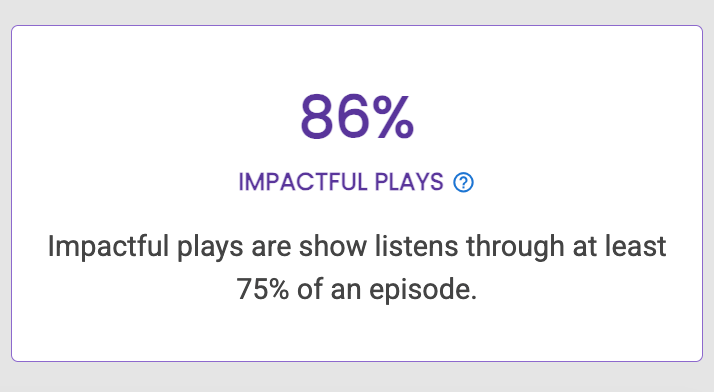
A fascinating metric to measure how powerfully your IC is landing with listeners is called “impact plays”. It’s defined as the percentage of listeners who consume at least 75% of your podcast. Pirate Christopher’s audience sticks around.
Question 2: How Do I Design a Different Podcast?
Pirate Christopher started podcasting in 2017, about nine months after his first book, Play Bigger, came out.
Like most category designers, his motivation was missing. He couldn’t find the podcast he wanted to hear. So he started one.
A radically different one.
Most business, startup, leadership, and marketing podcasts are created for people who spend most of their careers making existing things better.
Of course, making things better matters. But there was much less for people who wanted to center their careers, and maybe their lives, around the exponential different.
Startups.
Innovations.
New products.
Breakthroughs.
New companies.
New categories.
People creating things that did not exist before.
Sure, there are a lot of shows about business, startups, and marketing, but few that feel like eavesdropping on a conversation that grabs you. And fewer still for people who feel a little on the outside. Working on the more innovative, swing-for-the-fences, go-for-growth stuff.
And there was a very personal side to the missing.
At a high-level, you could say there are people who find their place in the world. And then there’s a smaller group of people for whom there is no place to find. These people have to make their place in the world.
The misfits, pirates, dreamers, and innovators. The different. Underneath all of it was one provocative insight:
The people who are different make the biggest difference.
The other ‘missing’ was that Pirate Christopher didn’t like the way most business podcasts felt.
Highly edited.
Highly produced.
Question. Answer. Cut.
Take a long conversation, chop it into pieces, extract the “value bombs,” remove the messy parts, and manufacture a polished media product.
Making it worse, because it’s an INTERVIEW, both people know they’re being interviewed. Game faces on. PR Trained. Talking points ready. Perform.
Pirate Christopher wanted the opposite. A real conversation. Start to finish.
If you listen to Follow Your Different when an author is the guest. At about the 15-20 minute mark, you’ll notice them slide out of their prepared stories and talking points, forget they are on a podcast, and slide into a real dialogue.
This is where magic starts.
The tangents, laughter, pauses, and disagreement are differently delicious. Listening to someone change their mind is amazing. The anticipation builds when someone is thinking out loud.
This is when Lochhead’s ADHD kicks in, and he gets lost in the experience.
He wanted the experience of sitting at the next table while two fascinating people had coffee or cocktails and getting to eavesdrop. Those missings came together in the Venn diagram that became Follow Your Different. But this isn’t just the origin story of a podcast.
Podcasters Are Different
To be a good Podcaster, you have to be arrogant / confident enough to think people should listen to you. And humble, curious, endearing enough to come across as a friend to listeners and guests.
That’s a weird combo.
Most importantly, you must help listeners solve problems.
It could be as simple a problem as, “I want to listen to something interesting while I garden” to “I want to take my B2B marketing career to the next level”, but legendary podcasts, like legendary categories, solve problems that matter.
With all that said. You might (still) be asking: “Why would anyone listen to me?”
Keep reading.
The Podcast Category Design Hexagon
The world doesn’t need another podcast.
Give people a different lens, on the other hand. And you can make an incalculable difference.
Notice what we’re not telling you.
Which microphone to buy. Whether your podcast should be 23 minutes or 93 minutes. How often to publish. How to create clips. The “17 Proven Podcast Growth Hacks.”
There are plenty of people who can teach you those things. We’re asking a more strategic question: Why should your podcast exist? There are millions of podcasts. We don’t need another one.
We do need your podcast.
But only if yours gives us something the others can’t. Because anybody can copy your microphone. Copy your format. Your production. Your guest strategy. And increasingly, AI can reproduce almost every mechanical aspect of creating a podcast.
But they cannot be you.
The goal isn’t to become another podcaster. It’s to become the only podcaster who could make your podcast. How do you do this?
Our Podcast Category Design Hexagon shows you: