


Welcome to Category Pirates. Each week, paid subscribers get one radically different framework for turning what you already know into a category you own, instead of a market you fight over. Sign up for a Founding subscription to ask the Pirate Eddie and Christopher Bot your category design questions and get complimentary digital copies of all 7 of our big books.
Dear Friend, Subscriber, and Category Pirate,
Our Pirate brother, Thomas Parrott, passed away tragically and suddenly a month ago.
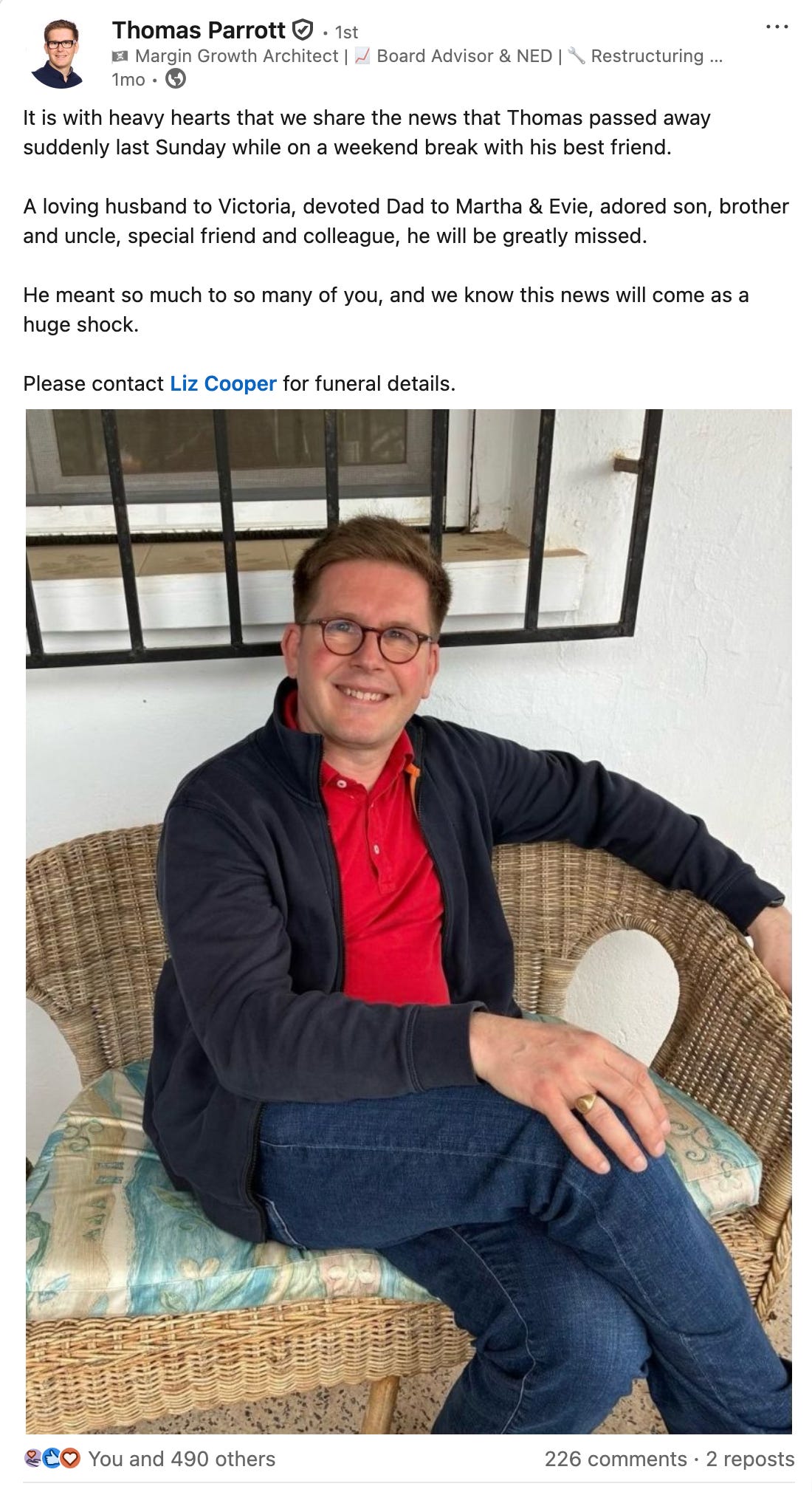
Pirates Christopher and Eddie first met him when he was a BeachBody senior executive. Shortly after he left to go solo and joined the 3rd cohort of the Category Design Academy. He spent most of the cohort thinking his business was helping US companies expand into the UK and Europe.
That was the obvious path. The direction that matched his titles and the trajectory of his career.
But when the Academy cohort was two thirds done, Pirate Thomas decided to start over. He re-did the early months of the cohort. He dug into his superpowers, past his old assumptions, and asked why, which led him to the non-obvious problem that he niched-down to discover his category.
Contribution margin! That was his fingerprint.
Zebra hole alert!
Gross margin is your profit after the cost of making the product. It can look healthy, but it leaves out what it costs to market, sell and deliver each one.
Contribution margin tells you how much money each sale actually leaves behind after every cost that comes with it: making it, shipping it, selling it, the fees and the returns.
It’s the treasure you keep after all the incremental pirates needed for the raid are paid.
Pirate Thomas didn’t figure it out until he let his guard down and his anger out.
In an Academy jam session, he started to rant about companies expanding from the US to the UK. How they were excessively focused on ROAS and other fake metrics.
How companies would grow revenue and even gross margin, but wouldn’t figure out until much later. They were losing money hand over fist. He told war story after war story about how companies were so smart they were stupid, and how tired he was of companies not listening to him.
Pirates Christopher and Eddie had to point out to Pirate Thomas that he lost his temper. The intensity of his demeanor rose with the decibels of his voice. He was no longer polite, polished, professional Thomas.
He became Pirate Thomas.
He re-launched his business, ranting and raving about contribution margin. Prospective clients would call him about helping them build a growth strategy to enter the UK and European market. Pirate Thomas said he could do that, but it wouldn’t be smart. He told them it was a bad idea and they were surprised he was talking himself out of revenue.
He was doing the no-sell-sell perfectly.
The more he said no, the more the prospects said yes. They didn’t want him as a consultant, they wanted him as a fractional CEO of their ventures. The largest of the large companies would call him to fix their new ventures that were growing revenue, but burning cash. His pipeline grew until he had a 1.5 year backlog. With more revenue than he had imagined was possible.
He had forged a business and a POV that was uniquely Thomas.
Are there other experts on contribution margin? Sure. Did they have Pirate Thomas swagger? Did they have his battle scars as both an executive and an advisor? Did they have his track record of results? Did they have a waiting list of clients so long, Pirate Thomas could be selective and walk away from clients that weren’t right?
No, no, no and no. Pirate Thomas is, was and always will be a category of one.
Which is why the world is worse off without him. Because he had a banger of a mini-book just waiting for him to write.
Not a boring accounting mini-book. Not a superficial set of stories with no practical, tactical value. Not a mini-book from some armchair quarterback who has never been in the arena.
Mini-books must come from lived experience.
Pirate Thomas had everything he needed:
A powerful, precise and courageous point of view
A framework that explained the past and predicted the future
A ton of battle scars, war stories and a long list of legends & losers
A mini-book to turnaround businesses burning cash into ones that survive and thrive.
TL/DR of Part 2 of Mini-Book Category Design
In Part 1 of Mini-Book Category Design, we encourage you to fight the right fight.
To know why you are writing your mini-book. And to be able to say it in one sentence. To niche down on Superconsumers and Life Quakes. To be precise in rejecting the premise and what problem you are solving.
In this Mini-Book, let’s focus on your mini-book writing fingerprint.
Your fingerprint is unique to you. Don’t sand it down or smudge it. Don’t hide your fingerprint in a glove of professionalism, politeness or polish. You must be you. You know. The smart, powerful, engaging, courageous, legendary you.
(It’s been said a million times, a million ways. The greatest thing a person can give is their 100% self. Nothing more. Nothing less.)
How you communicate is as important as what you communicate. Malcolm Gladwell has proved you can have a wonderful career writing other people’s ideas.
We know Pirates who worry they lack Intellectual Capital.
They didn’t realize that you can take someone else’s idea, and put a twist on it. A twist based on outcomes you’ve driven. Insights you’ve earned. Dots you’ve connected. Battle scars you’ve uniquely endured. A twist using your favorite words, sayings and written in your own rhythm and rhyme that you love.
The way you write is as much Intellectual Capital as what you write.
This mini-book will speed up the time for you to create your own Intellectual Capital. So you can be paid to be you and make money while you sleep.
Because you never know how much time you have in this life.
The Category Pirates Writing Formula and Fingerprint
Pirate Dan McGinn is the Editor of the Harvard Business Review magazine.
He started at HBR a year after Pirate Eddie started writing for HBR. When the book Play Bigger came out in 2016, Pirate Eddie introduced Pirate Christopher to Pirate Dan. That led to HBR publishing an excerpt from Play Bigger in HBR, How Unicorns Grow. Pirate Dan appeared on Pirate Christopher’s podcast about his book, Psyched Up. Later as Pirates Dan and Eddie were catching up, Pirate Dan said this about Pirate Christopher.
“He sure loves the word Legendary.”
Legendary. Long story longer. Don’t be so smart you’re stupid. Thinking about thinking is the most important kind of thinking.
If you’ve read or heard those words, you know your brain has been kissed (haunted) by Pirate Christopher.
Did Pirate Christopher invent those words? No. But he loves and uses them so much they are his identity. Those words mean a great deal to him. They delight him.
Words matter.
Pirate Bri built an MCP (Model Context Protocol) server for all our Category Pirates mini-books, Pirate Street Journals, Deep Dive Reports and our jam session transcripts. Basically as close as possible to everything we’ve said or written.
Zebra hole #2!
MCP is like a USB port for your Intellectual Capital.
You put everything you’ve ever written, recorded or analyzed in one place, like our Category Pirates library of mini-books. MCP lets an AI plug in to search, read and use that content.
And it lets you protect your Intellectual Capital. You’re lending the AI a library card, not giving away the library.
You can pull the plug anytime you want. You decide who gets access and how much they can see at a time. It’s super cool, and the Pirates are planning some fun stuff for the ship to play with our IC in a special, proprietary way.
This is what the Category Pirates word cloud looks like across 283 mini-books, dozens of PSJs and DDRs.
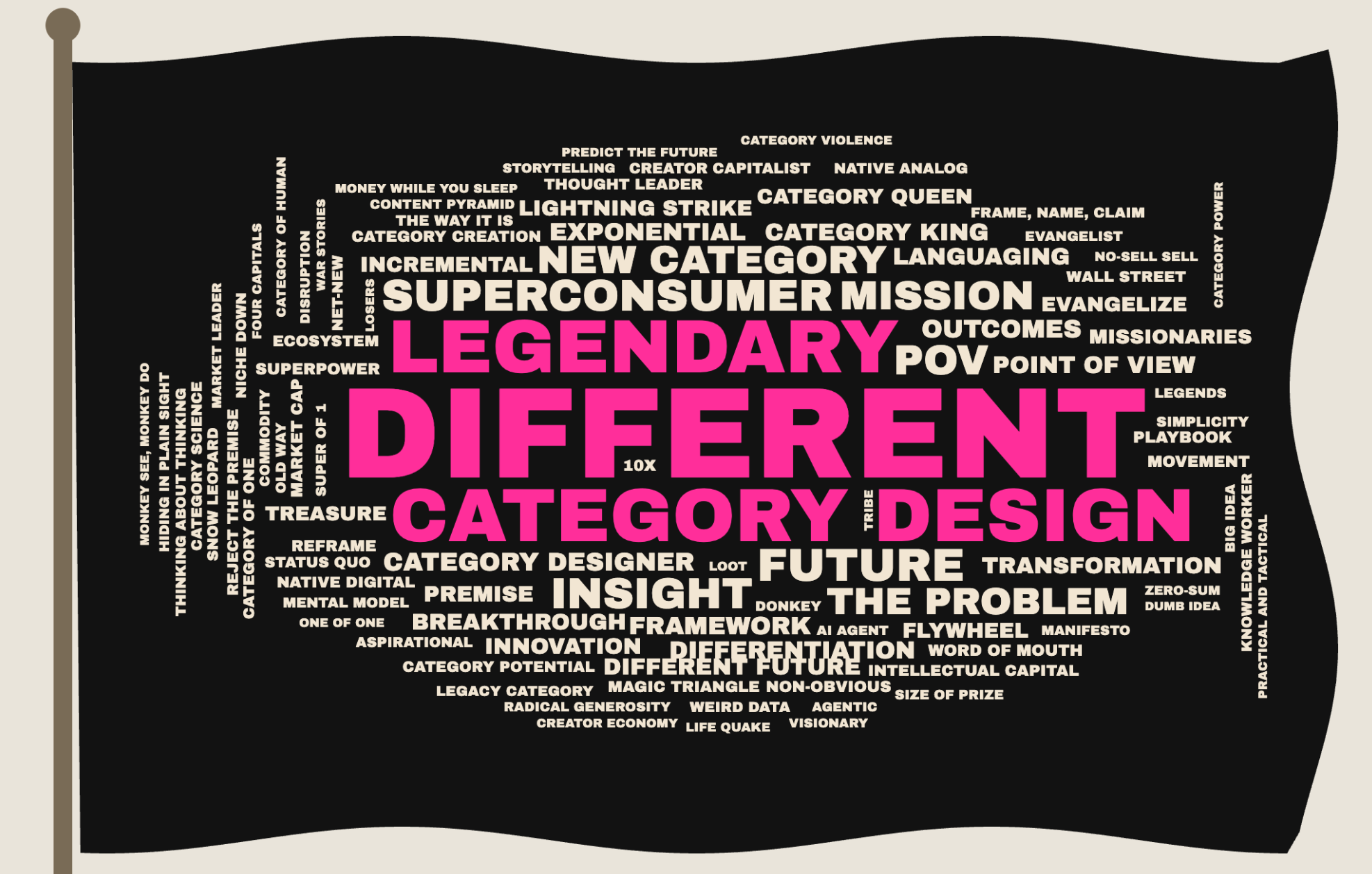
It’s not just words.
Numbers matter.
The Category King earns 76% of the category economics. A Superconsumer of 1 category is a Superconsumer of 9 categories. Category Kings grow revenue 4x faster and market capitalization 6x higher than other fast growing companies in their category.
Frameworks matter.
The Magic Triangle. The Content Pyramid. The 8 Category Levers of differentiation. The 7 Categories of the top 444 best selling business books.
Your writing fingerprint matters.
The Category Pirates writing style and signature is different. It’s two thirds serious and one third silly. We write with an odd mix of affection and anger. We aim for courageous and sometimes land on outrageous.
Weird data and war stories matter.
We can’t think of another writing duo that has our odd mix of Silicon Valley and Fortune 500 stories. We know God has a sense of humor pairing up a Pirate born in Canada with a Pirate born in Hawaii, both of whom grew up as have-nots and were blessed by the American Dream.
We’re not saying you need to write your Mini-Books like us.
We are saying your Mini-Books should be distinctly different. They should be uniquely you. They should be personal to your life experiences. Both your massive wins and your most painful failures.
Never forget that you are unique in the entirety of humanity.
Zebra hole #3!
There’s an old story. We don’t know if it’s true. But we love the story. Legendary artist Michelangelo when asked how he created his masterpiece statue, David. Said it was easy. “All I did was remove everything that was not David”.
And whether you use AI or a ghostwriter, you must make sure the DNA that makes you different is at the forefront of your writing.
Step 4: POV with Power, Precision and Courage
You might be thinking, “Step 4? What about Steps 1-3.”
Steps 1-3 were in Part 1 here. Remember, Mini-Books start with the Magic Triangle.
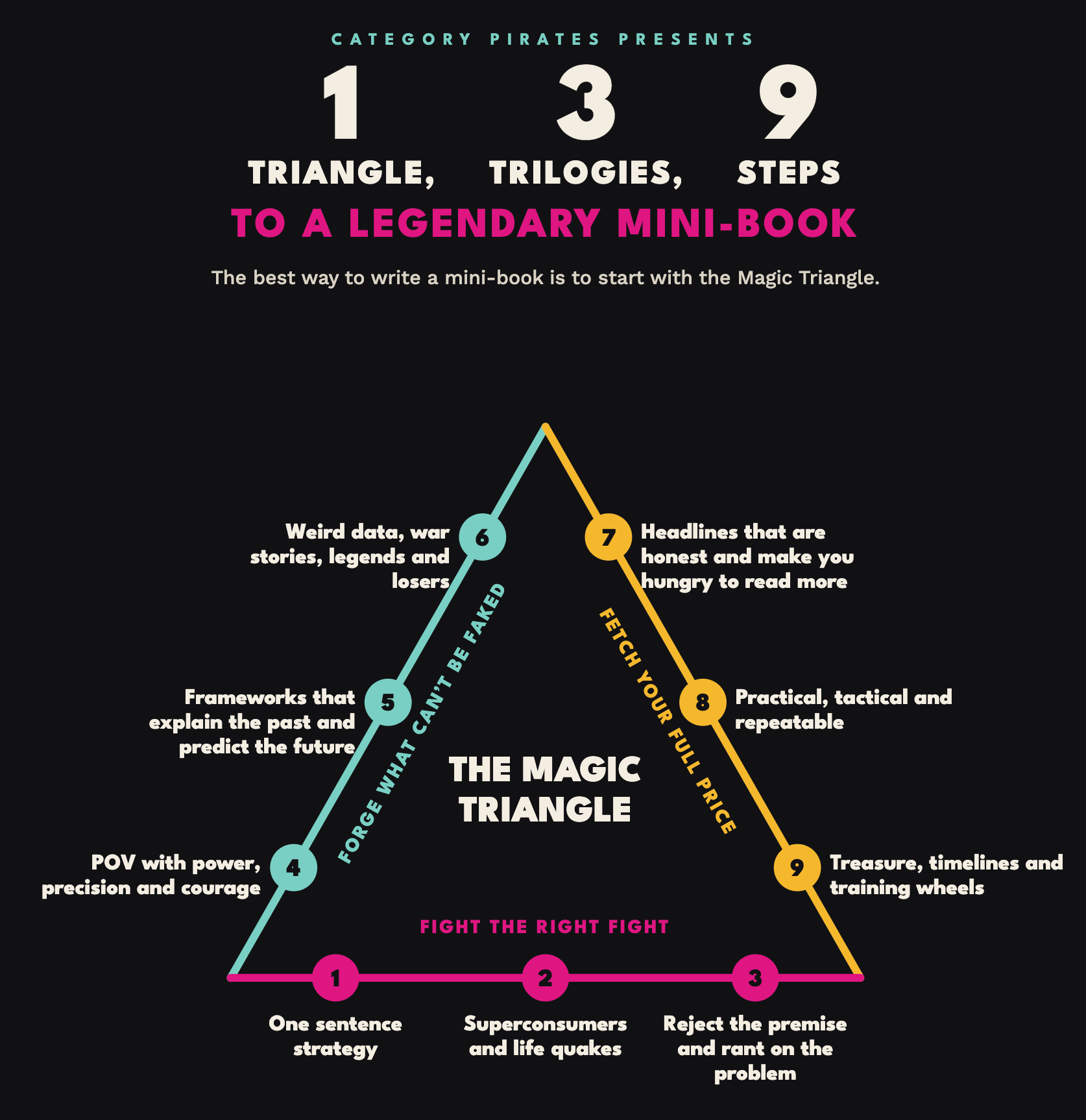
In Step 4, we assert every great POV has a ton of precision, power and courage.
Most POVs we see are generic, weak and blow with the wind. Weak POV equals a weak mini-book.
You still might be wondering, why are the Pirates harping on POVs vs. punctuation?
It’s because grammar is never the reason why a mini-book is great. A mini-book is great because it makes you think differently about a problem you weren’t aware of. A mini-book is great because of a provocative POV that is audaciously abundant.
You must have something different to say.
Don’t waste your reader’s time with a watered down, weak-ass POV.
Weak POVs are usually caused by three common problems.