


Welcome to Category Pirates. Each week, paid subscribers get one radically different framework for turning what you already know into a category you own, instead of a market you fight over. Sign up for a Founding subscription to ask the Pirate Eddie and Christopher Bot your category design questions and get complimentary digital copies of all 7 of our big books.
Dear Friend, Subscriber, and Category Pirate,
Meet Pirate Kyle Okimoto.
He built a stellar resume by the time he hit his late 40s. Northwestern, University of Chicago MBA, The Cambridge Group, Merrill Lynch Wealth Management Head of Strategy, E*TRADE Head of Marketing and SVP. At Merrill, he led a massive sales optimization process with over 15,000 Financial Advisors that yielded monster economic outcomes.
The top 500 FAs double their practices in 3 years, thanks to Kyle’s program.
There was even more money and milestones ahead if he stayed the course. So he did some consulting as he interviewed for big ding-dong jobs. The more he did, the less excited he was. This is no surprise, as 57% of GenX is looking to make a career change. Kyle’s career walkabout took ten years. Then, he figured out what his different superpower is. And how he can use his different to make a big difference for others.
Pirate Kyle became a teacher to consumers instead of an executive for corporations.
And that makes a massive difference.
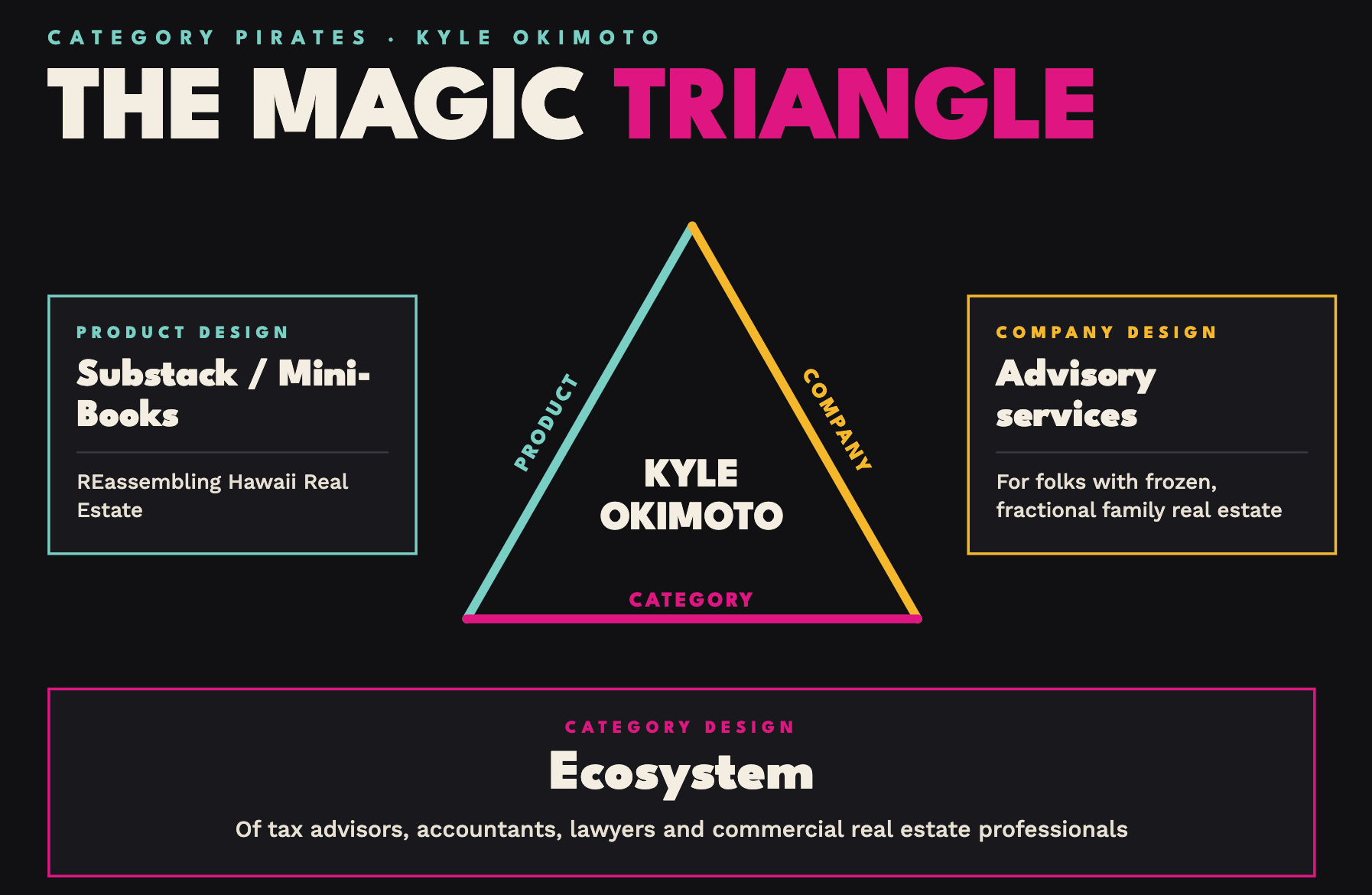
Category designers shift their thinking from marketing to educating. Pirate Kyle teaches by writing on Substack, REassembling Hawaii Real Estate. It is a Trojan horse collection of mini-books, which will eventually become a big book. He’s building a podcast to educate consumers and an advisory to help consumers solve the problem Kyle fell in love with.
He helps folks with inherited fractional real estate to convert it from burden to blessing.
He saw a missing in the market while helping his mom. They owned a partial share of commercial real estate in Hawaii, where The Running Room operated in Kapahulu.

Zebra hole: Pirate Kyle’s family’s commercial real estate was just a few minutes away from Leonard’s, home of the Malasada. Leonard’s makes arguably the greatest doughnut in the entire world. It’s a Portuguese-origin, deep fried doughnut that is rolled in sugar and filled with dobash (chocolate), haupia (Hawaiian coconut pudding), custard or more. Pirate Eddie’s favorite is a Li Hing powder (a sweet, sour, tangy powder from Chinese plums) with no filling. It’s a hot, crispy, doughy gooey culinary delight that does a Daryl Dawkins Chocolate Thunder in your face dunk on a hot Krispy Kreme. IYKYK.

This is the genius way Kyle defrosted frozen, fractional family real estate into real cash flows (you can read about it here.)
“Over the next five years, my mother and I bought out the other family members, explored different ways to use the property, and ultimately sold it and reinvested proceeds into a rental apartment portfolio in the Midwest. We multiplied rental revenues by 6x. We deferred a seven-figure capital gains tax bill. And we transformed the financial futures of both my 87 year-old mother and my own family -- by unlocking the value of a single 14,000 square foot property on the outskirts of Waikiki.”
Pirate Kyle was an expert in corporate finance, not real estate finance.
But Kyle was confident he could learn. (People who make successful mid-life career changes are obsessive learners.) He found experts he could trust and built a playbook that spans multiple disciplines across real estate, tax and wealth management. He found a smart source of debt to buy out his relatives at a price that made them happy. He did a 1031 exchange into a diversified portfolio of over a hundred rental properties that had a much higher yield.
Pirate Kyle is convinced that what took him 5 years to do can take 5 months.
He’s got the playbook. It’s not just technical; it’s deeply personal. No attorney can help you handle a crazy, unreasonable Uncle. No accountant can help quantify the cost of too much sentimentality in family history. He simplifies the complexity and open-sources his knowledge to help people like him and his mom.
But he knew writing the mini-books was necessary. But not sufficient.
Pirate Kyle’s mini-books needed a legendary magic triangle.
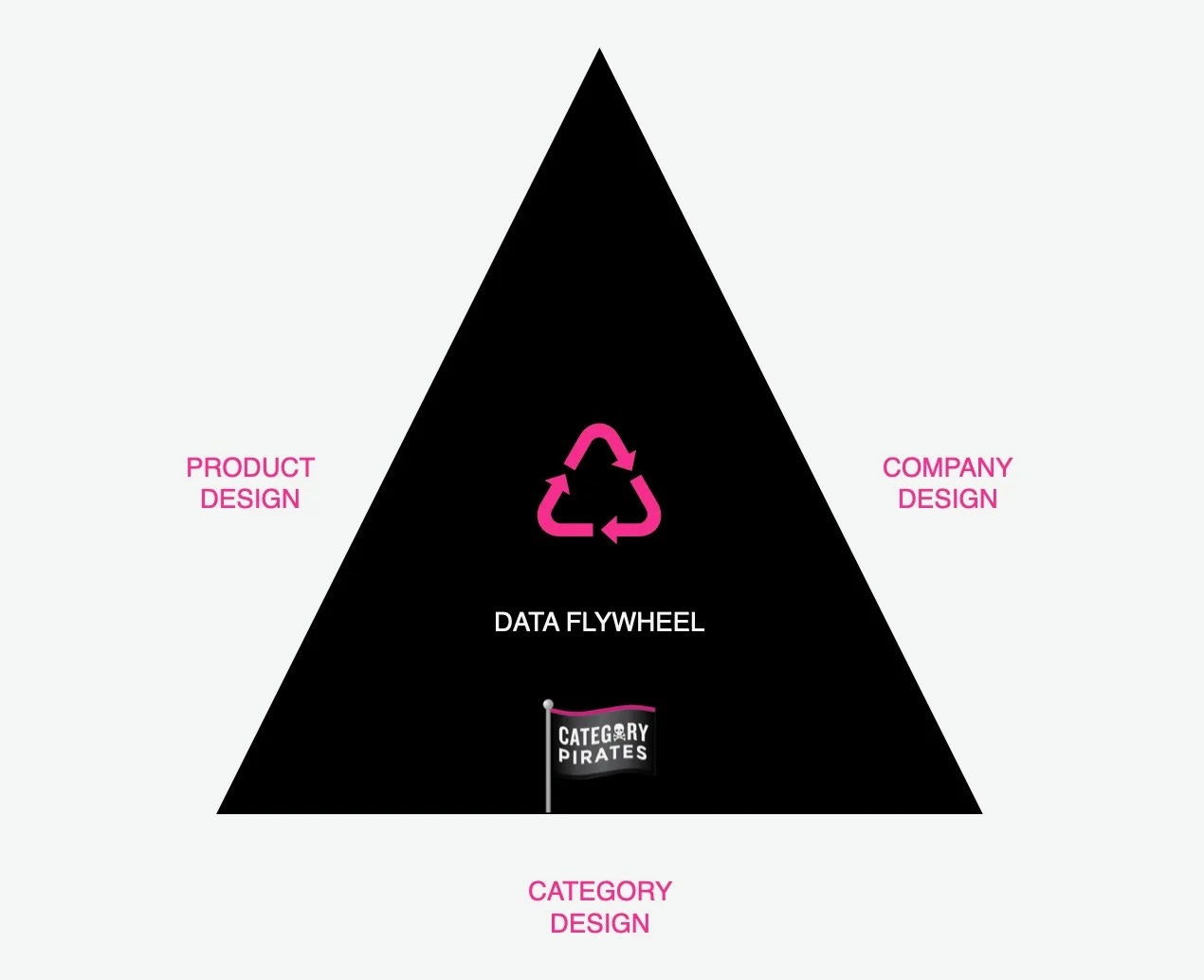
So he joined the Category Design Academy and sharpened his POV and designed his Category. He got the confidence to launch a Lightning Strike back home in Hawaii that Pirate Eddie got to attend. Dozens of people showed up, and now Kyle is in discussions to help out a handful of folks personally as his new advisory service. A small percentage of 7 to 8 figure real estate transactions adds up to real money.
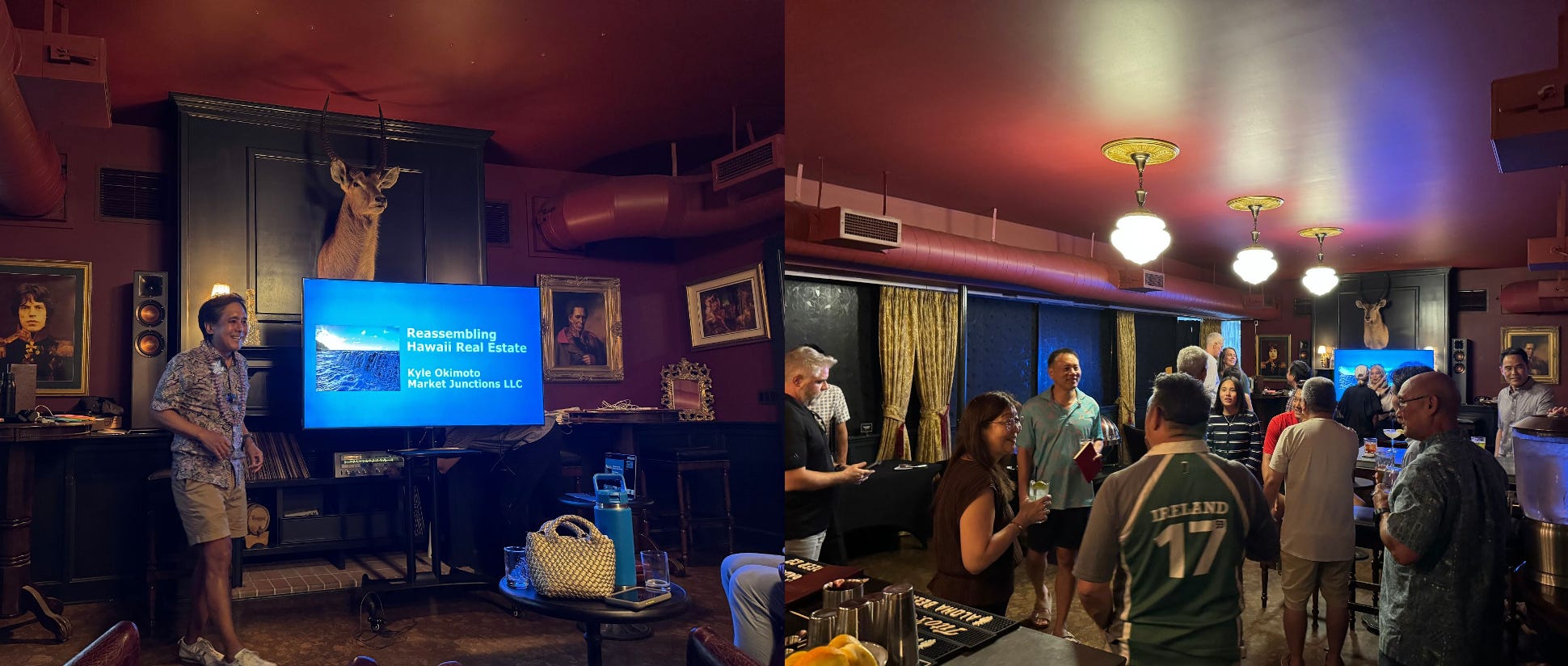
Kyle found the right fight to fight. A problem that mattered to his family.
And many more families.
His future wasn’t being a ding-dong senior executive at a big financial services firm. It wasn’t being a ding-dong consultant. It was helping everyday folks who don’t have decades of financial services experience navigate the frustrating maze of real estate transactions, tax codes, and that crazy uncle, aunt, or cousin who is making things harder than it needs to be.
To get there, he needed to write mini-books (educate the market) AND design his personal magic triangle.
But before all of this, he started with three steps:
He wrote his one-sentence strategy. Helping folks with frozen, fractional family real estate convert it into vibrant wealth.
He niched-down on his Superconsumer and Life Quake. Hawaii families when their fractional real estate costs are about to jump.
He rejected the premise and ranted about the problem. Don’t get overwhelmed by the complexity of transactions, tax and attorneys.
These are the first three steps of nine total to Mini-Book Category Design.
What is a Mini-Book and Why Should I Care?
Category Pirates framed, named, and claimed the Mini-Book category back on January 21, 2021.
The original Pirates Cole, Christopher, and Eddie had been writing a traditional book on Category Design. Pirate Cole suggested we launch it via Substack. Piece by piece at a time to get feedback. And (like pirates) monetize it more than once.
When we started, some people said our newsletters were too long.
“No one’s gonna read a 3,000-word business newsletter.”
So, like good category designers, we rejected the premise. And thought, what if we’re not writing (too) long newsletters? What if we’re writing mini-books?
Ta-da! Mini-Books!
A New category 🏴☠️.
Not a blog or article at 1,000 words. Not a regular book at 60,000 words. But a Mini-Book at 5,000 to 15,000 words that you could read on a short flight and take action on right away. All with a consistent look and feel to create a billboard effect. And with intentionality. So that multiple mini-books can easily be put together to create a regular big book.
This means anyone can be an author.
We know this because Kyle wasn’t a writer before he started writing. Pirate Eddie wasn’t a writer when he first started in 2008. He wasn’t thought of as a thought leader who was worthy to be an author. Neither was Pirate Christopher, who doesn’t have a PhD, GED, IED, or IUD.
Pirates Kyle, Eddie and Christopher wrote, not because they were anointed by the powers that be as worthy to write.
They wrote because they couldn’t stop thinking about the idea of Frozen Real Estate, Superconsumers and Category Design. The problem they were solving made them say, “This aggression will not stand, man.” The POV held them prisoner until they took action.
They knew they had trapped wisdom in their head that could help others, and it was selfish to keep it to themselves.
We believe each and every one of you has trapped wisdom in your heads. Some of you don’t believe it and dismiss its value. Some of you haven’t even considered it, because the world lied to you and said you weren’t worthy. Some of you know you have it and (hear this with love) are being lazy and too selfish to share it with the world.
It’s easy to look at Pirate Kyle and think he is just helping rich people get richer.
The folks reaching out to him are teachers. Folks with everyday jobs, trying to make ends meet. Folks who are unnecessarily intimidated by the complexity of real estate and taxes. Folks who don’t realize they are sitting on a winning lottery ticket and don’t have to struggle living paycheck to paycheck anymore.
Don’t you dare diminish your different.
Don’t you dare hold back the help only you can provide. You should care because you are unique in the history of humanity. You were designed to use your different to make a massive difference for others at scale.
And it is easier than ever to do it with a mini-book.
Big Books, Big Reputation Capital and Big Challenges
Our love of mini-books doesn’t mean we don’t also love big books.
Big books solve the credibility gap with big Reputation Capital. Most Creator Capitalists worry customers won’t buy from them if they’re not backed by a big company or brand. Most customers won’t read the book, but will read into the fact that you must have something legit to say.
Back in the day, big books gave you instant uplift.
“Ohhh… did you hear? Suzy’s a published author!?”
Not necessarily because of the quality of the book, but the sheer difficulty of giving birth to one. When Pirates Christopher and Eddie were first coming up, you needed to take 1-2 years to write a Big Book, with a Big Ding Dong publisher that showcased your book in big bookstores. Pirate Christopher had HarperCollins, and Pirate Eddie had the Harvard Business Press. Lots of smart people had to be convinced that Pirates Christopher and Eddie had smart stuff to say before Play Bigger and Superconsumers were available to buy in every major bookstore in multiple countries.
The difficulty meant not everyone was invited to write a big book.
Not because they didn’t have something legendary to say. But because books were like venture capital risk, but without the venture capital rewards. The truth is the publishing industrial complex had three challenges.
First, the book category has horrible economics.
There were huge fixed time costs for authors to write a manuscript without knowing if it would succeed. The fixed cost of printing books was even higher, given the lack of certainty about how many would sell. Book margins sucked, given the high physical costs.
Second, publishers don’t really know why one book sells and another doesn’t.
Hint: the title and cover have a lot to do with it. We know, we did the Category Science that we wish publishers had done for us. Given that most books are one good idea spread over 200 pages, you’d better make sure the idea, not the fame of the author, is radically different and powerful.
Finally, publishers are better at optimizing margins than making the pie bigger.
Book publishers stupidly priced digital innovations like ebooks and audiobooks cheaper with a moronic cost-plus mindset. Which is the reason why the cost of a book has been flat for decades, while inflation has raised prices for so many more categories. Too bad most of them don’t understand how to build super-premium bundles, as we have.
The Magic and Curse of Mini-Books
The mini-book plus Amazon’s great gift of print-on-demand solves all three challenges.
The magic of Mini-books is that they are way easier to write, with minimal fixed cost and risk. This means everyone is invited to the party.
Pirate Cole has democratized the art and science of writing, as the G.O.A.T. writer about digital writing. Pirate Chris Stanley has open-sourced his excellent playbook, the Mini-book flywheel. Mini-book ghostwriters like Pirate Katrina Kirsch have hung up their shingles. And AI has gotten good enough to solve the blank page problem, to get writers started.
But today’s solutions become tomorrow’s problems.
Writing a mini-book has gotten so much easier that now everyone sounds the same. To be a thought leader, you have to have leading thoughts. AI pukes obvious. A lot of the ideas sound the same. Many mini-books look the same.
The sledge of sameness is oozing as people use AI to crank out (slightly) re-swizzled existing knowledge.
But it puts a massive premium on having a different point of view.
Which raises the question, “How do I have leading thoughts without copying what other people have written?”
You do that by designing your personal Magic Triangle before you write your mini-book.
This is something AI can’t do for you (yet). This is something ghostwriters can’t do for you. This is something most advisors/consultants can’t do for you (because they’ve not done it for themselves.)
You have to do it yourself.
Our mission is to teach you how.
Great Mini-Books Have a Legendary Magic Triangle
To write a legendary mini-book, you must start with Category Design.
Specifically, the Category side of the Magic Triangle. The mini-book is the product side of the magic triangle. And your company or Creator Capitalist play is the company side of the magic triangle.
The simplest way to explain it is to show you.
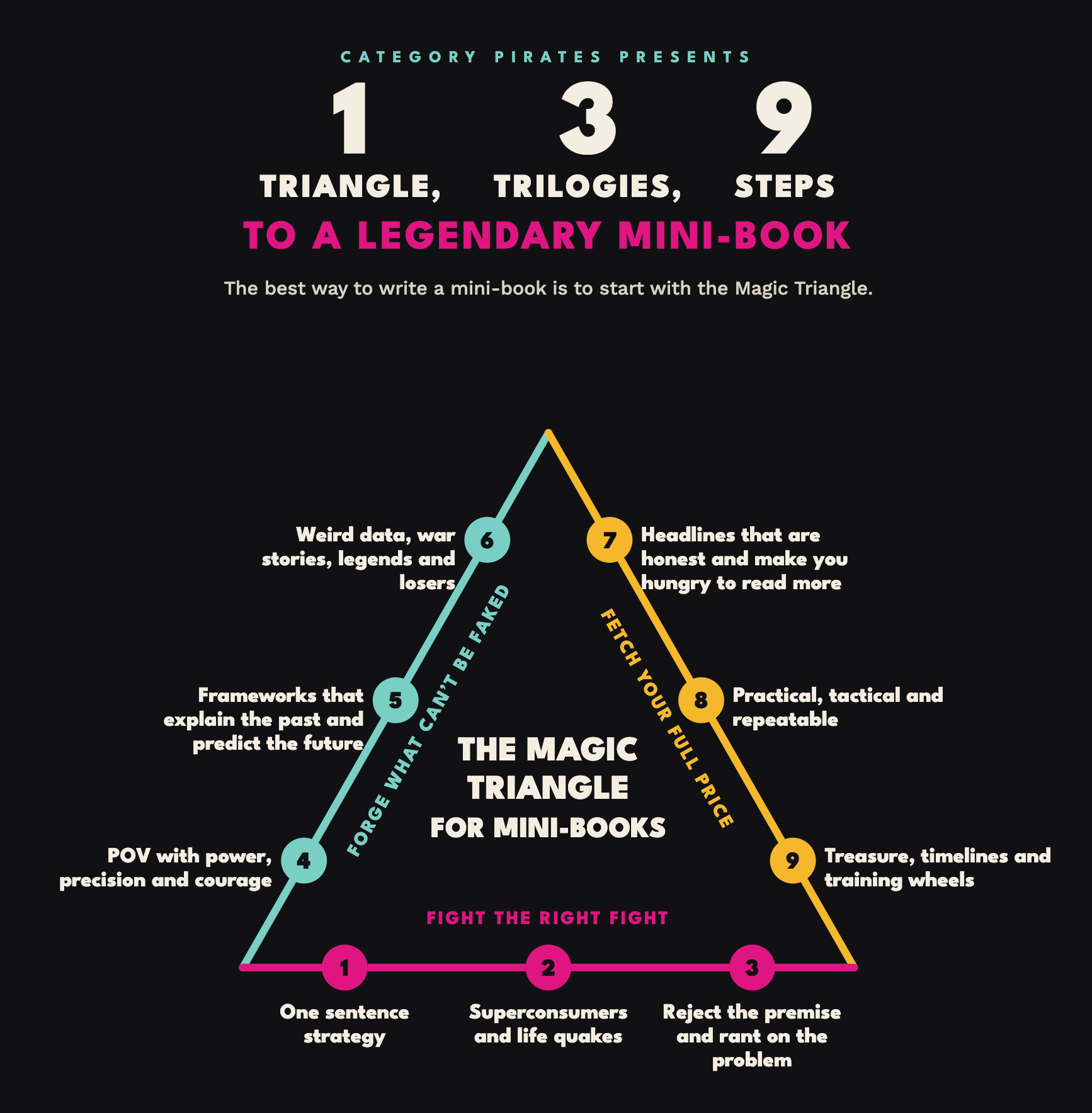
This is where we are headed.
There’s so much that we had to break this up into parts. So we are writing three trilogies for a total of nine steps. Modeled after the great George Lucas (more to come on him later).
Here are the first three steps to writing legendary mini-books: