


Arrrrr! 🏴☠️ Welcome to a 🔒 subscriber-only edition 🔒 of Category Pirates. Each week, we share radically different ideas to help you design new and different categories. For more: Audiobooks | Category design podcast | Books | Sign up for a Founding subscription to ask the Pirate Eddie Bot your category design questions.
Dear Friend, Subscriber, and Category Pirate,
Before we go deep, here’s the TL/DR.
You were born at the exact right moment.
Not because things in the world are perfect. They are not.
But things are a lot better for you than you’ve been told.
Your future is a lot brighter than you’ve been led to believe.
We’re offering you a different lens. On your future. Starting this summer.
That’s if you want to build a business now. Learn something powerful now. Make money now. And set yourself up for a legendary future.
🔊 Want to listen to this mini-book instead? Head to the audiobook.
Because for the first time in history, the tools and technology that used to cost a million dollars and require a team of adults now cost $20 a month and run on your laptop.
AI didn’t just change what’s possible. It nuked the permission structure. All you need now. A little drive. A little focus. A desire to make a difference. And a playbook (this newsletter).
You used to need a boss to give you a job. An investor to give you money. A degree to prove you were worth hiring. A decade of experience before anyone would trust you with real work.
That gate is gone.
The adults around you haven’t figured this out yet. A 17-year-old with one AI summer and one good idea can out-earn a 35-year-old with a LinkedIn profile full of certifications.
We know. Because it already happened. A 17-year-old named Luke helped build a bot that now drives a real business. Not a hobby. Not a science fair project.
A six-figure business with 99% gross margins.
That’s what this is about.
Not AI homework shortcuts. Not going viral. Not “hustling.” Those are all ways to stay broke.
This is about building something that pays you while you sleep. A voice agent, a bot, an automation or a paid newsletter. One of 18 specific, proven, real-money ideas any one of which can put $30,000 in your pocket before you graduate.
$30,000 invested at 18, compounding for 47 years, is $2.6 million at retirement. That math doesn’t care how old you are when you build it.
Three things this mini book is not:
It is not get-rich-quick. Every idea in here requires real work.
It is not cheating. Using AI as a rocket is the opposite of using AI as a cheat code. One makes you better. One makes you dependent.
It is not for someday. Someday is how your parents ended up with a job they’re lukewarm about.
One thing this book is:
Your playbook for the summer that changes the rest of your life.
Pick one idea. Get one customer. Come back for the next one.
The kids who figure this out in 2026 will be the ones everyone else works for in 2036.
Be that kid.
If the next few sections are boring to you, we won’t be offended if you say, “Ok, Boomer” and skip to the 18 AI ideas to make $30,000.
Let’s jump in.
A kid named Jensen.
Jensen was born in Taipei but moved to Thailand from the age of 5 to 9 with his parents.
Then they put him and his older brother on a plane to America to live with an uncle in Tacoma, Washington. They spoke almost no English. And had no money. The uncle did his best and found what he thought was a prestigious boarding school and enrolled them. It was a reform school in Oneida, Kentucky.
The dorms had no closet doors. Some “students” carried knives. Jensen was assigned to clean the bathrooms for a hundred teenage boys. His brother was sent to work in the school’s tobacco fields. They were called ethnic slurs and threatened.
Pirate Jensen still calls it one of the best things that ever happened to him.
His parents eventually moved to the U.S. and the family settled outside Portland, Oregon. He graduated high school at 16. He worked the night shift at Denny’s, washing dishes, then bussing tables, then waiting tables.
He went to Oregon State University.
In an engineering class of 250 students, he met a woman named Lori. He was 17. She was 19. He walked up to her and said, “Do you want to see my homework?”
They have been married for four decades.
At age 30, Jensen and two friends founded a chip company at a Denny’s in San Jose.
That company is Nvidia.
As of this writing, it is the most valuable company in the world. Jensen Huang is the most important CEO on the planet because he runs the company that builds the chips that run AI.
After flying on Air Force One with the President for a big meeting in China, he bailed on the procession and went to eat street food. He still wears the same black leather jacket his wife and daughter picked out for him, not just because it is cool but because other clothing irritated his skin.
Despite all of this and being worth $175 billion plus, he’s still Jensen from the block.

Not all leaders of AI are evil tech bros. Some dance like Uma Thurman.
Some of them are kids who washed dishes at Denny’s and cleaned toilets.
Pirate Jensen is not here to steal your future. He’s helping you build it.
An Expert Predicted AI Would End Radiology. He was wrong.
In 2016, a man named Geoffrey Hinton, who is known as the “Godfather of AI” and who later won a Nobel Prize, stood in front of a room and said this: “People should stop training as radiologists now.” He predicted that within five years, AI would be better than humans at reading medical scans and radiologists would be obsolete.
He was famous. He was credentialed. He was very confident.
Sometimes you can be so smart you’re stupid.
A decade later (2026) a radiologist in America can make as much as $693,000 per year. The American College of Radiology projects the number of radiologists will grow by up from 26% to 40% between 2023 and 2055. Mayo Clinic alone has 400+ radiologists, a 55% increase since Hinton’s prediction. Almost every radiology platform is now powered by AI.
The AI part of the prediction came true.
The “no more radiologists” part went the opposite direction.
Why?
Jensen Huang explained it on a podcast last year. Hinton confused the job with the task. Reading a scan is a task. The job of a radiologist is to diagnose disease. When AI took over the task, radiologists got faster, more accurate, and able to see more patients. Demand for radiologists went up, not down. The bottleneck cleared. The category expanded.
(The pie got a lot bigger. Not smaller)
Hinton himself later admitted he was wrong on the timing and the implications.
No matter who the expert is. Doing your own thinking about thinking, is always wise thinking.
Every time someone confidently predicts AI will destroy a job, what actually happens is the job changes, demand expands, and the people who learned to use the new tech win.
Technology moves where value gets created.
So when someone tells you AI is going to destroy your future, ask them: are you talking about the task, or the job?
AI, Like Most Technology, Leads to Abundance for All
The beauty of Category Design is it makes the overall pie bigger.
Sadly most of what we’ve been taught is that life is a zero-sum game. That’s simply not true. When humans fight over scarcity. Very bad things happen. When humans collaborate we create abundance.
Look at the actual scoreboard of human progress over the last 50 years.
In 1975, the entire world economy was about $6 trillion. Today it’s roughly $120 trillion. That growth came by creating new categories of value.In 1974, the average human could expect to live 58 years. Today they can expect to live 73.
In 1990, 1 in 11 children died before their fifth birthday. Today, it’s 1 in 27. We have cut child mortality by 60% in just 34 years.
In 1990, 36% of the world lived in extreme poverty. Today, it’s 10%. More than 1.3 billion human beings climbed out of extreme poverty in the last 35 years. That is the single largest reduction in human suffering in the history of our species.
In 1976, only 67% of adults on Earth could read. Today, 87.7% can. For women, the literacy rate went from 56.7% to 84.6% in the same period.
Smallpox killed an estimated 300 million people in the 20th century alone. It was eradicated in 1980. Polio is down 99% since 1988. Measles deaths are down more than 80% since 2000.
All of these upgrades came from new categories of technology.
And with every advance, a zero-sum doomer told you the sky was falling.
The biggest zero-sum doomer story is billionaires don’t pay taxes.
Before we plant our identity in a belief, some more thinking about thinking is wise thinking.
In December 2024, The New York Times published a story headlined “How One Of The World’s Richest Men Is Avoiding $8 Billion In Taxes.”
The article reported that Jensen and his wife Lori set up legal trusts: an irrevocable trust in 2012, four GRATs in 2016, plus a private foundation. Those trusts will save their heirs billions in estate tax when Jensen eventually dies.
There is some truth to this.
Yet.
When Jensen was asked about the proposed wealth asset tax in California and said, “I haven’t thought about it even once. We work in Silicon Valley because that’s where the talent pool is. I’m perfectly fine with it, it never crossed my mind once. We chose to live in Silicon Valley and whatever taxes they would like to apply, so be it.”
So what is the truth? Let’s look at the numbers.
Jensen pays a massive amount in income tax in California, at the highest rates in the US.
His total compensation in fiscal 2025 was just under $50 million. About $1.5M of that was base salary. $6M was a cash bonus. $38.8M was stock awards (RSUs). $3.6M other. RSUs are taxed as ordinary income at the moment they vest, just like your paycheck. Jensen lives in California. So his effective tax rate on that comp is roughly 50% once you add federal (37%), California state (13.3%), Medicare, and the additional Medicare surtax.
50% of $50 million is $25 million. In one year. In personal income tax. From CEO comp alone.
His 2024 total comp was $34 million. Same math, same rate, around $17 million in tax.
So just from his W-2 compensation, in 2024 and 2025 alone, Jensen paid approximately $42 million in personal income tax.
He paid roughly $1 billion in capital gains tax on stock sales in the last 18 months.
Between mid-2024 and late 2025, Jensen sold approximately $2.9 billion in Nvidia shares through pre-scheduled 10b5-1 trading plans. These are founder shares with essentially zero cost basis, which means almost the entire $2.9 billion is taxable as long-term capital gains. Federal long-term cap gains tax (20%) plus Net Investment Income Tax (3.8%) plus California (which taxes capital gains as ordinary income at 13.3%) puts his effective rate around 37%.
$2.9 billion × 37% is approximately $1.07 billion in capital gains tax paid by Jensen Huang in 18 months.
The Seattle Times clarifies what the New York Times story buries. “If the Huangs’ trusts sell their shares, that will generate a hefty capital gains tax bill, more than $4 billion.”
The “$8 billion saved on estate tax” headline implies zero taxes paid. The actual story is more like “the trusts will pay roughly $4 billion in capital gains tax instead of $8 billion in estate tax, a net savings of $4 billion.” That’s still a lot of money. It’s also half the headline.
Nvidia under Jensen has created roughly 27,000 employee millionaires.
A June 2025 survey of more than 3,000 Nvidia employees found that 76-78% of them are now millionaires. Roughly 50% are worth more than $25 million. One in three is worth more than $20 million.
Across Nvidia’s roughly 36,000 employees, that extrapolates to about 27,000 millionaires walking around the company right now, plus thousands more former employees who held shares and have moved on.
Jensen said it himself on the All-In podcast in July 2025: “I’ve created more billionaires on my management team than any CEO in the world. They’re doing just fine. Don’t feel sad for anybody at my layer.”
In June 2026, Jensen was in Taipei on his way to Korea. He was asked about a big standoff Samsung had with its union, before ultimately agreeing to pay worker bonuses given all the DRAM demand and growth. He said, I’m not an expert, but I think people should be paid as much as possible. Ask my employees. Literally, I do that. I pay my employees as much as I can.”
Where did all that wealth come from?
It came from Nvidia’s stock compensation. RSUs (restricted stock units) granted to employees, vested over time, and taxed as ordinary income at vest. Same as Jensen’s. Same as your future paycheck, if you build the right career.
Nvidia files these numbers with the SEC. They are public. Here’s what the 10-K says about the total fair value of RSUs and PSUs vested for Nvidia employees in the last three fiscal years:
Fiscal 2024: $8.2 billion in employee equity vested
Fiscal 2025: $15.1 billion vested
Fiscal 2026: $22.2 billion vested
Three-year total: $45.5 billion in ordinary income paid to Nvidia employees through RSU vesting
Every single dollar of that $45.5 billion was taxed as ordinary income at the moment it vested. Most of those employees live in California. So apply the same blended effective rate (federal + state + Medicare) of roughly 45% to be conservative.
$45.5 billion × 45% is approximately $20.5 billion in federal and state income tax paid by Nvidia employees in the last three fiscal years from RSU vests alone.
That doesn’t include:
Capital gains tax on the appreciation of shares they held past vest and later sold
Property tax on the Bay Area houses they bought
Sales tax on every dollar they spent
The corporate income tax Nvidia itself pays
Payroll taxes (Social Security, Medicare, unemployment) on $30B+ in annual wages
Nvidia the company also pays a lot of taxes.
Nvidia’s own corporate income tax bill (in the 10-K, on the income statement) was $4.1 billion in fiscal 2024 and $11.1 billion in fiscal 2025. Fiscal 2026 is even higher.
Three years of Nvidia corporate income tax: approximately $25+ billion.
Let’s add the conservative numbers, just from the last 2-3 years:
Jensen’s personal income tax on his own CEO comp: ~$42M
Jensen’s capital gains tax on $2.9B of stock sales: ~$1.07B
Nvidia employee income tax from $45.5B in RSU vests: ~$20.5B
Nvidia corporate income tax: ~$25B+
Total, conservatively: roughly $46-50 billion in taxes paid to federal and state governments by Jensen, his employees, and his company in the last 2-3 years alone.
The NYT headline says $8 billion in estate taxes will be avoided when Jensen dies in some unknown future year.
The reality is that Jensen, his employees, and his company are sending the U.S. and California governments somewhere around $15-25 billion a year, every year, while he’s alive.
Said differently: the “tax dodger” headline talks about a one-time estate event decades from now. The tax engine he built today is bigger than that every year.
How This Applies To You.
Your worldview massively shapes the decisions in your life.
Make sure your worldview is real and based on facts.
Pretty please with whiskey on top.
The story that says billionaires pay no taxes is false.
The story that says AI is destroying radiology jobs is false.
The story that says you can’t build something real because the system is rigged against you is the most expensive false story of them all.
Beliefs are expensive because they are self-fulfilling prophecies.
If you choose to believe in scarcity, it will be true. If you choose to believe in abundance, it will be true.
What you believe determines your future.
Why not tap into a different lens that says there has never been a better time to be alive?
Jensen was once a 16-year-old who didn’t know what the future had in store for him.
But he took a chance and went to college early.
He took a chance to court Lori, who became his wife.
He promised her that by the age of 30, he would become a CEO.
He wasn’t born at the age of 63, as the CEO of Nvidia worth 12 figures.
He designed his future through a set of decisions he made as a teenager about your age. Decisions that were grounded in a worldview that suffering is a net positive and the future is full of abundance.
Because abundance is yummy.

Every one of those 27,000 Nvidia millionaires started as a regular person who took a job. Some of them are immigrants. Some came from regular state schools. Many did not grow up rich. They got hired, did the work, held the equity, and became category kings.
That’s available to you too.
But only if you reject the doomer story first.
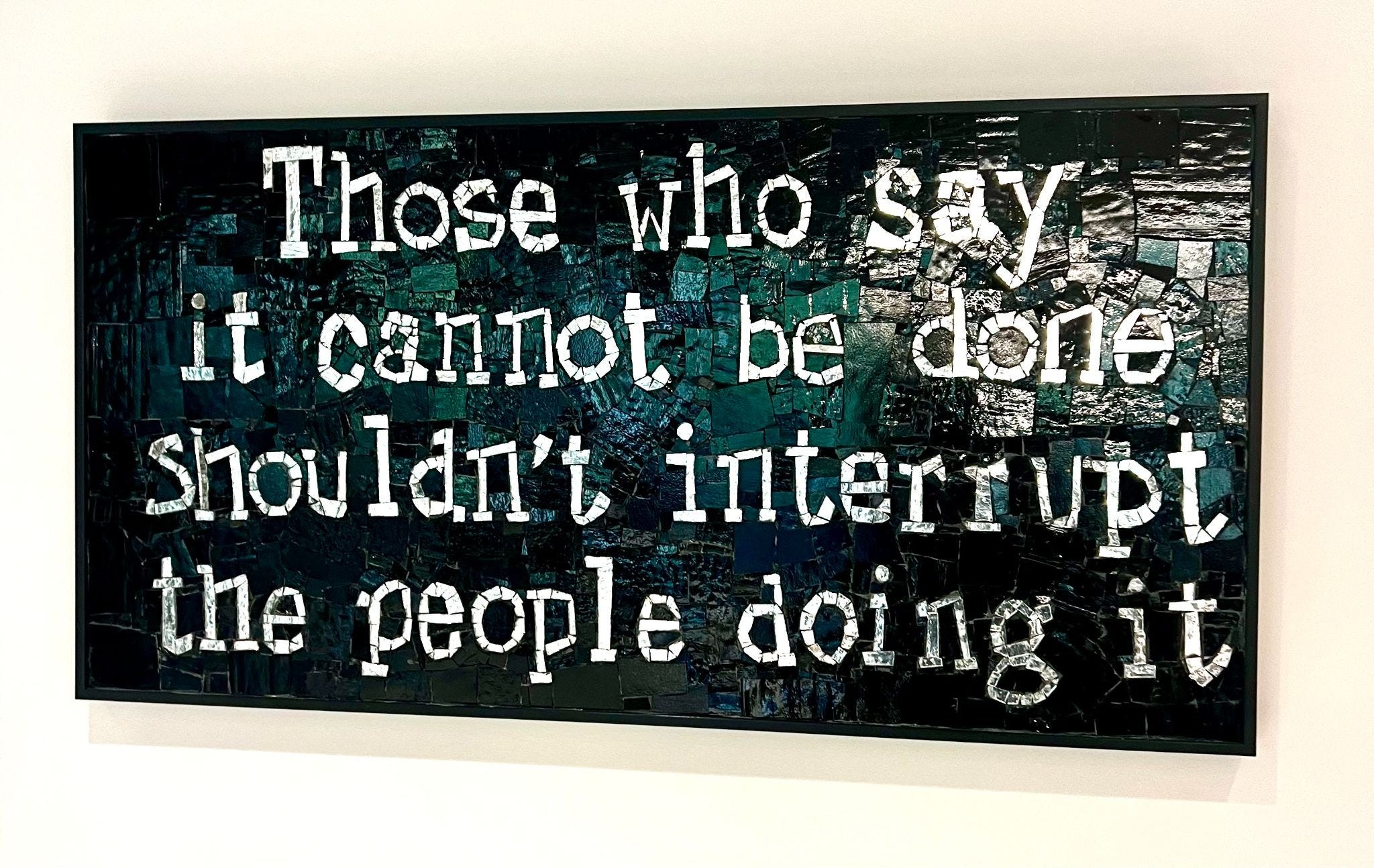
The world is full of people who will tell you why it can’t be done. And even if it could be done, you could never be the person who does it. Spend no time with these people.
(Pirate Christopher took this picture in the office of a self-made, multi-billionaire, category designing entrepreneur.)
For The Aspiring Artist, Writer, Musician, Or Filmmaker
You might say, but I don’t want to go into business. I want to do something creative. And I’m scared and angry at AI.
We’ve watched AI image generation hit the art world hard.
We’ve seen AI music tools that can produce a song in 30 seconds. If you want to be an illustrator, an animator, a screenwriter, a session musician, or a graphic designer, the ground is moving under your feet and we’re not going to pretend otherwise.
The most important creators on the planet are wrestling with AI too.
They are engaging with AI on their own terms. Some of them with deep skepticism, mixed with excitement.
James Cameron is the director of Terminator 2, Titanic and Avatar. He joined the board of Stability AI in 2024. He’s spent his career warning that AI could end humanity. He still thinks AI replacing actors is “horrifying” and that human art is “sacred.”
But he wants to understand the technology from the inside. He wants to use AI to cut the cost of blockbuster VFX in half, so big films can still get made without laying off the artists who make them.
Jacob Collier is a five-time Grammy winner. He partnered with Google on an AI music tool in 2024. He calls AI a “marvelous sort of sonic soup” that he can steer in uncharted directions. He’s used it to create sounds nobody had heard before.
Björn Ulvaeus is the songwriter behind ABBA, one of the biggest pop acts of all time. He’s co-writing a musical with AI right now. He says working with AI is “like having another songwriter in the room with a huge reference frame.” He also says AI is “lousy at making a whole song” and “not good at writing lyrics.”
Grimes has officially opened her voice for AI music collaboration.
Holly Herndon built a public “AI voice twin” she calls Holly+.
Wyclef Jean used Google’s Lyria 3 to help develop his song “Back From Abu Dhabi.”
None of these artists are saying AI is great. Several of them are saying parts of it are alarming. What they’re all doing is engaging with it on their own terms instead of letting other people use it on theirs.
If you want to be a filmmaker, you can be the filmmaker who learns to direct AI like Cameron. Or you can be the filmmaker who got replaced by someone who did.
And maybe, because of you and AI, we will have 1,000 times more art than we have now.
Art that both wounds and inspires us. Music that moves us to action to make the world better. Movies that bring an abundance of beauty to soothe us when the world leaves us with open sores.
Maybe, because of you, the phrase ‘starving artist’ will become an oxymoron.
Van Gogh died penniless, but his art is worth hundreds of millions a century later. Billie Holiday died with $0.70 to her name, despite being one of the great Jazz vocalists. Orson Welles created Citizen Kane, but never directed a profitable movie in his lifetime.
What if this next generation of artists, powered by AI, shrinks the cost to create and smashes the timeline for the artist to be fully appreciated so they can see and enjoy the fruits of their labor?
The choice to believe in abundance or scarcity is yours.
And whatever you choose to believe, it will come true.
Now, let’s get to the 18 ideas.
18 Crazy Profitable AI Businesses You Can Build Before 18
A few years ago we wrote a mini-book called How To Build Your First (Crazy Profitable) Business As A Teenager.
It became one of our most popular pieces of writing ever.
The argument was simple: Native Digital teenagers had an unfair advantage over Native Analog adults, because they understood the digital world in ways their parents, teachers, and bosses did not. If a teen would stop treating their phone like a TV and start treating it like a workshop, they could build a profitable digital business by 18, sock away $30K, and let the time value of money do the rest.
That advice still works. We still believe every word of it.
And there is even more proof it works. About 42% of U.S. teens under 18 earn something online. But that bar is low. Selling one hoodie on Depop counts. But still. Selling one thing once, counts as an entrepreneurial act. About 5% are running something that looks like an actual business.
Most importantly (for the first time in 25 years of tracking) 18–24 year olds are now starting businesses at higher rates than any other age group. Babson College called it a pattern “not seen in recent GEM USA report history.”
Here’s the part that’s genuinely, historically different: every generation before this one had to wait. Wait to be old enough. Wait for capital. Wait for permission.
This generation doesn’t wait. They got an AI co-founder.
In 2022, “Native Digital” meant you knew how to use Instagram, TikTok, Shopify, and YouTube. In 2026, that’s table stakes. The new advantage is being able to vibe create with AI, train your own agents, and ship outcomes ten times faster than the adults around you who are still asking, “Wait, what’s a custom GPT again?”
Last summer Pirate Eddie’s 17 year old son Luke helped us build the Pirate Eddie Bot. By the time he was done, we had an AI version of Pirate Eddie that’s available 24/7 to thousands of Founding Subscribers.
That bot is now one of the biggest drivers of our business.
(Built by a “kid”.)
That’s the opportunity in front of every teen reading this. Not “use AI to do homework faster.” Build a business with AI as your co-founder. Stack $30,000 by the end of one summer. And graduate high school with skills your peers (and most adults) won’t have for years.
This is the sequel to the OG mini-book.
One last word of caution.
Too many young folks are using AI as shortcuts. They end up creating AI slop. And it is obvious.
Using AI to cheat makes you a donkey. You want to use AI as a rocketship.
There are your peers who use AI to fake their way through homework, assignments, and life. They paste a prompt into ChatGPT, copy the output, and turn it in. Their writing is bland. Their thinking is borrowed. They’re just generating low-value output that anyone with a free OpenAI account could generate.
As AI gets cheaper and faster (it will), they’re going to discover their “skills” have zero market value.
Great writers become greater with AI. Lazy writers become lazier with AI.
AI works like money, it doesn’t change people, but it does reveal and amplifies who they are.
You want to learn to use AI as a co-founder. Not as a cheat code. Not as a threat.
As a partner. To do legendary stuff. And create legendary things. And when you do, you’ll have what the Doomers think is impossible and what the Slop Teens think they already have: a real, durable skill that pays you $30,000 by the end of a summer.
Don’t believe us yet?
Let’s get to the math.
$30K In Your First AI Summer
In the OG mini-book, Pirate Eddie ran the numbers on $30K by 18.
If you invest $30,000 in the Vanguard S&P 500 Index Fund by age 18, assuming 10% historical returns, you’ll have a little over $2,600,000 by the time you retire at age 65.
If you invest in Category Queens like Microsoft or Apple and average 25% annual returns, you’ll have over one billion dollars by retirement.
That math hasn’t changed.
What’s changed is the timeline to get there.
In 2022, hitting $30K as a teen meant: 10 clients × $3,000 each across a year. Or 100 products at $300. Or 300 products at $100. Real, doable, but a year-long project for most teens.
In 2026, hitting $30K as a teen means: one AI summer.
Here’s the math:
10 weeks of summer
$3,000 per week target
= $30,000
That’s one Delphi bot serving 100 customers at $30/month. Or three local businesses paying you $1,000/month each for AI automation. The math gets easier every month because AI tools get more powerful every month.
$30K by 18 is the OG promise. $30K in one summer is the AI version.
Now here are the 18 ways.
We’ve organized them into three buckets:
Save Time ideas, where the buyer is an adult who’s drowning in work
Save Money ideas, where the buyer avoids overpaying for something they need
Make Money ideas, where you build an asset that pays you back
Pick one. Don’t read them all and try to do them all. Pick the one that fits your existing interests, skills, or relationships. Get one customer. Then get five. Then come back for the next.
SAVE TIME
The buyer is an adult who is drowning. You’re selling them their life back.