


Arrrrr! 🏴☠️ Welcome to a 🔒 subscriber-only edition 🔒 of Category Pirates. Each week, we share radically different ideas to help you design new and different categories. For more: Audiobooks | Category design podcast | Books | Sign up for a Founding subscription to ask the Pirate Eddie Bot your category design questions.
Dear Friend, Subscriber, and Category Pirate,
Captain Shelly Rood’s job was to know things that other people didn’t.
As a tactical all-source intelligence officer in the United States Army, she ran teams of analysts across multiple intelligence disciplines:
Image intelligence
Human intelligence
Signals intelligence
“I could tell you, but I’d have to hurt you” intelligence
Captain Shelly’s job was to take the raw data flowing in from every source and synthesize it into a coherent picture. She’d brief the decision-maker with the clearest, most accurate reading of reality she could construct.
What was happening? So what does it mean? Now what do we do?
In every intel brief, an area will exist called ‘analyst note,’ and that’s where the true expert gets to share their read on the situation to the decision maker, possibly in an attempt to sway the briefing outcome. Analysts’ notes are the “hears what that means” portion of the briefing.
She briefed full-bird colonels, one-star to three-star generals. She gave intel briefings ten stories underground in a bunker in South Korea. She led covert briefings overseas and ran security programs for 4,000 soldiers.
Captain Shelly was exceptionally good at reading situations.
We could all use an intelligence officer for our lives.
Especially when we face life quakes.
What’s a life quake?
Let’s ask Bruce Feiler, the Category King of Life Quakes.
Pirate Bruce spent years crisscrossing America collecting hundreds of life stories for what he called the Life Story Project. He coded those stories for dozens of variables and published his findings in Life Is in the Transitions.
His core discovery: we experience a disruption (a meaningful life change) every 12 to 18 months. Most of those we navigate with relative ease. But about one in ten becomes what Feiler calls a “lifequake”.
A massive, forceful burst of change that leads to a period of upheaval, transition, and renewal.
His research found that the average person goes through three to five of these in their adult life, and the average transition takes about five years.
Do the math.
That means we spend roughly half our adult lives in an unsettled state. Feiler identified 52 distinct types of disruptors across five categories (body, love, work, identity, and beliefs) and found that the transitions they trigger don’t follow the neat, linear stages that a century of psychology promised us. Life, he argued, is nonlinear.
And the transitions that reshape life are nonlinear, too.
Captain Shelly was no stranger to life quakes.
She married her ROTC sweetheart right out of college.
Endured infidelity, excess drinking, and abuse/violence.
She divorced her ex-husband when her son was four.
But she also endured Career Quakes.
Targeted by insecure male superiors who saw her competence as a threat.
Falsely accused of plagiarism because her intel work was “too good”.
The chain of command that often put inferior leaders above her.
Every time she outperformed a weak boss, she got punished for it.
Make no mistake, Captain Shelly is no pushover.
She was captain of the rifle team. The best shot in her unit. A five-foot fireball who won awards for feats of strength in her sorority, before she chose the uniform over the Greek letters. Distinguished Military Graduate at WMU.
She grew up swinging hammers on rooftops in Detroit for her grandfather’s construction company—a third-generation business at Seven Mile and Van Dyke, the same neighborhood where 8 Mile was filmed.
Don’t mess with Captain Shelly.
How did she respond to these life and career quakes?
She became her own intelligence analyst.
She left the military
She went to seminary.
She became a chaplain.
She built a course on intimate partner violence.
She built a series of cohorts to help female military vets.
She built intellectual property on 8 “Wildflower” profiles of female veterans.
She just launched her own Substack and created the Pirate Shelly AI bot!
Captain Shelly became a Creator Capitalist.
Today, Shelly is remarried.
She has two more children. She says she’s the best she’s ever been. She’s a chaplain, a podcast host, a broadcast television executive, the founder of a community called Others Over Self with 154 members and 1,600 conversations in 2025 alone, and the creator of the state’s official Woman Veteran Peer Support Program in Michigan, going nationwide. She teaches courses on moral injury and intimate partner violence based on lived experience.
Pirate Shelly is a successful business owner and federal contractor getting ready to celebrate the ten year mark.
The problem she is solving is that the military has more Iron Man (playboy, rule breakers) than Captain Americas (ethical and physically strong). That leaves many women veterans without a narrative of their own.
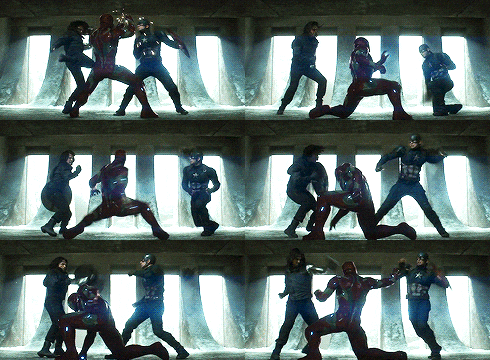
Her Superpower is exactly what it always was.
She just does it now for a different mission.
She reads situations, synthesizes data, constructs narratives, and briefs decision-makers. But this time, she is briefing the military women who disproportionately are the caretakers of aging parents, struggling friends and more. Because if we take care of these military women, everyone wins.
This mini-book is about how to use AI to have your own Career Intelligence Officer as you navigate Career Quakes.
Because career quakes are coming.
For some of you, they’re already here. AI is the biggest quake in a generation. It might be the biggest quake ever.
Entire categories, industries, and societies are being reshaped. Companies are restructuring. Re-starting with AI as their co-founder.
And somewhere in your life, a personal quake is going to collide with all of it.
We speak with more experience on this than we’d like.
The question isn’t whether you’ll face career quakes. You will. The question is whether you’ll be wise enough to let them build you.
Shelly was. Here’s how.
P.S. Quakes create the most growth. Because they force you to grow.
The Three Rings to Rule Them All
Your career doesn’t exist in a vacuum.
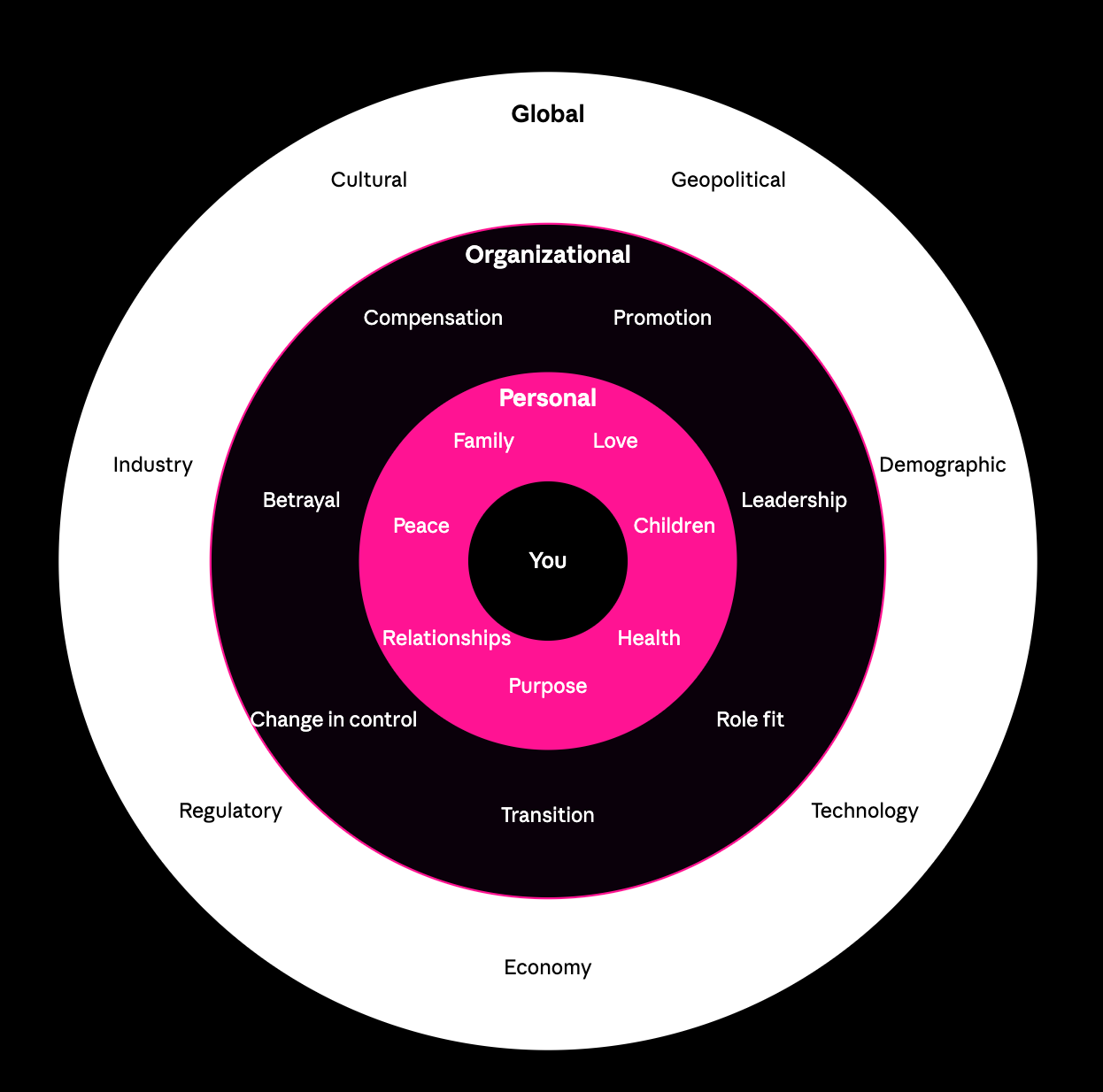
It sits at the center of three concentric rings. Each one is capable of remaking your life (or wrecking it) in ways you never saw coming.
Ring one: Global quakes. What happens around us matters. War, economic shifts, and rising inflation on the price of carbondigulators. We are not alone in the world.
Ring two: Organizational quakes. Who runs the company? Who controls the budget? Who gets into the meeting? Whoever decides if you’re in or out?
Ring three: Personal quakes. Your relationships. Your sense of purpose. The stuff the therapist asks about.

Most career advice picks one ring and pretends the other two don’t exist.
The business books obsess over global change. As if knowing a trend is coming makes you ready for it.
The leadership books obsess over promotions and organizational chess. As if climbing the ladder matters. Especially a ladder learning on the status quo building, which is already on fire.
The self-help books obsess over purpose and connection. As if your inner life is separate from the category quake happening around you.
The rings don’t move independently.
They interact. They amplify each other. They collide.
And the interaction effects (the place where category transformation meets organizational chaos meets personal upheaval, at the same time), that’s where people get built.
Or crushed.
Especially if they were only watching one ring.
Let’s go deeper.
Ring 1: Global Quakes
Seven world quakes you will face.
These are forces you can’t control and didn’t choose. They can cascade downward. A pandemic triggers remote work, which reshapes capital flows, which rocks industries, and which forces your company to restructure.
One quake.
Seven layers deep.
Geopolitical: Wars, pandemics, geopolitical change.
Demographic: Birth rates, aging populations, migration shifts.
Technology: Steam engine. Assembly line. Internet. AI.
Economy: Recessions, booms, interest rates, and capital markets.
Regulatory: One law, one signature, one ruling.
Industry: Category violence and Category Design.
Cultural: Social movements, generational value shifts, the zeitgeist.
To say nothing about the potential impact of meteors, aliens, or your weird neighbor Jim.
Each of the 7 quakes in the global ring can be a tailwind or a headwind.
These are not forces you can overpower, outmaneuver, or outrun. But you do have the power to choose your lens. To reframe your perception of them entirely.
Many legendary breakthroughs are forged in crisis.
Ring 2: Organizational Quakes
Seven category quakes reshaping work, and what they’re doing to you.
These happen inside the walls of your professional life. They’re more personal than global quakes but still largely done TO you by the organization, the boss, or the structure you’re operating in.
Or at least that’s how it can feel.
But just like the global quakes, a green and positive quake isn’t always a blessing. A red and negative quake isn’t always a burden.
Promotion: Too fast and you’re in over your head. Too slow and resentment breeds.
Compensation: More money isn’t always a blessing. Less money always stings. How you get paid shapes the outcomes that build your reputation capital.
Leadership: A great boss accelerates your career by a decade. A terrible one sets it back farther.
Role & Responsibility: Too much authority without clarity sets you up to fail. Wrong-fit jobs can turn a career you love into dread.
Transition: The lateral move. The industry jump. The step down you take to eventually go up. The step back to become a parent.
Change in Control: Merger, acquisition, IPO, bankruptcy. Life-changing wealth or wipeout, decided above your pay grade.
Betrayal & Blessing: You’ll be stolen from and screwed over. You’ll also receive credit you didn’t fully earn. Be prepared for both.
Ring 3: Personal Quakes
Seven quakes life does to you.
“Life is fired at us point-blank.” -José Ortega y Gasset
These are the original lifequakes (the legendary) Bruce Feiler studied—and they belong in any honest career framework. Because the idea that your career exists separately from your life is one of the most damaging lies the professional world tells.
Love: Your spouse is the highest-ROI career decision you’ll ever make. Divorce is experienced as something close to death.
Children: Having them changes every calculation. Not having them is its own quake. Children can multiply the highs and lows of your career.
Family: The unexpected phone call or the slow march of caregiving hugely impacts your career. Family can be the sanctuary from the storm.
Health: The wealth of health is almost always taken for granted. Until it is slowly or suddenly taken away.
Peace & Violence: Peace isn’t the absence of conflict. It’s the foundation you stand on for everything. If evil violently attacks you or someone you love, you will experience a seminal before/after in your life. Violence (or fear of it) changes everything. Peace changes everything, too.
Relationships: Humans need each other desperately. The right people are worth more than any credential. The wrong ones are deadly to your soul.
Purpose: You hit the goal, get the title, and feel not-so-satisfied. Or purpose finds you. And doesn’t let go. Work can be a means or an end in itself.
Pirate zebra whole:
When work shifts…
FROM: being the thing you do.
TO: the thing you were designed to do and only you can uniquely do.
You win.
And the world wins too.
Seven Core Truths About Quakes
Here is what we believe to be true—based on our own careers, on the data, on the hundreds of career stories we’ve studied, and on the three military stories in this book.