


Arrrrr! 🏴☠️ Welcome to a 🔒 subscriber-only edition 🔒 of Category Pirates. Each week, we share radically different ideas to help you design new and different categories. For more: Audiobooks | Category design podcast | Books | Sign up for a Founding subscription to ask the Pirate Eddie Bot your category design questions.
Dear Friend, Subscriber, and Category Pirate,
In Career Quakes Part 1, we wrote about 21 distinct global, organizational, and personal quakes and 7 core truths about quakes. We shared Pirate Shelly’s story as an example of how to build a personal AI intelligence officer to navigate the quakes in your lives.
Never let a crisis go to waste.
In this mini-book, let’s go deep into the practical and tactical about how to turn a Career Quake into Quake Capital. Turmoil into treasure.
The Treasure is in the Turmoil
Pirate Christopher went through a ton of turmoil as a teenager.
His band was signed when he was 14. 3 years later, he thought his band was on fire.
Then the quakes started.
Drummers quitting. Bass players quitting. Getting screwed by bar owners.
And the band was running out of money.
One quake led to another.
As the band was going bust, Pirate Christopher was getting thrown out of school. No one realized he was dyslexic. They told him he was dumb.
His mother’s voice on his shoulder, “You don’t get to grow up to be a bum.”
She was a 5’3” single mum. Pirate Christopher towered over at the age of 12. There were only two things to get her message across.
Guilt and love.
So she used a lot of both.
Those feelings drove Pirate Christopher. His entire life comes down to aiming to not experience the horror of disappointing his mother, father, and his grandfather.
He chose to strive to become the man they told him he could be.
Pirate Christopher’s mother taught him.
When somebody says, “I’m really disappointed in you,” what they’re saying is, I love you, and the potential I see for you is so much greater than the way you’re conducting your life right now. The delta between who you are and who you could be is crushing me.
We are only disappointed to the degree to which we see potential unrealized.
This is true for entrepreneurs, category designers, and creator capitalists of all types.
When we see the potential for a different future and the gap between what exists and what’s possible, it drives us to act.
It drives us nuts. And when a young person we care about doesn’t exploit their opportunities, it breaks our hearts.
Pirate Christopher isn’t the only person to find treasure in the turmoil. Fueled by love and guilt.
What Drives Career Breakthroughs?
We recently completed the “Creator Capitalist Mt. Rushmore Analysis”.
It’s a deep dive into what drives people to make a career change, which drives meaningful economic outcomes across hundreds of careers.
We mapped the demand landscape across two dimensions: the type of situation that triggered the value creation and the type of outcome that was achieved.
What we found was startling.
Most people think career breakthroughs happen when everything goes right.
They don’t.
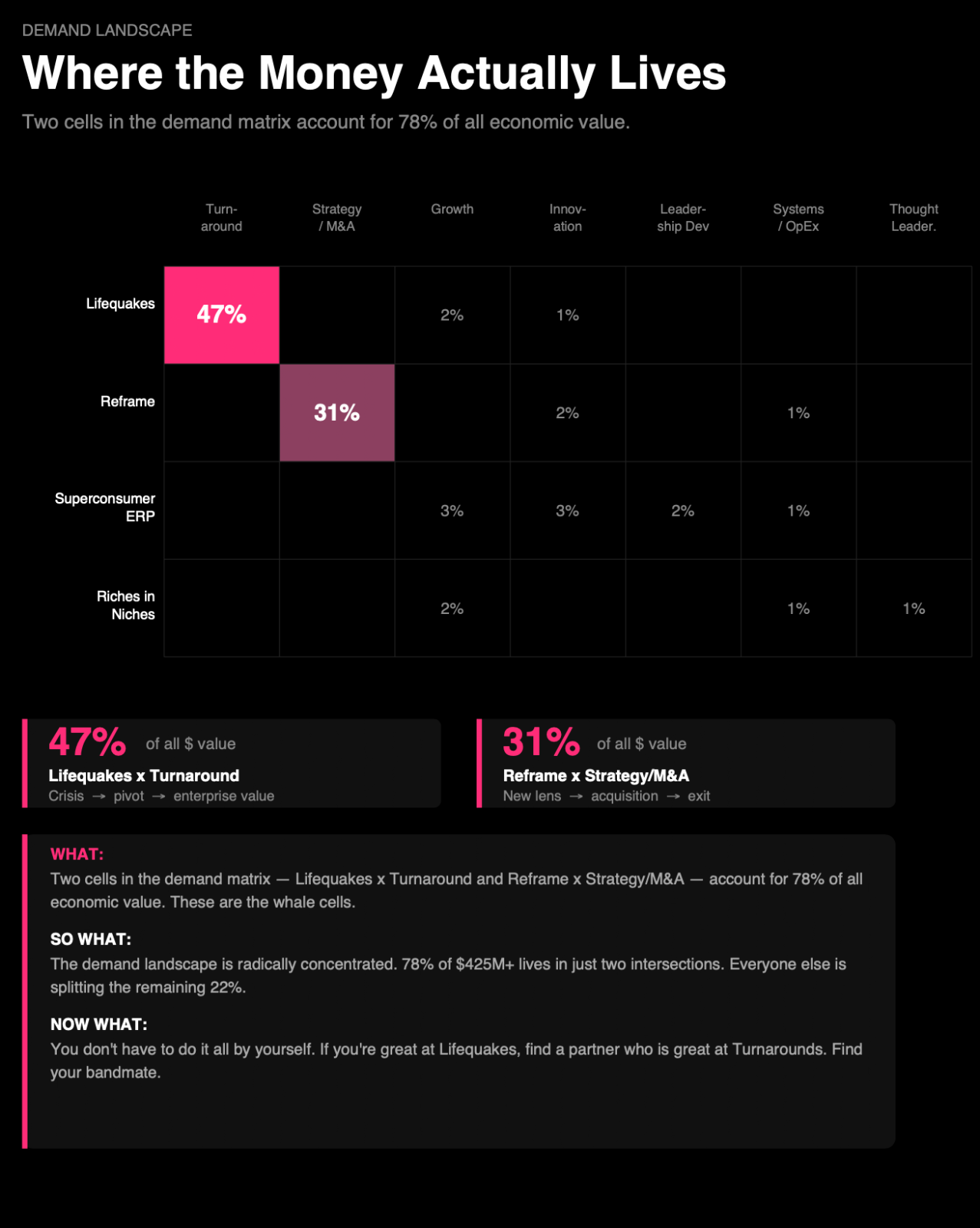
Two cells in the entire demand matrix accounted for 78% of all economic value created.
Not 78% spread across a dozen categories. Two cells. Out of dozens of possible intersections.
Lifequakes × Turnarounds = 47% of all value:
Crisis meets pivot, meets enterprise value creation. Nearly half of all economic value came from people and/or organizations that experienced a lifequake, used it to execute a turnaround, and built something transformative on the other side.
A disproportionate amount of celebration goes towards the entrepreneur going up in the world. Many acts of entrepreneurship are really acts of desperation. A way out, not a way up.
What forces the person is a quake. They realize, “My life is going to suck if things don’t get different.”
Or said a different way:
The risk of staying the same is greater than the change.
Reframe × Strategy/M&A = 31% of all value.
Bringing a new lens to an old problem opens up a world of possibilities for new strategies or M&A.
A reframe means someone looked at a familiar asset, market, or situation and saw something completely different from what everyone else did. That new lens is almost always built from one of the Four Capitals: financial, intellectual, relationship, or reputation.
The examples below show what happens when that shift in perspective gets applied to a major strategic move.
Financial Capital: Warren Buffett buys an infinite treasure chest for M&A
Buffett didn’t buy insurance companies; he bought a machine that paid him to borrow money forever for free.
Everyone else saw insurance as a premium-and-claims business. Buffett saw the float: the cash sitting between when premiums are collected and when claims are paid out. He got to invest it interest-free for decades. He bought National Indemnity in 1967 for $8.6 million, and nobody understood why. Then he bought GEICO. Then General Re.
“This collect-now, pay-later model leaves us holding large sums we call float. Meanwhile, we get to invest this float for Berkshire’s benefit. We enjoy the use of free money and, better yet, get paid for holding it.” Warren Buffett
The float grew from $16 million in 1967 to $164 billion by 2022. An 8,000-fold increase. He used it to buy BNSF Railway, See’s Candies, and dozens of others. No outside capital.
For many companies, their WACC (weighted average cost of capital) is anywhere from 5% to 15%. Capital carries a cost that companies must pay.
Buffett’s wacky source of capital gave him a negative WACC to take unlimited whacks at buying and investing in everything from AmEx to Apple.
Intellectual Capital: Roche acquires Genentech
Every other pharma company that bought a biotech did the same thing. They did the deal, absorbed the team, installed their processes, and watched the innovation die.
Roche bought a 56% stake early and left Genentech completely alone. Didn’t touch the culture. Didn’t touch the scientists. Let it run independently for years. Then paid $47 billion for the rest in 2009.
What came out of that engine: Herceptin, Avastin, Rituxan. Three of the best-selling cancer drugs in history.
You can’t acquire innovation by controlling it. Roche bought the goose and kept it safe.
Relationship Capital: InBev acquires Anheuser-Busch
InBev wasn’t just buying brands like Bud Light. They were buying a century of relationships with American beer distributors.
The U.S. beer distribution system is a legally protected three-tier network. Those distributor relationships are built over generations, governed by state franchise laws that make them nearly impossible to terminate. No new entrant can replicate them. No amount of money builds them from scratch. InBev knew this. They paid $52 billion in 2008 not for the brands, but for the pipes.
Within two years, they cut $2.25 billion in costs. AB InBev today controls roughly 25% of global beer volume.
The distributor network is the business. The brands were a bonus.
Reputation Capital: Microsoft acquires GitHub
One developer’s reaction to the day the deal was announced said it all: “Microsoft buying GitHub feels like Exxon Mobil buying Greenpeace.”
That reaction was the whole point. For two decades, Microsoft was the villain of the developer world. They were closed source and anti-Linux. Ballmer had literally called Linux a cancer. GitHub had 28 million developers, and the one thing Microsoft couldn’t build or fake: trust. Nadella paid $7.5 billion and said the quiet part out loud: “We’ll have to earn the trust, there’s no question of that.”
“Overnight, Microsoft now has a relationship with almost every developer in the world,” John Connors, Microsoft CFO
GitHub had $300 million in revenue at acquisition. By 2024, it had hit $2 billion. Nadella on a 2024 earnings call: “GitHub Copilot is already a larger business than all of GitHub was when we acquired it.”
Copilot didn’t exist when Microsoft bought GitHub. It was built on the reputation capital they acquired, and then earned the right to use.
They weren’t buying a code repository. They were restoring their reputation.
Almost a third of all value came from people who saw the world differently and used that new perspective to execute a major strategic move.
Read that again. The single biggest driver of economic value creation is lifequakes combined with turnarounds. They’re called pivots.
Not smooth growth. Not incremental innovation. Not optimization. Crisis. Disruption. The thing everyone runs from.
This isn’t philosophy. It’s math. And the math says: the red ring is where nearly half of the value is created.
Every instinct tells you to avoid the quake.
The data says use it.
Because the people in this data didn’t just recover from their quakes. They came out the other side with a POV nobody else had, because nobody else lived through what they did.
That’s the raw material for a new category.
The 4 Piratey P’s
When a career quake hits, you need a playbook. A powerful lens. Not a 47-step strategic plan. Not a meditation app.
A simple, honest, actionable framework that respects the reality of what you’re going through while giving you something (concrete) to do about it.
We call it the 4 P’s:
Puke
Plant
Prioritize
Progress
Pirate Eddie and his family have deep firsthand experience.
In June 2017, Pirate Eddie left his old firm to go solo and started off with a bang.
He gave a keynote speech at a conference in Anaheim alongside Arnold Schwarzenegger, Giada De Laurentis, and Earvin Magic Johnson.
His consulting income doubled, while working a fraction of the hours he used to. He was writing freely at HBR.
The organizational Ring was all green. In a way he had never felt before. His career was driving with incredible momentum, and Pirate Eddie was enjoying the wind in his hair. He had dreamed about this moment for years.
Then a personal quake t-bones his family.
One of his kids went through a major mental health crisis in junior high. She was struggling with depression and anxiety. Eventually, they had to hospitalize her for her safety.
When Pirate Eddie’s wife took their daughter into the hospital in the middle of the night, she had to call a friend to stay with the other kids.
Because Pirate Eddie was traveling for work.
Pirate Eddie had the most agency and freedom he ever had in his work.
But he wasn’t there when his family most needed him.
Today, his daughter is in a much healthier place. She’s put in a ton of work with counselors. She has great coping skills.
She’s emotionally healthier and more mature than most adults.
When Pirate Eddie loses his temper, she will calmly call him out with courage and care. Pirate Eddie and his wife are proud of the progress she has made. She is using her scars to serve and help other people.
But Pirate Eddie is still counting the cost of how he reacted to the personal quake.
He created a ton of freedom in his work, but work was so addictively fun that he didn’t always make the right choices in the moment.
He focused on his career and lost sight of his wife’s. Pirate Eddie’s wife was making a comeback in her nursing career when all of this went down. She yet again had to sacrifice her career.
Pirate Eddie was too blind, busy, and not empathetic enough to appreciate her sacrifice.
It took years and thousands of dollars of marriage counseling to hash all of this out.
The counseling was necessary because there were feelings Pirate Eddie was reluctant to puke out. Because he was ashamed that he wasn’t there when his family needed him. He was ashamed that he cared so much about how this impacted his work. He was ashamed that he couldn’t see the sacrifices his wife was making.
If you don’t puke out your feelings, you can’t process them.
P1: Puke
Get it out of your system.
When a quake hits, the first thing you need to do is puke.
Don’t ignore it. Don’t clean it up. Don’t look on the bright side of puke.
Look at the puke in all its disgusting, smelly and revolting mess for what it is.
Puke is pure data.
Just got laid off? You’re furious, terrified, humiliated, relieved, excited? Good. Feel that. Say it out loud. Write it down. Call someone you trust and vent until you’re empty. Journal like your life depends on it, because it might.
Every career decision you make while you’re full of fear, rage, excitement, or despair will be a bad one.
The goal of the puke phase is to drain the emotional poison so you can think clearly.
The mistake most people make isn’t feeling their feelings. It’s skipping this step entirely—pretending they’re fine, jumping straight into “what’s next,” and making reactive decisions from unprocessed panic.
Or they get stuck in the puke and never move on.
Puke.
Get it out.
And stop puking.
If you’ve read A Pirate’s Guide to AI, you already know what comes next: puke it into the AI.
By the way, the Pirate Eddie bot is a pretty good listener. And it doesn’t fall asleep early like the real Pirate Eddie.
P2: Plant
Use it like fertilizer.