


Welcome to the Pirate Street Journal. Most people make their biggest calls category blind. They see the price, the pitch, or the headline and miss how the whole category is built. In Deep Dive Reports, we call where the category is going next so you can be the visible expert in your Monday meeting.
Piratey disclaimer: This is NOT financial advice. None of us have Series 63, Series 6 7, CPAs, CFAs, IUDs, IEDs, and hopefully not IBS. Think of this like professional wrestling. It’s entertainment. Don’t be so smart you’re stupid and suplex your safety net savings.
Dear Friend, Subscriber, and Category Pirate,
This Deep Dive Report (DDR) is for our fellow Gen Xers.
You’re probably not new to real estate. But more real estate transactions are looming. Becoming an empty nester is on the horizon, and with it comes the decision to downsize or not. Or you may be dealing with aging parents, who may need your help transitioning to a different life stage.
A dream for the next phase of life that comes with a dream home.
That’s a lot of life quakes, Pirate!
The sandwich generation is real. 54% of Americans in their 40s have a parent 65 or older and are raising or supporting a child. (Pew Research.)
The new Personal AI category holds the promise of helping Gen X tackle this smarter, faster, and different.
And save 6 figures.
Personal AI will likely save Pirate Eddie and his wife about a quarter of a million dollars in cost savings and deferred taxes this year. He was excited until he looked back and realized not having Personal AI for past real estate transactions likely cost him and his wife nearly the same amount.
So we’re sharing his learnings and battle scars here, in a two-part DDR.
The Fine Line Between Barbie’s Dream Home and Nightmare on Elm Street
One of the best investments Pirate Eddie and his wife made was their Big Island rental property.
It was new construction and has more than doubled in value. They got extremely favorable mortgage terms during the 2019 to 2021 period of low interest rates. They found a fantastic property manager (Shiwota Resorts), who was also buying from the same developer at the same time.
They hit the jackpot of recurring rental income, significant property appreciation, and the personal benefits of enjoying the home. And the Pirates love their writing retreats at Pirate Eddie’s house!
But this outcome was a stroke of luck, not a stroke of genius.
The Pirates have also seen real estate go way wrong.
A family they know bought and lived in a home. Nearly a decade later, they sold it for less than what they paid for it despite big upgrades. They bought a new place in a new city. The new place just dropped in price, so they thought it was a good deal. But it was a falling knife.
Years later, they sold it for about a quarter less than what they paid for it. And it took nearly two years to sell. With 20/20 hindsight, if they pushed the transactions a few years later, the first home would have sold for 50% more and they could have bought their second home for 30% less.
It was bad luck that resulted in a negative $800K swing in net worth.
The Big Real Estate Lie
Owning real estate is and has been a core part of the ‘American dream.’
Real estate accounts for half to two-thirds of the net worth for the median US household. This makes it seem like real estate is an awesome investment.
Not always, and not recently compared to stocks.
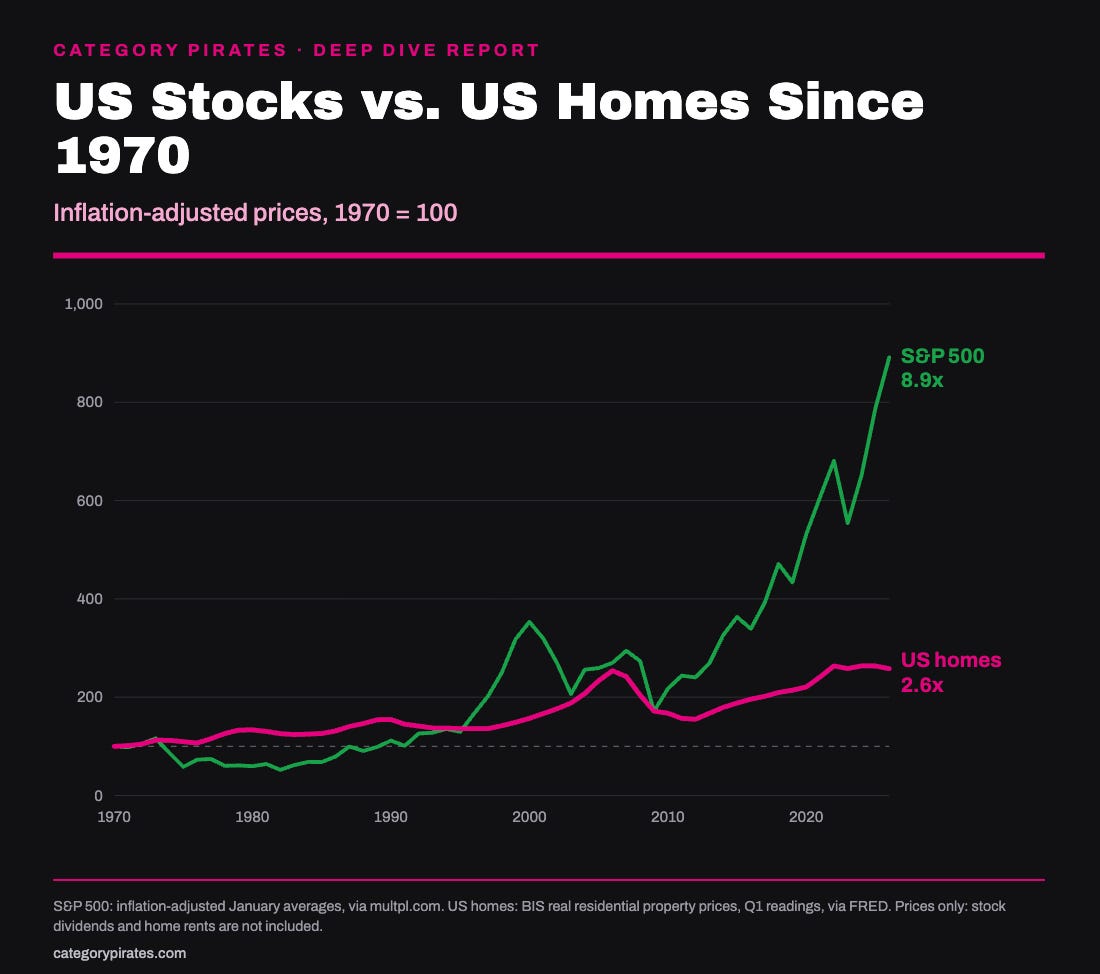
The stock market underperformed real estate from the 1970’s to the 1990’s. But since 2010, the S&P 500 has trounced real estate.
So why is real estate so sought after?
Leverage, aka taking on debt to buy an asset.
Leverage Massively Multiplies the Risk and Reward of Real Estate
Leverage in stocks is rare.
Only 10% of US stock investors buy stocks on margin, where you take out a loan using your stocks as collateral. This being so low is a (very) good thing. Because languaging gives us a different word for this.
Gambling.
Exhibit A: Leopold Aschenbrenner.
He graduated from Columbia at 19 as valedictorian. He worked at OpenAI, co-authoring technical papers with the smartest of the smart. He built a $45 billion hedge fund that was up 439% from January to June 2026.
Butt…

He did it by borrowing $3 dollars for every $1 dollar he invested. In July 2026, his AI stocks fell more than 30%. The banks issued margin calls. This forced Leopold to sell his public stock portfolio (about $16 billion) in a fire sale to Ken Griffin’s Citadel.
The fund shrank to about $10 billion.
The speculation is other hedge fund sharks knew how leveraged Leopold was and specifically targeted to take him down. The most incredible part was Leopold’s languaging, specifically the name he chose for his hedge fund.
“Situational Awareness.”

While these stories are rare in the stock market, leverage is part of the category design of real estate.
No leverage. No real estate category.
74% of buyers buy real estate with a mortgage. The median down payment on a home is 19%, that means every homeowner is borrowing $4 dollars for every $1 dollar invested.
Ready for the wild part.
A slightly higher leverage ratio to Leopold.
Let that soak in.
An unthinkable feature in one category.
Built into the design of another.
Now the important difference is mortgages don’t have margin calls. If Zillow says your home value has gone down, the bank that has your mortgage won’t force you to sell your home.
We’re not saying real estate leverage is bad.
We are saying context is king.
It can be great to own your own home, but the timing matters. It’s not always a no-brainer. It can break very good and very bad for you.
Real estate calls for situational awareness.
The 3 Problems of Analog Real Estate and Realtors
Lucky for you, Pirate, we live in the age of AI.
Pirate Eddie relies on Personal AI for real estate more than his real estate agents, accountants, and attorneys. Every prior real estate transaction without AI felt like driving blindfolded, steering with your feet on the Autobahn.
This is because AI solves three category problems in real estate today.
First, AI clarifies the give to get from realtors.
Realtors get 5% of the home value for a home transaction. This is split between the buying and selling realtors. For a $300,000 home, that’s $15,000. For a million dollar home, that’s $50,000. This “get” part is clear.
But the “give” ranges wildly. And it is not spelled out.
A great realtor might project-manage your entire transaction. A poor one leaves you to do it yourself. A great realtor gives you tips on taxes, financing, and investing related to your home, even though that’s not their job. A poor one drives you to transact without regard to whether the deal is a net positive or negative for you. A great realtor knows you want a new life experience, not just a place. A poor one over-sells to get you to close.
The second problem is that the ideal realtor is a mixed martial artist (MMA).
An MMA fighter is someone who can box, kick, wrestle, and more. The ideal realtor has expertise in real estate, personal finance, real estate, accounting, tax, negotiation, construction, project management and therapy.
Good luck finding all that expertise in one person. AI is the only way to augment your realtor with these diverse types of expertise.
(This gets truer and truer every day in every knowledge worker’s career.)
The final problem is the lack of true AI native realtors.
Pirate Eddie worked with realtors who are skilled and real estate savvy, but not tech savvy. Analog realtors who are so far behind. DocuSign is a novelty.
They still want to place ads in dying newspapers. AI was barely on their radar.
Here are nine specific ways to design your own personal real estate AI.