


Arrrrr! 🏴☠️ Welcome to a 🔒 subscriber-only edition 🔒 of Category Pirates. Each week, we share radically different ideas to help you design new and different categories. For more: Audiobooks | Category design podcast | Books | Sign up for a Founding subscription to ask the Pirate Eddie Bot your category design questions.
Dear Friend, Subscriber, and Category Pirate,
Pirate Christopher’s Scottish grandfather served in His Majesty’s Royal Navy in World War II.
When the war ended, he married his grandmother, packed everything they had, and moved to Montreal with a two-year-old daughter and a job at a rubber factory.
He didn’t move for comfort. He moved out of desperation and possibility.
Often, two sides of the same coin.
A generation later, Pirate Christopher did the same thing. Left Canada at 28 for Silicon Valley. Ten years after failing out of school at 18 with no options, no credentials, no money, and no obvious path forward. He carved out a niche and built a small company. Sold it. To go somewhere that would empower him instead of holding him down.
There was only one place on earth where a kid with nothing could build something legendary.
Pirate Eddie’s family made the same bet from a different direction. His father was pursuing a career as a prosecutor in Korea. But his father remembered how hungry he was as a teenager during the Korean War. He left Korea behind to immigrate to Hawaii. He left his career behind to work as a janitor and limo driver to remove the limits on the education of and upside for his kids.
Two families. Two wars. Two bets on the same country.
And neither of us would be Pirates today without it.
🔊 Want to listen to this mini-book instead? Head to the audiobook.
The USA is Still the #1 Place to Move to
Since 2007, Gallup has asked people in 150+ countries a simple question.
If you could move anywhere on Earth, where would you go?
Every single year, the same country wins.
It’s.
Not.
Even.
Close.
About 18% of all the world’s population, more than 170 million people, pick the United States. The runner-up, Canada, draws about half that.
In contrast, China has four times America’s population, yet draws and naturalizes almost no one. Foreign-born folks in China is 0.1% versus 15% in the US. China actually had a net loss of 3.5 million people. Any migration is happening within China, with 376 million people moving from village to city.
America’s demand is not due to its superiority.
People want to move to America because America is different.
Every other country on Earth is a club. America is a catapult.
The wealthiest person in Japan is Masayoshi Son, CEO and founder of Softbank. He was born in Japan. He speaks Japanese. He married a Japanese woman. He is a Japanese citizen with full voting rights.
He is ethnically Korean. He was bullied for being Korean, to the point of contemplating suicide. When entering the Japanese software business as a young entrepreneur, Son faced obstacles, including being denied credit specifically because he was Korean.
In nearly every country. You’re born a member, or you spend a lifetime on the outside.
America is different.
America is purpose-built for giving people driven by dreams an opportunity to go further than they could have at home. America was founded by pioneers.
Not growing up in the US makes it crystal clear to many of those who come here what is possible in America.
They can play bigger in the USA.
It’s hard to see the legendary opportunity that is America if that is all you’ve ever known. Maybe it feels like there’s a lot of fighting in America right now.
But the fight inside this country was never really left versus right.
The fight is between those trying to preserve the past and those trying to create the future. Between the makers and the takers. This has been true throughout the history of America.
The Declaration of Independence was for a future with more freedom.
“Whenever any Form of Government becomes destructive of these ends, it is the Right of the People to alter or to abolish it, and to institute a new Government…”
The Gettysburg Address was for a future with more freedom.
“from these honored dead we take increased devotion to that cause for which they gave the last full measure of devotion — that this nation, under God, shall have a new birth of freedom...”
JFK’s Moon Race was for a future with more freedom.
“We choose to go to the Moon in this decade and do the other things, not because they are easy, but because they are hard…”
MLK’s I Have a Dream was for a future with more freedom.
“I have a dream that my four little children will one day live in a nation where they will not be judged by the color of their skin but by the content of their character.”
Reagan’s Dawn of a New America was for a future with more freedom.
“While other countries cling to the stale past, here in America we breathe life into dreams. We create the future, and the world follows us into tomorrow.”
Jobs’ Stanford commencement speech was for a future with more freedom.
“Stay hungry, stay foolish. You can’t connect the dots looking forward; you can only connect them looking backwards.”
Obama’s Yes We Can speech was for a future with more freedom.
“Change will not come if we wait for some other person, or if we wait for some other time. We are the ones we’ve been waiting for. We are the change that we seek.”
Musk’s mission for SpaceX was for a future with more freedom.
“America would never have been colonized if ships weren’t reusable. We must make life multiplanetary… to extend the light of consciousness beyond Earth.”
Andreessen’s It’s Time to Build was for a future with more freedom.
“There is only one way to honor their legacy and to create the future we want for our own children and grandchildren, and that’s to build.”
And the future’s so bright, you gotta wear shades.
The Three Great Differences
Three questions make America different.
How do you belong?
Where does power live?
What does participation cost?
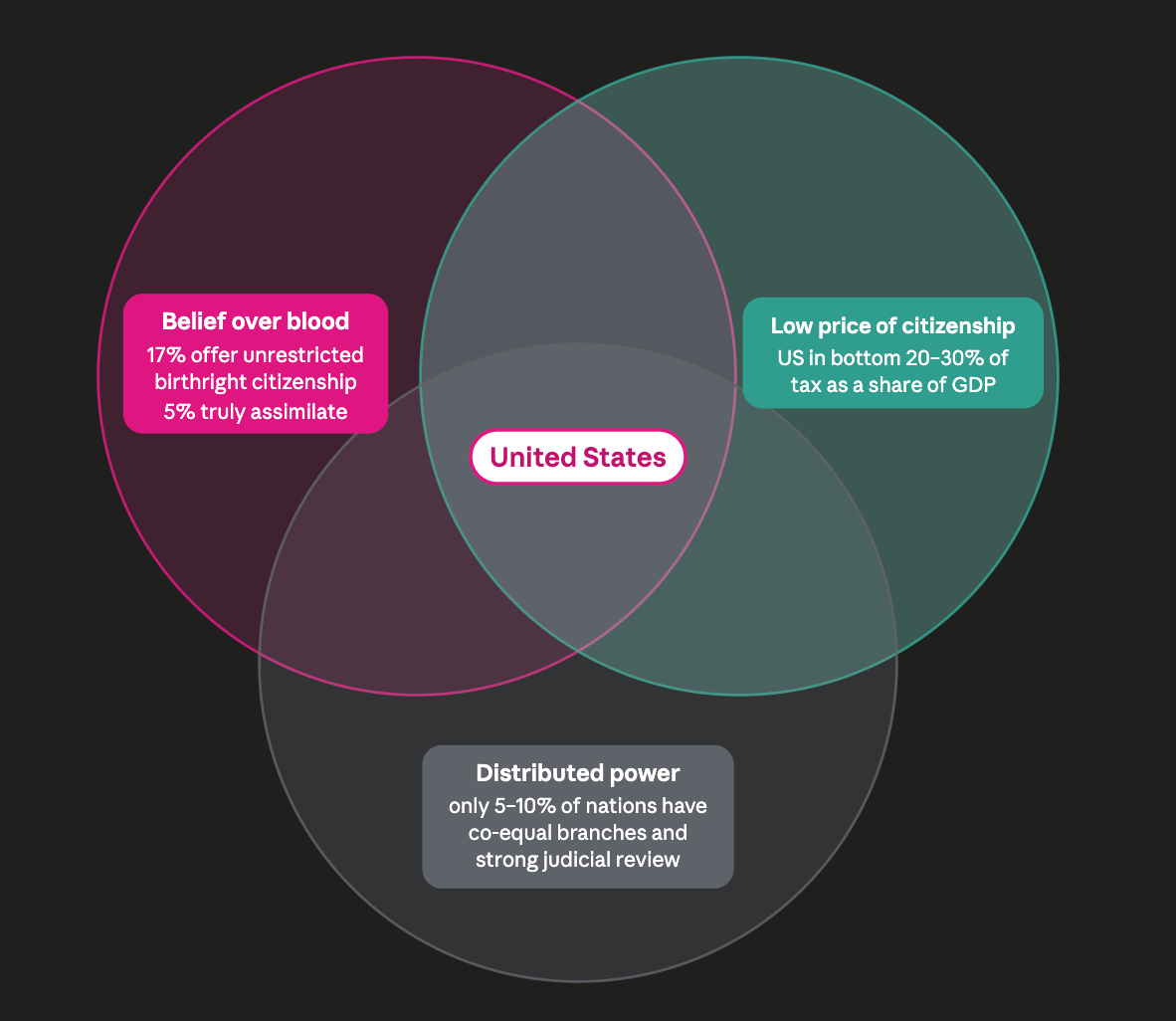
Belonging is based on belief and what you build, not blood.
Everywhere else, you belong by ancestry. In America, you belong by buying into an idea and proving yourself in the arena.
17% of countries offer unrestricted birthright citizenship. 5% have true assimilation without strong ethnic barriers.
Most Americans have no idea how rare that is. Because most Americans have only lived in America.
Russia: Dissent is deadly.
Saudi Arabia: religion determines your rights.
China: the state decides where you live, work, and move.
Much of the Middle East: Apostasy and homosexuality are illegal.
Much of Latin America: Lighter skin still buys more opportunity.
In most of the world, where you start is where you finish.
America has class distinctions. But they are far more fluid than fixed.
We know this because immigrants and their children founded 59% of America’s billion-dollar startups. Nearly 80% of US unicorns have an immigrant founder or key leader.
These are not people who arrived with advantages. Many arrived with nothing. They won because America asks two questions that no other country asks.
Do you believe the American dream can work for you?
What are you going to build?
Distributed power. The Declaration of Independence, the Bill of Rights, and the Constitution all share power vs. concentrate it. Checks and balances ensure this stays true. 5-10% of countries have legit co-equal branches of government and strong judicial review.
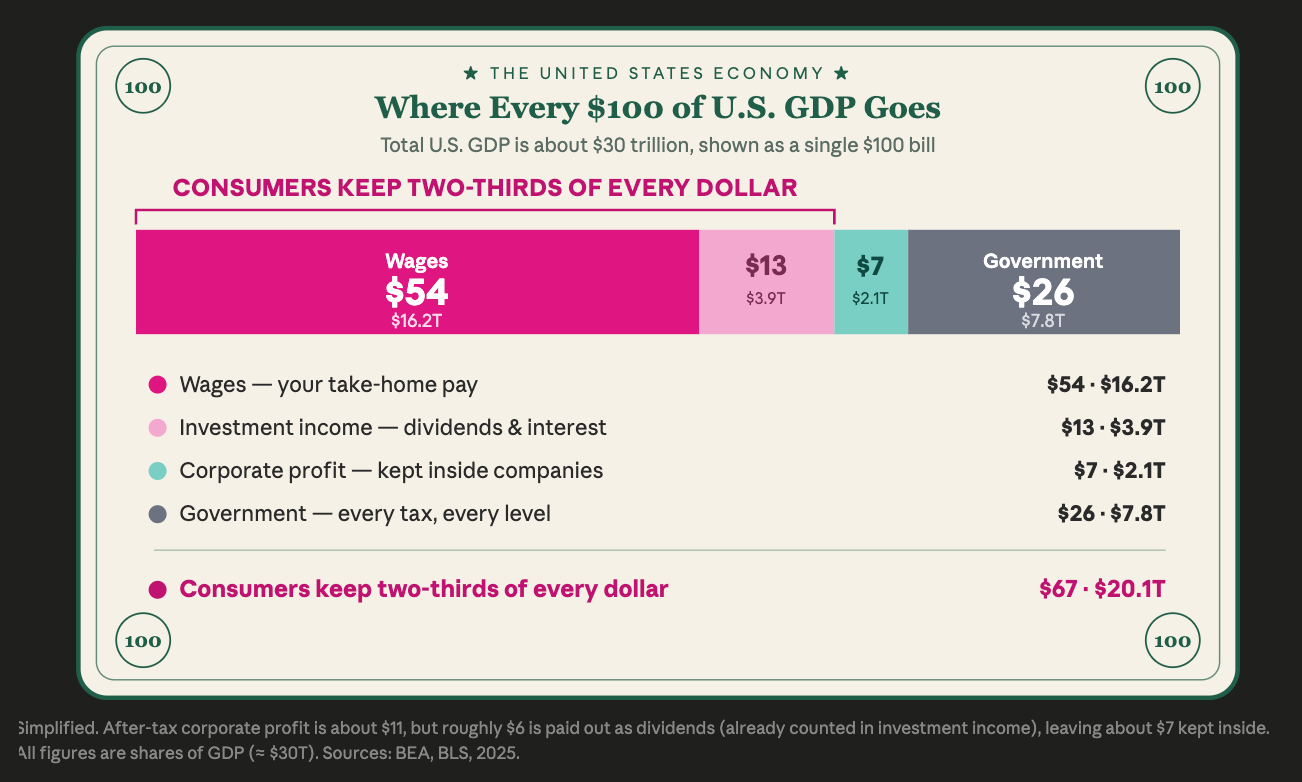
A relatively low price of participation. Taxation without representation was one of the original ways America was framed, named, and claimed. The US is in the bottom 20-30 percentiles for tax rates as a percent of GDP. America lets you keep more of what you make.
If you look at the Venn diagram of all three, you have one country out of the entire world.
Here’s more Category Science on how $100 of US GDP flows. The American dream can’t exist if you can’t keep enough of what you make.
We created another chart to bring this to life.
X-axis is how you belong (blood on one end, belief on the other).
We use Gallup data on which countries have the most demand to immigrate to.
China was excluded from that data, so we used a comparable Gallup data set.
Y-axis is the government’s cut of GDP, as explained above.
Bubble size is GDP
Bubble color is decentralized vs. centralized power.
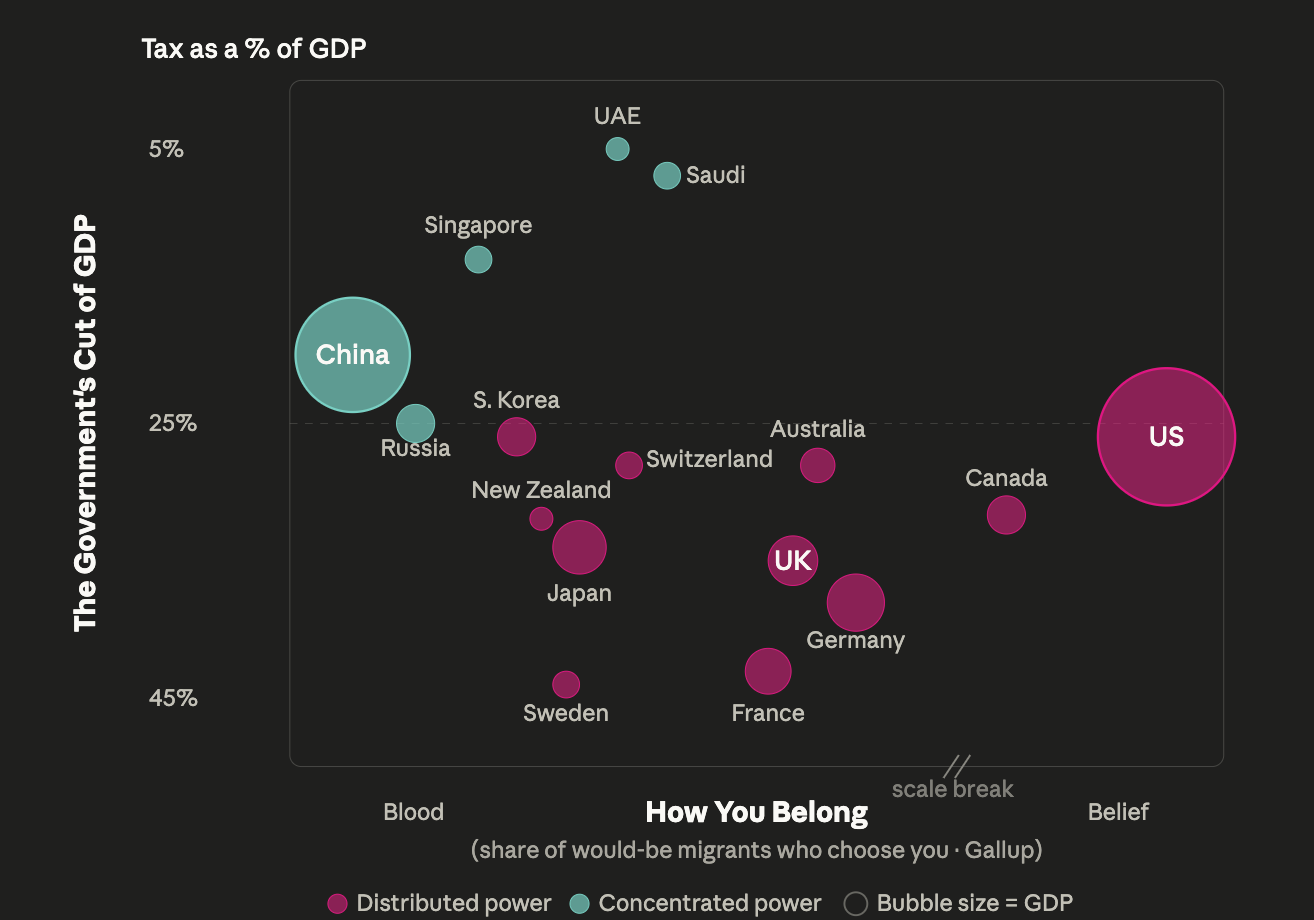
What do you see? The US is the largest bubble, given its unique cocktail of the three great differences.
China is the second largest, with slightly lower taxes, centralized power, and blood-based belonging.
The Party is Just Getting Started, thanks to Pirate Jevons and his paradox
American GDP went from under $3 trillion in 1980 to more than $30.7 trillion in 2025, a 10x in a single working lifetime. And America stands alone here. In an exceptional way. Most other G7 economies grew only about 4 to 6 times.
AI is going to amplify the three things that make America different.
AI amplifies your ability to build.
Builders drive abundance.
In 1790, the United States of America was a brand-new country. Thirteen colonies. Four million people. Mostly farmers. Estimated GDP: $193 million.
Today, the US has 330 million people. GDP is $30.7 trillion.
No country has ever created more abundance, at a greater scale, for more people, in less time than the United States.
But to understand why, we have to go back in time to one of the OGs of weird data.
In 1865, British economist William Stanley Jevons noticed something weird.
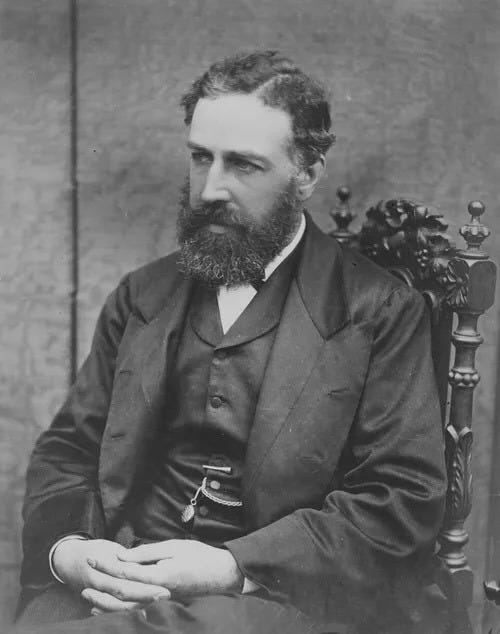
Steam engines were getting more efficient, using less coal to do the same work.
The “smart” economists of the era all predicted the same thing: coal consumption would drop.
The opposite happened.
More effective engines made coal-powered production cheaper. So, more businesses adopted steam power. New value got created. Total coal consumption exploded.
Greater efficiency doesn’t reduce demand for a resource. It increases it.
Because efficiency lowers the cost of doing something. So more people can do it. Which expands what gets done. Which creates entirely new categories of value.
This is the Jevons Paradox.
And it is the most powerful argument against the scarcity premise ever written. Because it proves that value is not finite. Value expands as humans create.
Every time human beings produce an exponential breakthrough. They invent entirely new things to do.
New categories.
New demand.
New value.
Think about what actually happened between 1790 and today.
Americans didn’t just get better at farming. We invented…
The railroad. Which allowed them to distribute and sell crops further away.
Electricity. Which allowed them to preserve their crops via refrigeration.
The automobile. Which let consumers buy and bring crops home.
The computer. Which allowed you to plan what crops to buy.
The internet. Which gave you recipes to cook the crops.
The smartphone. So you can post pics of your cooking.
The world benefited as well. All of this allows folks like Pirate Melissa to create Connected Farms to help bring farmers in Australia, New Zealand, and more out of digital darkness.
AI is next.
Before we look forward to the upside of AI, let’s look back at the internet’s abundance. Because the internet is the most recent and most measurable proof of the Jevons Paradox at society scale.
In 1995, the commercial Internet was brand new. World GDP was approximately $31 trillion. The internet economy was essentially zero.
Over the next 30 years, world GDP grew from $31 trillion to approximately $110 trillion.
Nearly $80 trillion in new value. The internet didn’t redistribute wealth. It helped create it.
McKinsey Global Institute research found the internet accounted for 21% of GDP growth in developed economies during its peak adoption years.
If measured as a sector today, the digital economy is bigger than agriculture or energy.
The World Bank now estimates the global digital economy at $16 trillion. Roughly 15% of all world economic output. And, world GDP totaled approximately $31 trillion in 1995.
Which means the internet category created new digital value worth more than half of everything the entire world produced in 1995.
(Read that twice.)
This is the Jevons Paradox playing out in real time.
The internet made communication, commerce, and information radically different. And instead of reducing demand for those things, it exploded demand. New categories were designed that hadn’t existed before. (New categories create more new categories.)
Let’s look at two scenarios.
Scenario 1: AI Matches The Internet
World GDP today: $110 trillion.
If AI creates the same proportional value as the internet (half of today’s world GDP), that is $55 trillion in new economic value. Created from nothing. Over the next 30 years.
Scenario 2: AI Is Twice The Internet
World GDP today: $110 trillion. If AI creates twice the proportional value of the internet over the next 30 years, that is $110 trillion in new economic value.
Sounds crazy?
Goldman Sachs projects AI will raise global GDP by 7% over the next ten years.
PwC projects AI could contribute $15.7 trillion to global GDP by 2030 alone.
McKinsey says between $2.6 and $4.4 trillion in new value.
Every year. Compounding.
The argument we’re making is to let our winners ride.
Remember Masa?
What if Masa wasn’t allowed to let his winners ride? What if his wealth was redistributed versus reinvested?
This is the future that would have been prevented. Masa’s company Softbank, went public in 1994, when this chart started. Credit to Ryan Petersen, CEO of Flexport, for this legendary post.
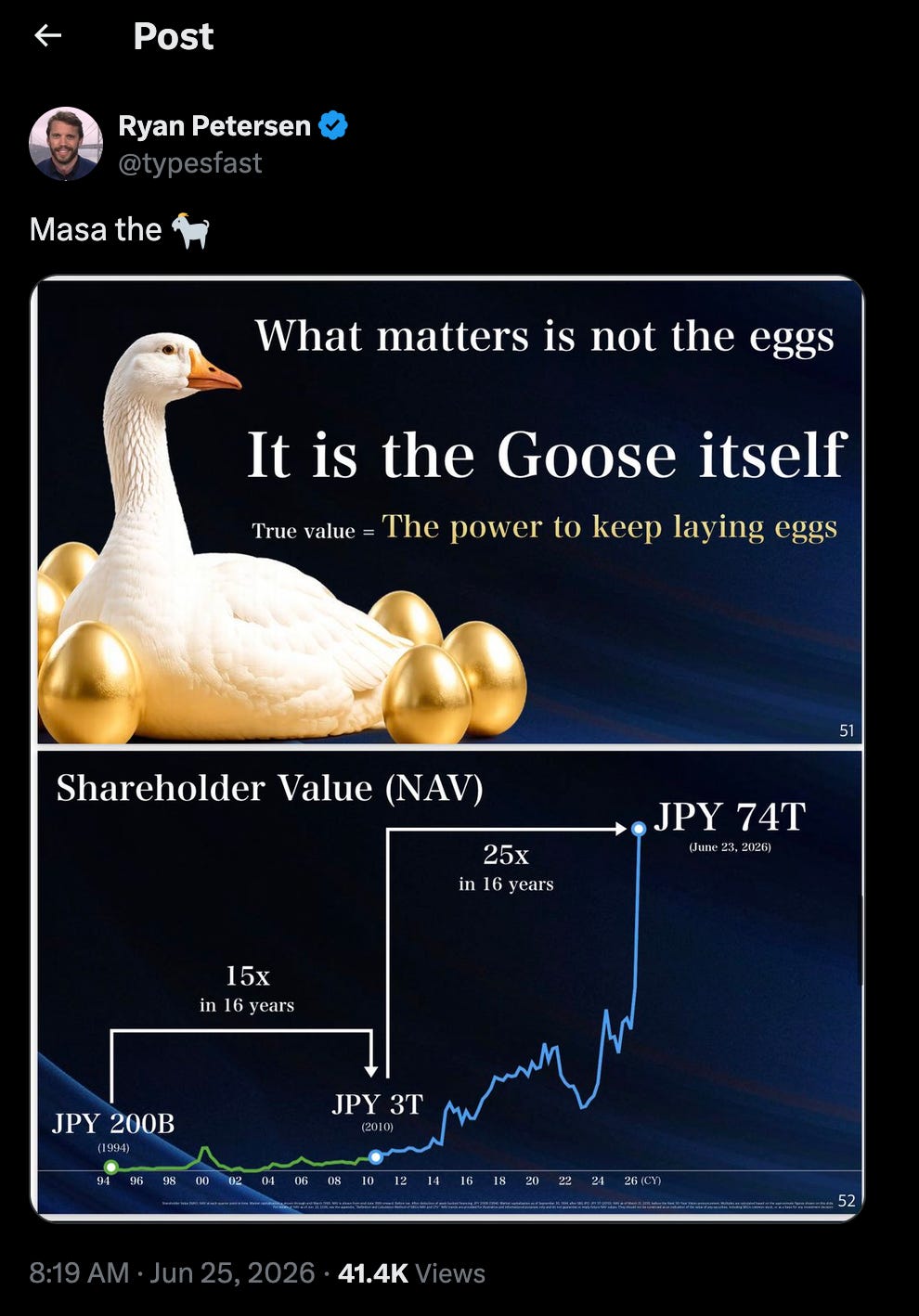
We’re not saying all of this is because of Masa.
But a lot of it was because of Masa and the mission he inspired others to follow along. And while Masa is legendary, there are many more Masas in America.
Many people who believe in redistribution are decent, compassionate human beings who look at inequality and feel genuine moral discomfort.
We feel that too.
The question is not whether redistribution can help. But when and how redistribution happens.
The Pilgrims of America decided that redistributing the early US GDP of $193 million might be better off re-invested. And they were right, to the tune of $30.7 trillion.
We’re saying let ‘the when’ compound longer. Because sharing a quadrillion-dollar pie is sure to be more exciting than sharing a trillion-dollar pie.
Let’s leave the how for another mini-book.
What follows are 25 predictions for the next 25 years, across six arenas: AI, Space, Health, People, Money, and what makes America exceptional. Each one leads with why it matters to you, shows the weird data underneath it, extrapolates to a window, and ends with what must be true for it to happen.
What you’re about to read is unapologetically optimistic.
We know the world is complicated and the problems are real. But it is easy to be pessimistic. It can make you seem smart.
We believe you can be honest about the problems and optimistic about future solutions.
More than one thing can be true.
We also know predictions can be hard to get right. As Nobel Prize-winning physicist Niels Bohr put it: “Prediction is very difficult, especially if it’s about the future.” We are very confident in the trajectory and less so on timing.
But we have faith these can be accomplished in the next 25 years.
Optimism requires believing that human ingenuity, American audacity, and the compounding force of new categories can do what they have always done.
Happy birthday, America!