


Welcome to the Pirate Street Journal. The Wall Street Journal covers companies. We cover categories.
Every Tuesday, we pick three headlines worth paying attention to and break down the category underneath. Every other Friday, we go deeper with a Deep Dive Report, calling where the category goes next. Become a Founding Member to get every Deep Dive Report, mini-book, audiobook, and access to the Pirate Eddie and Christopher bots.
Piratey disclaimer: This is NOT financial advice. None of us have Series 63, Series 6 7, CPAs, CFAs, IUDs, IEDs, and hopefully not IBS. Think of this like professional wrestling. It’s entertainment.Don’t be so smart you’re stupid and suplex your safety net savings.
And, while we are writing to parents, this also applies to anyone with a niece, nephew or anyone with a young person in their life they want to invest in.
Dear Friend, Subscriber, and Category Pirate,
Pirate Eddie and his wife saved enough to cover college for their three kids.
They saved early, as soon as their kids were born. They saved consistently. They saved smartly through 529 College Savings plans.
Or so they thought.
529s are like 401K accounts, but instead of saving for retirement, you are saving for college education. Some states give you a tax deduction when you put money into it, and your money can grow tax-free for qualified educational withdrawals. Pirate Eddie thought he was smart to set aside savings in a 529.
Saving early and consistently were two smart decisions.
Trusting the category of college savings cost them six figures.
We want you to avoid the mistakes Pirate Eddie made.
Did Pirate Eddie and his wife save enough to send their kids to college? Yes. But one dumb decision made two decades ago could have meant they could have also saved enough to pay for college for every grandchild and great grandchild going forward.
Without having saved an incremental dollar.
Hey Ho, Let’s Go!
Is College Right For Everyone?
The data says no. The give-to-get for college does not look good and is getting worse.
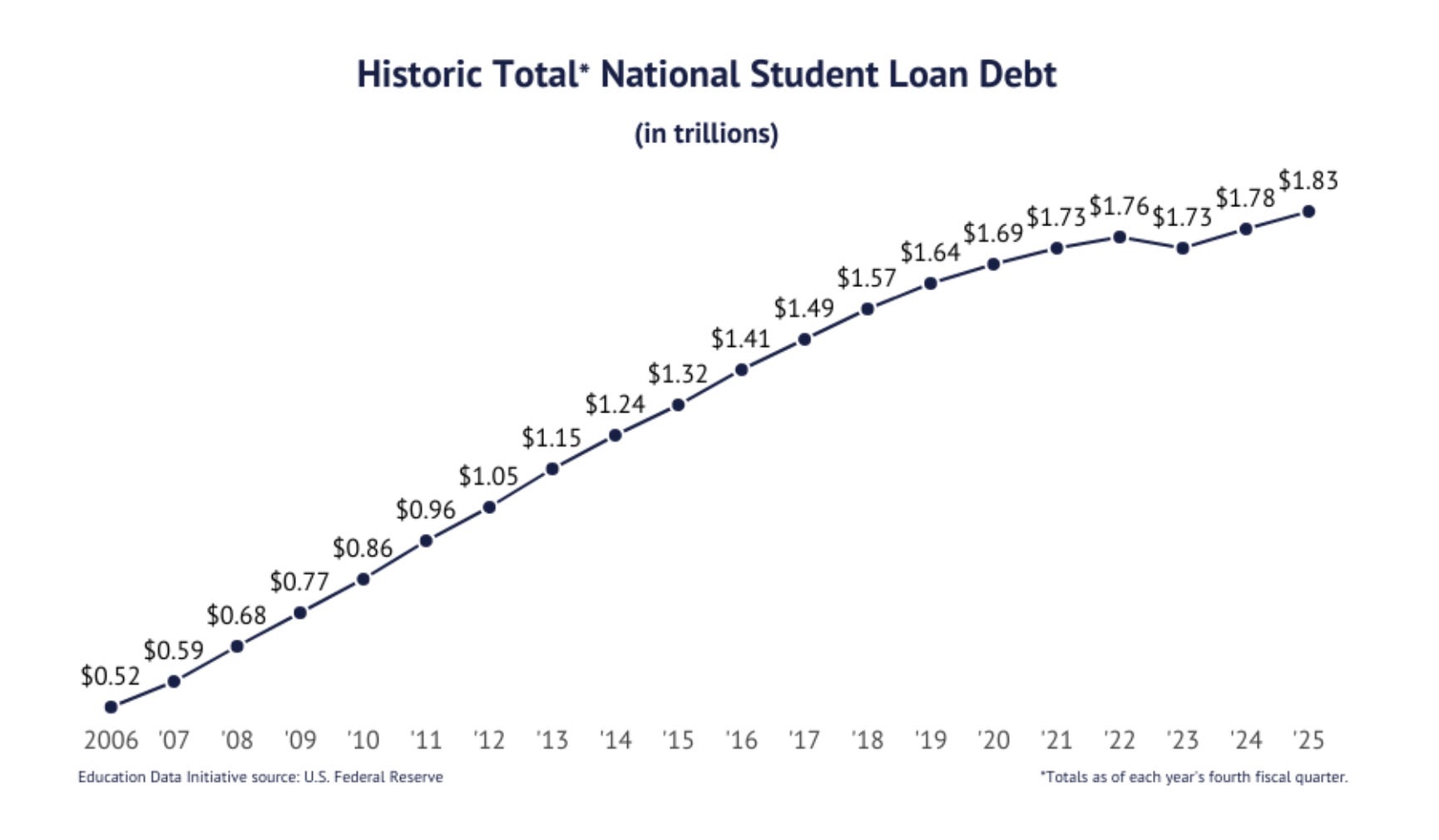
Total college debt has gone up consistently since 2006, growing nearly 3.5x in 20 years.
Total college enrollment peaked in 2010.
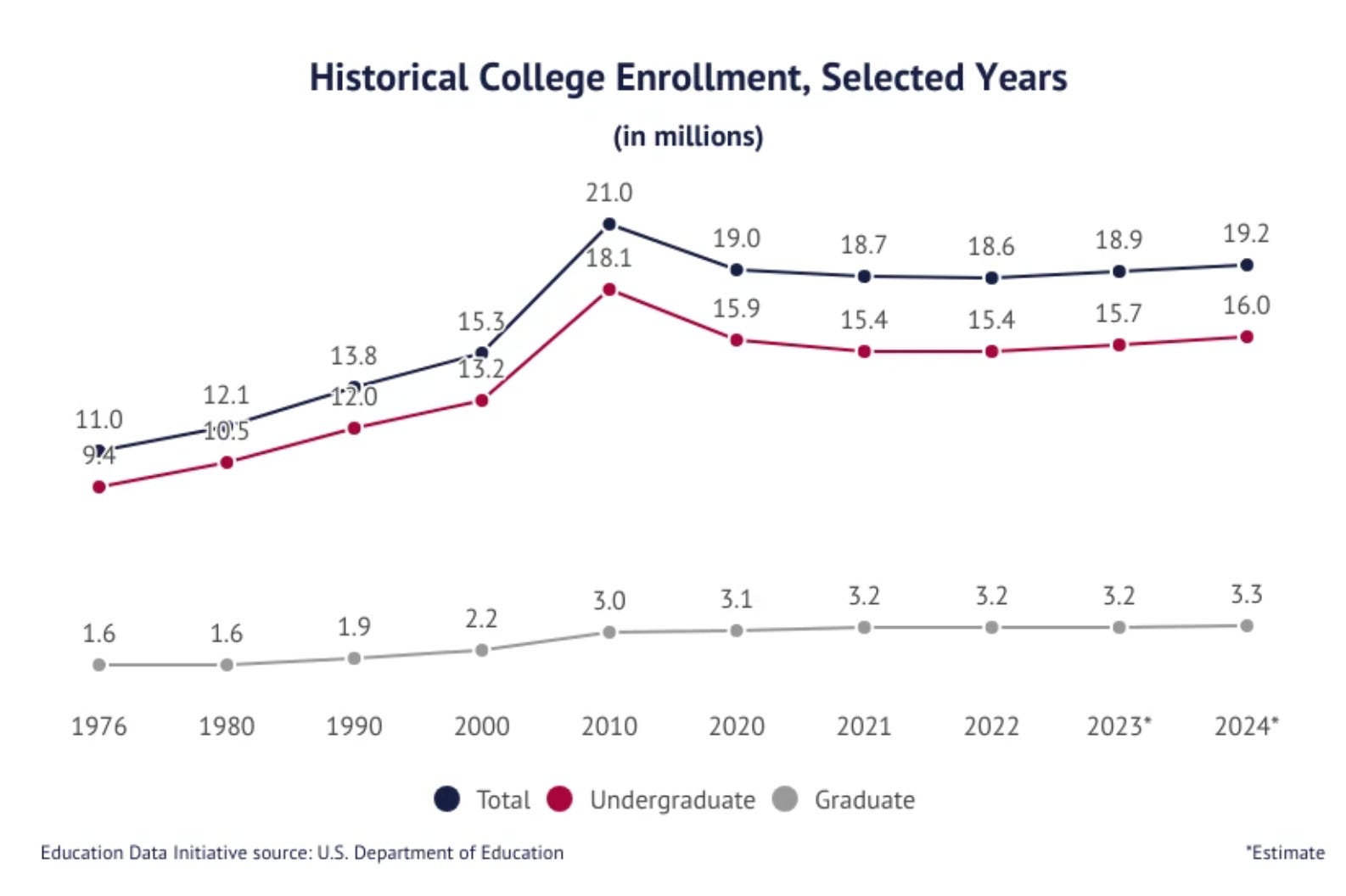
Why is total college debt going up when total college students are going down or flat? College has gotten more expensive. And students aren’t able to pay down the debt.
Pirate Eddie grew up in an immigrant family that told him education was the silver bullet.
His brother Jimmy went to Cornell on financial aid, studied Mechanical Engineering, got a co-op job from Lockheed Martin and has been sending satellites into space for three decades.
Pirate Jimmy became an expert.
Pirate Eddie went to the University of Chicago on financial aid, studied Political Science and Economics, landed in consulting, wrote a ton in HBR, helped the Fortune 500 generate tens of billions of dollars of profitable revenue and received a small sliver of that.
Pirate Eddie became an advisor and thought leader.
But Pirate Christopher got there without college.
He became an entrepreneur and started his own company at 18. Sold his company at the age of 28 and moved to Silicon Valley from Canada. Became a three time CMO for publicly traded tech companies and became the godfather of Category Design.
Pirate Christopher became an entrepreneur, executive, advisor and thought leader.
Being an expert in law, banking, consulting or medicine still requires college.
But expertise is being commoditized by AI. College is increasingly less necessary to be an executive, advisor or thought leader.
Becoming an entrepreneur has never required college.
Don’t assume that you need to go to college to have the career you want.
The Three Thieves of College Savings
1.7 trillion reasons make us mad about the category of College and College Savings.
That’s the total size of the US education debt. The debt is a big reason why young people feel hopeless about their future. Having 5 to 6 figures of debt over your head makes young folks think twice about getting married, having kids and buying a house. It is an anchor that slows them from making forward progress in their lives.
Let’s get personal.
One of Pirate Eddie’s kids had a friend whose parents said, “We’re sorry, but we only have money to send you or your younger brother to college. Your younger brother has more potential and upside. So if you want to go to college, you’re going to have to pay for it yourself.”
This made the Pirates piss fire.
The Pirates weren’t just mad at the parents, especially since there is context we don’t have. The Pirates were mad at the system and the category of college overall.
This kid was smart, hard-working, and motivated.
But he was so stressed because he believed he had to get into a certain tier of college to succeed in life (wrong.) He felt pressure that he had to take out massive loans (nope.)
The good news was that the kid was going into business.
This kid got into one of the best business schools in the country and got a full ride. It’s a legendary start to what we know is going to be a legendary career. This kid is going to make a dent in the universe.
The best news is business is as much of a meritocracy as there is out there.
The top college that produced the most Fortune 500 CEOs is the University of Wisconsin. 14 out of the 20 CEOs of the top 20 largest companies went to public schools.
Many in college are missionaries, trying to educate our kids.
But money often turns missionaries into mercenaries. And thanks to government loans into education, there’s a lot of money sloshing around the categories of college and college savings.
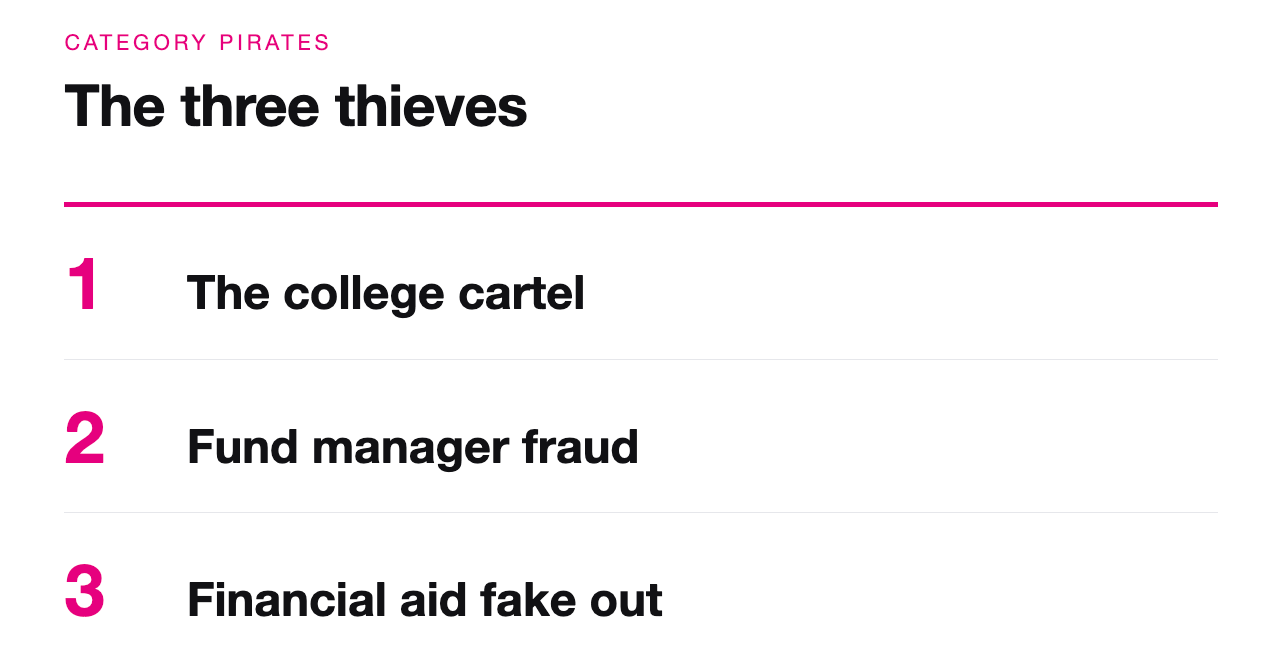
Be eyes wide open about three thieves that are trying to steal your money and your kids’ future.
The College Cartel
The US government is watchful and concerned about cartels and antitrust.
A cartel is any group of would-be competitors who coordinate their actions to benefit them, typically at the expense of the consumer. The theory is cartels and monopolies lead to higher prices and other bad outcomes for consumers.
Colleges, especially elite colleges, are the cartel in plain sight.
The narcotic they market and sell is especially insidious. It’s not fentanyl, cocaine or heroin. They are selling envy and it is as addictive and destructive as any drug.
Just like drugs, colleges have amazing pricing power.
The issue is pricing is oddly very similar in amount and the rate of increase. It is the epitome of keeping up with the Joneses. When someone adds a super ding-dong dormitory, the others follow suit. When one raises their prices, the others do so as well.
In 1989, the Department of Justice opened an investigation and, in 1991, sued 57 universities for price fixing.
Each of the eight Ivy League colleges signed consent decrees without admitting guilt. MIT fought back and got it overturned. Crazily enough, Congress passed Section 568 of the Improving America’s School Act in 1994 to make it lawful for colleges to collude on a financial aid formula.
It took five former students to kick-start the change required in 2022.
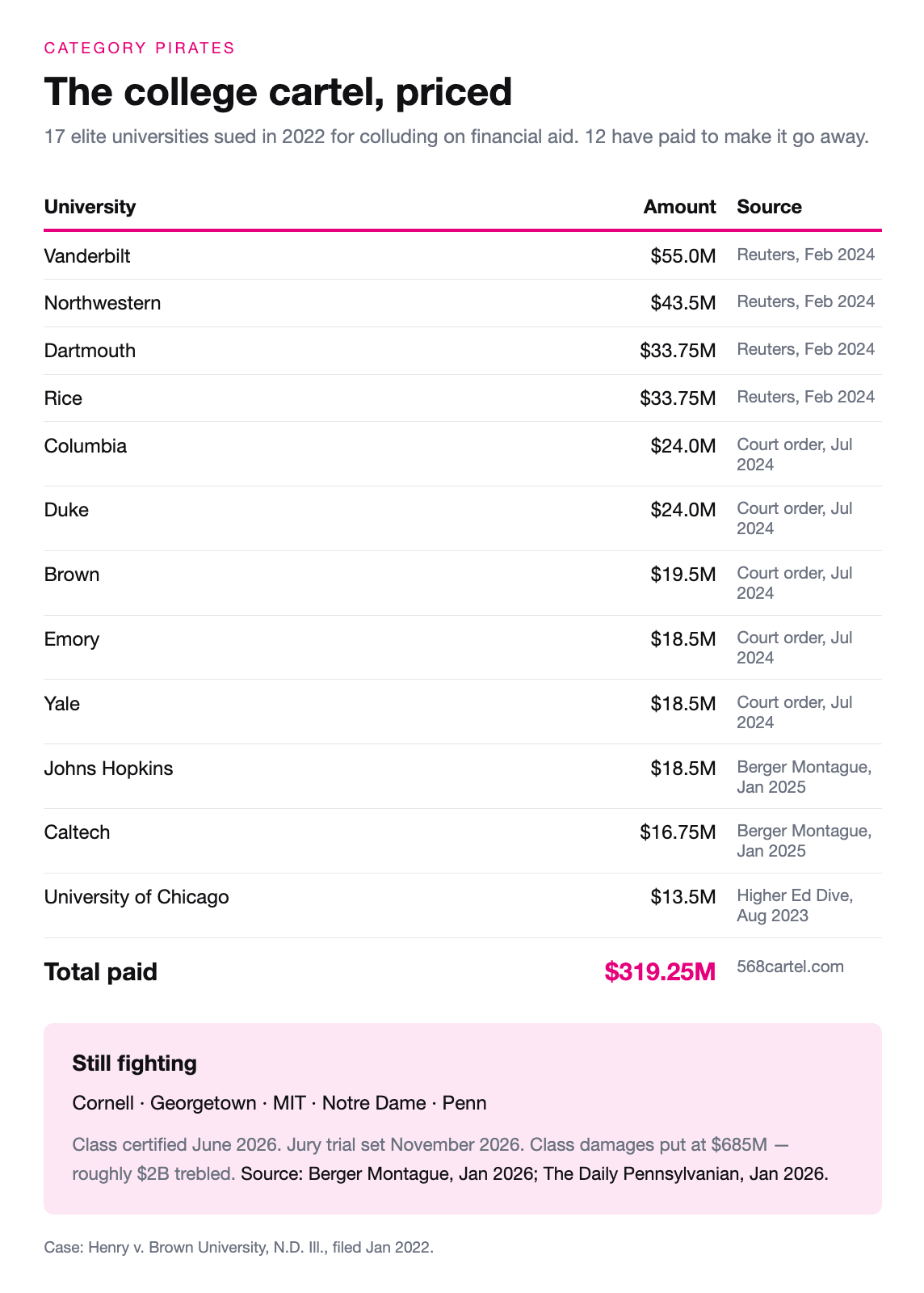
Henry v. Brown University was a class action lawsuit on behalf of 200,000 students on financial aid that alleged 17 elite universities got together and agreed on the same formula to calculate what your family could pay.
Hundreds of millions of dollars were paid by colleges to settle the claims.
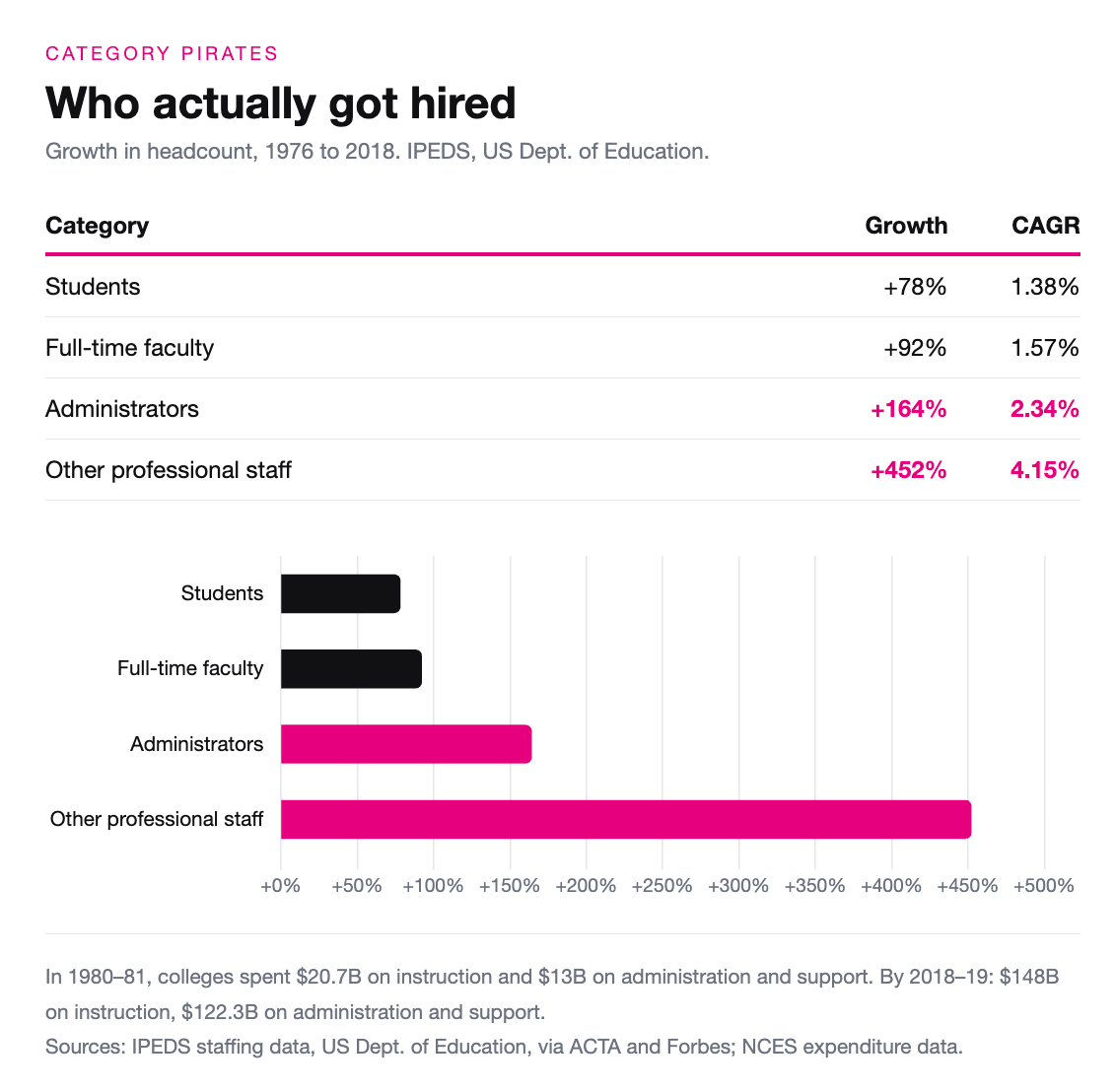
Why are colleges raising prices?
To pay for college administrators and G&A headcount that have nothing to do with your students.
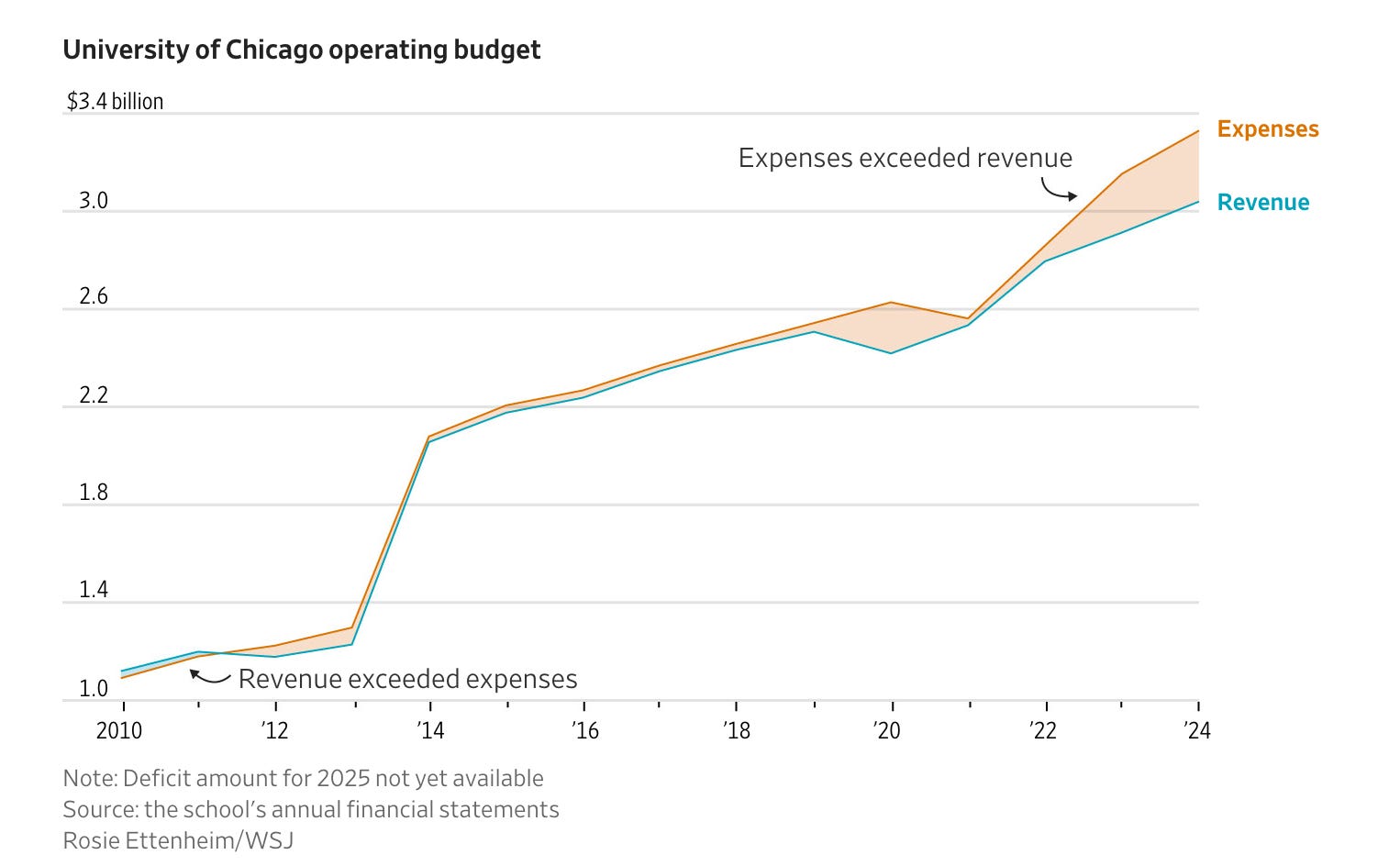
If colleges were publicly traded on the stock market, many would have been decimated for being bloated. Even Pirate Eddie’s alma mater, the University of Chicago, was highlighted in the Wall Street Journal for being poorly financially run.
The University of Chicago is arguably the best in the world at Economics.
It has the most Nobel Prize winners in economics. Folks like Milton Friedman (Free Markets), Gary Becker (Human Capital), Eugene Fama (Efficient Market Theory), Richard Thaler (Behavioral economics).
So how is it that the best school in the world at economics is losing money?
You can be so smart you’re stupid.
College is expensive because they are spending stupidly. College is expensive because they are greedy, creating jobs that don’t help kids. College is expensive because the government gives out education loans. College is expensive because there aren’t really consequences for elite colleges as applications and perceived selectivity go up.
Have the outcomes gone up?
When Pirate Eddie graduated, his starting salary was $42,000, and the all-in cost of the University of Chicago was about $28,000. So Pirate Eddie got a job that made 1.5x more than his annual tuition.
The most recent data is that the starting salary at McKinsey, the most famous consulting firm, is $112,000. The all-in cost at the University of Chicago is $90,000. So the ratio dropped from to 1.2x.

The price of college does not necessarily reflect the value you get.
Fund Manager Fraud
We’re not necessarily talking about illegal fraud.
We’re talking about allowable fraud. We’re talking about weaponizing word salad marketing. We’re talking about unnecessary complexity.
We’re talking about lying with the truth.
Pirate Eddie uses Bright Directions in Illinois for a 529. There are 57 different fund choices. 22 funds are actively managed funds. Yet the Dow Jones highlights that about 9 out of 10 active fund managers fail to beat the index.
How many S&P 500 index funds are there? One. That is the one Pirate Eddie should have picked 20 years ago.
But he fell for the great 529 fund lie. Age-based 529 funds.
There are 26 of them in his 57 different choices. They all promise simplicity. Tell us how old your kid is, and we’ll manage the investment choices to be less aggressive the closer they are to college.
It sounds simple.
But the only people who get rich are the fund managers.
You know the saying, “A fool and his money are soon parted”
Well, a mutual fund and his money are also soon parted in two ways. Front-end loads or sales charges to invest at the outset. Many of the 529 funds and age-based ones charge you 2.5% of your money off the top. The second way mutual funds take your money is through annual expense ratios. This pays for the fund managers’ compensation and all their administrative costs.
And it is the 90% of the fund managers who can’t beat the market that are often charging you the most. They aren’t worth the money.
Take a look at a representative set of choices that Pirate Eddie has.
The X-axis shows the annual expense ratio. The Y-axis shows the total year-one costs, factoring in front-end sales charges. We have a few age-based funds, a T Rowe Price fund, a Northern Trust S&P 500 Index fund, and we threw in a Vanguard S&P 500 index fund that is NOT offered.
Age-Based Aggressive and Age-Based conservative charge nearly 0.80% per year. 0.80% sounds small. But it’s nearly $1 for every $100 you invest. That’s the going rate you’d pay for a full-service broker at Goldman Sachs or Merrill Lynch.
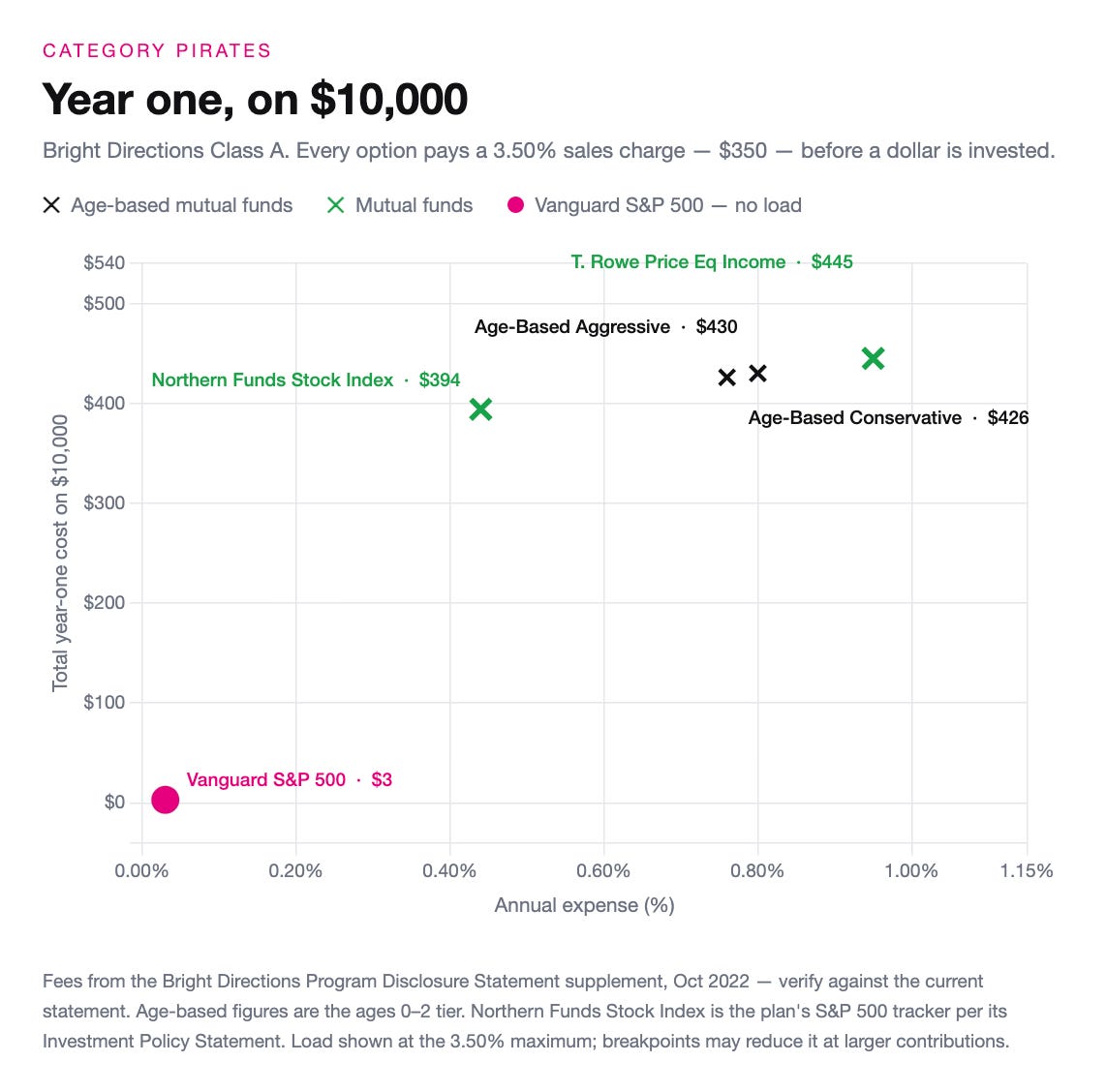
Every fund offered by Bright Directions in Illinois is vastly more expensive than the Vanguard fund. Which begs the question: if Bright Directions is on our side, why don’t they offer the cheapest, largest, and best index fund in the world?
The T. Rowe Price Equity Income fund is the most expensive on the chart. Vanguard’s S&P 500 index ratio is 0.03%. T. Rowe’s is 0.95% per year and comes with a 2.5% front-end load charge.
You’d assume it performed the best, right? No, it only beat the S&P 500 2 out of the last 10 years. T. Rowe’s 10-year CAGR was 10.66% vs. 14.82% for the S&P 500.
This T. Rowe Price fund is 32 times more expensive for 72% of the S&P 500 performance.
That’s a terrible give to get.
The Age-Based Funds are about 26 times more expensive than the S&P 500. Yet according to Pirate Eddie’s experience, they yielded about a 5% return per year. Or about one third of the market.
Why is this?
They are so conservative that they overweight the fund in bond funds early on. When Pirate Eddie’s kids were going to college, he was horrified that they were paying 0.8% to have a decent chunk invested in money market funds.
This is what the asset allocation looks like for the Age-based aggressive fund.