


Welcome to the Pirate Street Journal. The Wall Street Journal covers companies. We cover categories.
Every Tuesday, we pick three headlines worth paying attention to and break down the category underneath. Every other Friday, we go deeper with a Deep Dive Report, calling where the category goes next. Become a Founding Member to get every Deep Dive Report, mini-book, audiobook, and access to the Pirate Eddie and Christopher bots.
Dear Friend, Subscriber, and Category Pirate,
Piratey disclaimer: This is NOT financial advice. None of us have Series 63, Series 7, Series 6 7, CPAs, CFAs, IUDs, IEDs and hopefully not IBS.
Think of this like professional wrestling. It’s entertainment.
Don’t be so smart you’re stupid and suplex your safety net savings.
Hey Ho, Let’s Go!
Pirates love weird data.
Thomas Laffount of Coatue shared some cool stuff at the recent All-In-Podcast Liquidity event.
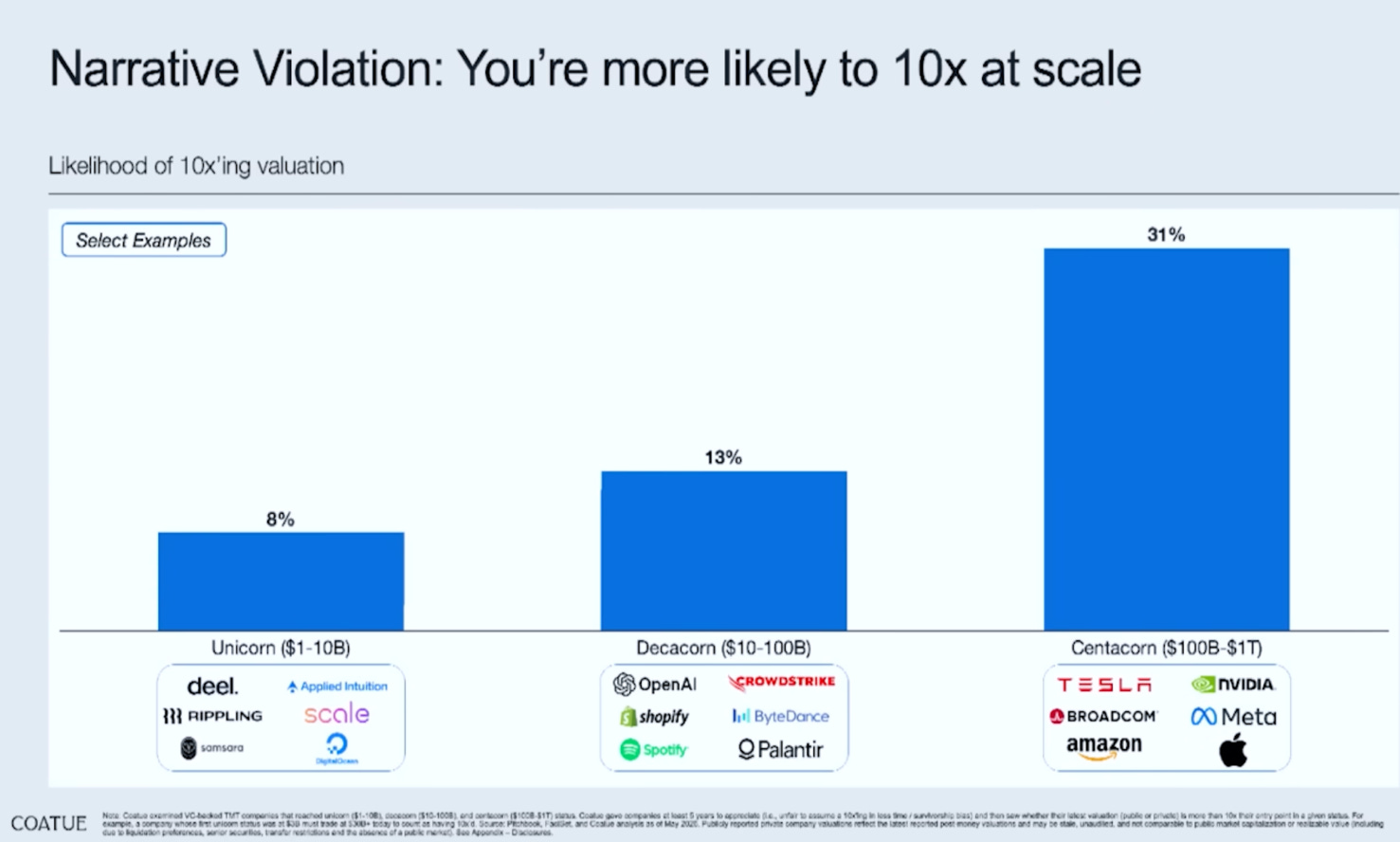
A unicorn worth a billion-dollar valuation has an 8% chance of becoming a decacorn at ten billion.
A decacorn has a 13% chance of becoming a centicorn at one hundred billion.
A centicorn has a 31% chance of becoming worth a trillion-dollar valuation.
VC David Sacks had the most valuable observation. And question. Does it suggest that the odds go even higher for a one trillion dollar company to become a ten trillion dollar company?
The data suggests Sacks’ hunch was right.
This insight contradicts the law of large numbers. The largest companies are expected to grow more slowly. The law of large numbers says your growth rate comes down as you get bigger. They even called it a “law”.
Now, there’s a new POV.
The Big Are Getting Bigger
The Mag 7-10 are too big to keep compounding, right?
Nvidia cannot run from five trillion to ten trillion, can it? Can Apple be any bigger? The math runs out, doesn’t it?
They can.
Let’s look at more weird data.