


Welcome to the Pirate Street Journal. The Wall Street Journal covers companies. We cover categories.
Every other Friday, we go deeper with a Deep Dive Report, calling where the category goes next. Become a Founding Member to get every Deep Dive Report, mini-book, audiobook, and access to the Pirate Eddie and Christopher bots.
Piratey disclaimer: This is NOT financial advice. None of us have Series 63, Series 6 7, CPAs, CFAs, IUDs, IEDs, and hopefully not IBS.
Think of this like professional wrestling. It’s entertainment.
Don’t be so smart you’re stupid and suplex your safety net savings.
Dear Friend, Subscriber, and Category Pirate,
Pirate Eddie is halfway through his fourth decade of living in Chicago.
He never imagined he’d stay. He moved in 1992 for college. Most of his friends went to the west or east coast. Over half his childhood friends have moved back to Hawaii.
Is he tired of the cold and snow? Yes. But he’s increasingly grateful for the cost of living advantage of the midwest. Could he have semi-retired and gone solo at the age of 43 had he not been living in the lower cost midwest?
Maybe, maybe not.
The upper bounds of income were higher on the coasts, but taxes and property values would have also been much higher. One of his clients at Kraft moved from Chicago to Boston and was shocked that housing was nearly twice as much for half the house.
Pirate Eddie wasn’t being a smarty pants in choosing where to live.
He came to Chicago for college and the most financial aid. He found his friends and career, fell in love and built a family. The lower cost of living was serendipity, not strategic.
But the proposed California billionaire tax is giving every Pirate on the Pirate Ship a chance to see the future and make a strategic choice to build your Financial Capital.
Billionaires are already leaving.
California’s loss is your gain. More importantly, much of their money and investments have already left to friendly states. Companies, careers and jobs follow the money.
It doesn’t matter if you’re a billionaire, millionaire or just living on a prayer.

Zebra hole: For you young Pirates, the 80’s were real. Rockstars had perms. And Glam Metal was a real category of music.
Anyone can profit off of this. You have to anticipate the ripple effects. You have to see the non-obvious opportunities.
The Super-Geos of tomorrow are being created.
But it’s not the obvious places the Billionaires are moving. Austin, Miami and Nashville are all great. But housing has already moved up a ton. We’re talking about the non-obvious places to move to.
Don’t follow the Billionaires, follow their money.
If you are willing to move, you can get in on the ground floor of an up and coming city where cost of living is low, but incoming capital means jobs, incomes, property values are all going up.
If you choose wisely, keep your ‘pay for the party’ costs low and save smartly, you can stack $100K+ in Financial Capital in 5 years.

We even built a tool that does the math for you.
It’s called the Pirate Tax Map. Plug in your household income, filing status and number of kids, and it shows your take-home pay in all 50 states plus DC. Then the Move Calculator runs a five-year what-if between where you live now and where you’re thinking about moving or investing and whether you rent or buy.
Pirate Eddie ran his own numbers in the video below. On $100,000 of income, he takes home $76,720 in Illinois. Pirate Bri, up in Alaska, would take home about $5,000 more on the same paycheck, because Alaska has no state income tax. (Pirate Eddie would like the record to show that Pirate Bri is smarter than he is.)
Then he ran a move from Chicago to Huntsville, Alabama, buying the median home in each city. The gap over five years came to about $50,000. If you invest that difference, it clears $100,000.
The Pirate Tax Map is for Founding Members, and the link is in the Pirate Tax Calculator section further down. If you’re not a Founding Member yet, join now and get access to run your own numbers.
TL/DR on the California Billionaire Tax
This is something Pirate Christopher has written and podcasted about in depth.
He wrote extensively about this in his Substack, Different. Everyone who wants a R-rated Pirate Christopher with even zanier Zebra holes should sign up for this. He also podcasted about this with Hoover Institute’s Ben Jarro, PhD here.
Here’s the top three takeaways from both!
1. This is a new category of tax
This is America’s first proposed asset/wealth tax of its kind.
It functions similarly to a home ownership property tax. When you buy a home, you pay an annual property tax on the assessed value of your home. The national average property tax is 1%, so if you own a $300,000 home, you pay $3,000 per year in property tax to the local city. Much of the property tax goes to fund local schools and local improvements. So most home owners feel better about a property tax, which is reinvested locally.
The California Billionaire tax is on other things you own, like your stocks and ownership in public and private companies.
The problem is public stocks have trillions of trades per year, giving it ample data to calculate the value of a stock. Homes have 4-5 million transactions per year, giving it a decent amount of data to value the home.
A private company has at best a few hundred transactions per year.
This makes it way harder to precisely value. Imagine the government created a cholesterol tax. The higher your cholesterol, the higher the tax since heart attacks make the entire healthcare system more expensive. But it’s been years since you had your blood drawn. So someone just eyes you up and down and guesses and then assesses you a tax.
This is why the California Billionaire tax is incredibly hard to calculate accurately.
2. 5% wealth tax is the same as 52.5% income tax
A one percent wealth tax would be equivalent to a seventeen and a half percent capital income tax rate.
A 5% wealth tax would be equivalent to a 52.5% capital income tax rate. That is higher than any single federal tax rate. This is pushing the limits when people start to wonder if the juice is worth the squeeze for entrepreneurship.
3. The estimated tax revenue is already dropping like a rock
The bill hasn’t even passed, and yet the estimated tax revenue is already dropping.
Six guys have already removed an estimated $536 billion from California’s tax base. Nearly 30% of the entire proposed tax base. California’s own Legislative Analyst’s Office concluded this new tax would cause an “ongoing decrease in state income tax revenues of hundreds of millions of dollars or more per year.” In over 71% of their simulations, California ends up poorer.”
You know who is good at math?
The billionaires. Followed by the accountants and attorneys who advise them. You know who is the worst at math? Politicians.
If a Wealth Tax Works, Why Did Most of Europe Repeal Them?
European countries love taxing their citizens.
The OECD (Organization for Economic Cooperation and Development) measures total tax collected as a percent of the economy. The top 8 countries are all European. Denmark is the highest at 45.2%, France is 2nd at 43.5%, Austria at 43.4%.
The US is near the bottom, ranking 32nd out of 38 countries at 25.2%.
Europe’s top income tax rates are north of 55%. Denmark is at 60.5%, France 55.4% and Austria at 55%. They also tax spending, known as the VAT.
So it makes sense that Europe would love a wealth tax.
So as Ben Jarro points out, why did most of them repeal it?
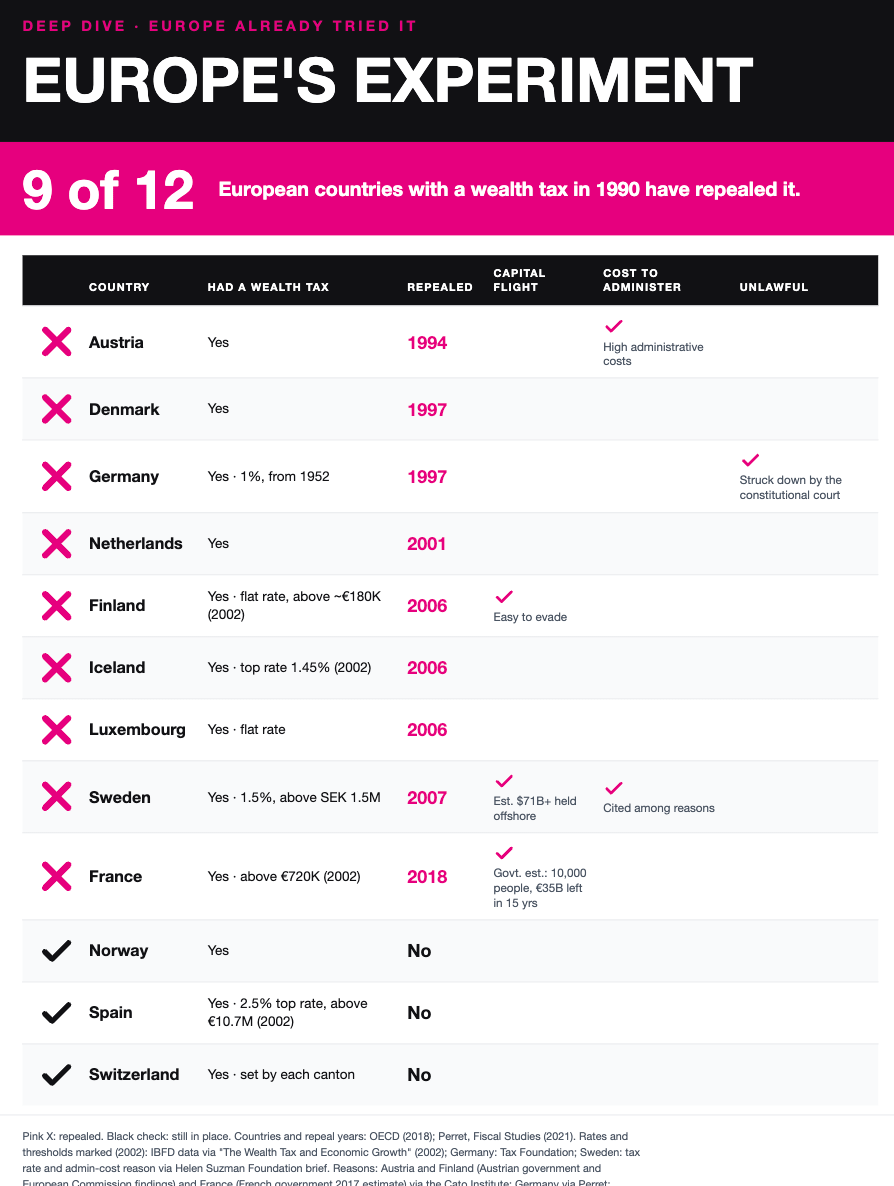
Money is mobile. Wealth tax doesn’t work if Billionaires can move on a dime.
Taxes are the ultimate FAFO experiment, aka the Laffer Curve.
Arthur Laffer is one of the most influential economists in modern times.
He got his PhD in Economics from Stanford and was one of the youngest tenured professors at the University of Chicago. He has been a sought after advisor to the President from Reagan to Trump.
He’s most famous for the “Laffer Curve”, which is a parabola that tries to predict the tax rate at which government tax revenue is maximized.
Everyone agrees on the far left, that if the tax rate is 0%, the government collects no taxes. Everyone agrees on the far right, that if the tax rate is 100%, then no one works and the government collects no taxes.
The fight is where the peak of the parabola is.
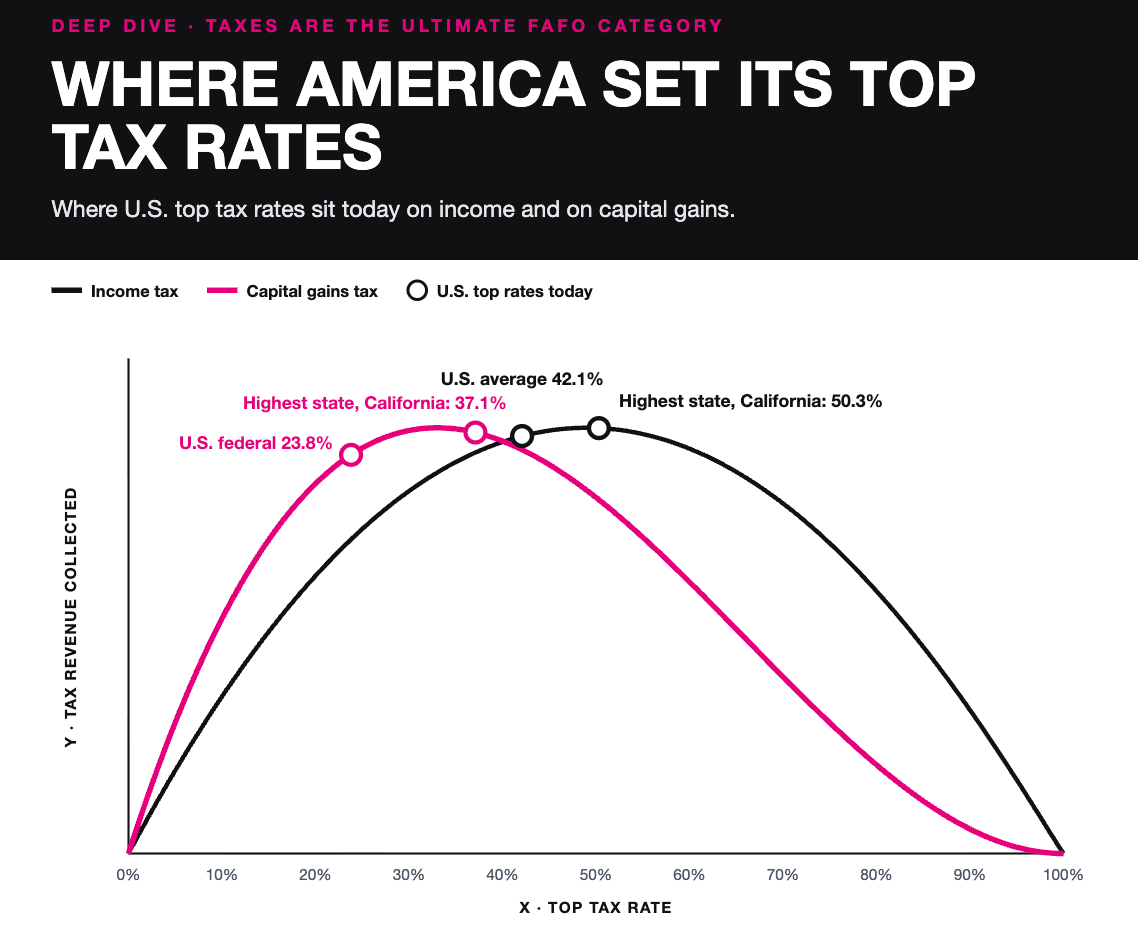
The black line is the income tax Laffer curve, where the US average top income tax rate is 42.1% and the highest example we have is 50%. The pink line is the capital gains Laffer curve on the sale of investments, where the US average is 23.8% and the highest example we have is 37%.
Ever wonder why Billionaires pay so little in income tax percent?
It’s because the peak of the pink parabola is at a much lower tax rate than the black. Meaning a billionaire would much rather get his or her income in capital gains than in income.
This is why tax rates are the ultimate FAFO (f around and find out) experiment.
When some politicians say tax the rich more, it doesn’t necessarily mean tax revenue will go up. In the UK, the top rate went from 40% to 50% on incomes over £150,000. They thought it would raise £2.7 billion a year, but in reality it raised only £0.6 billion. Parliament cut it back to 45% 3 years later.
If some politicians say we should lower taxes and it will raise tax revenue, they don’t know if it is right either.
The truth is the peak likely moves and is likely context specific. California and New York City can have high tax rates because people want to live and stay there. And until recently, you had to be there to be part of the action and all the upside. New York City was the center of finance, until broadband and technology meant a high frequency hedge fund could be anywhere. Silicon Valley was where everything was happening, until top tier VCs decided Austin and private jet was fine.
Don’t trust anyone who says they can predict the future precisely when it comes to taxes.
But three non-obvious ripple effects are evergreen. They are universally true. And anyone can use them to predict the future to stack real money.