


This is a FREE 🏴☠️ Founding Members 🏴☠️ post. Founding Members get access to the Pirate Eddie Bot to ask category design questions, weekly actionable insights, the full library with 30+ audiobooks 200+ mini-books, and more. See the Founders Deck here.
Dear Friend, Subscriber, and Category Pirate,
You’ve spent 15, 20, maybe 30 years accumulating assets. You just haven’t been tracking them—because they were always deposited into someone else’s account. The company’s balance sheet. The military’s mission. The tech firm’s valuation.
You built their categories. They kept the equity.
And now you’re standing at some version of the same crossroads: Do I keep going? Or do I finally build something that’s mine?
If you’ve been reading Category Pirates for any length of time, you’ve heard us talk about the Four Creator Capitals. Probably more times than you’d like. We’ve referenced them in mini-books, taught them in the Academy, built workshops around them.
So why are we breaking them down again?

Because after working with hundreds of pirates—we’ve realized most people think they understand the capitals. They can name them. They nod along when we describe them. But few have actually mapped their own.
And the gap between understanding a framework intellectually and applying it to your own life is where most people stay stuck. Sometimes for years.
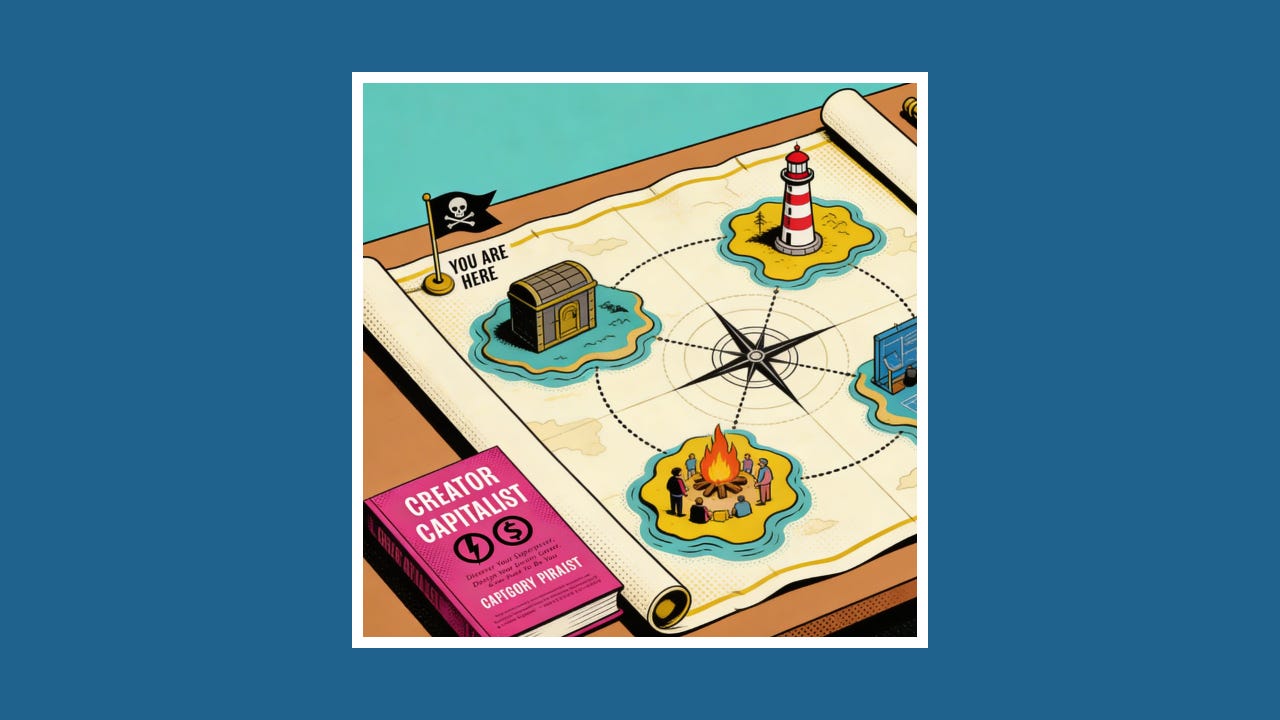
On March 17, we publish Creator Capitalist—the most important thing we’ve written since Superconsumers and Play Bigger. The book goes deep on all four capitals and gives you the complete system.
But we don’t want you to walk in cold.
If you’ve been wondering how people actually get paid to be themselves—not as a slogan, but as an economic reality—this is the flywheel that makes it work.
Below, we’ll break down each capital with a story that shows what it looks like in practice. Then, at the end, we’ve included a self-assessment so you can map where you actually stand—before the book even comes out. (Fair warning: some of the questions are uncomfortable.)
And if you already know this is for you—join the waitlist at creatorcapitalist.ai. You’ll get the Introduction and the opening of Section 1 for free immediately, and you’ll ne able to order a full day before the public launch on March 17.
Let’s get into it.
The Four Creator Capitals
Think of these as four interconnected assets. Each one amplifies the others. Together, they form the foundation for a career where you own what you create—and get paid accordingly.
1. Financial Capital
Financial Capital is the money you’ve saved, invested, or built that lets you cover your expenses and fund your ambitions. It’s the resource that makes courage rational.
Most people think they need millions before they can make a move. They don’t. They need enough—enough to cover their version of “pay for the party” while they build everything else.
Pirate Christopher was 18 years old, broke, and struggling with his first startup. Regular school didn’t work for him, so he self-curated an education—books, tapes, courses. His perspective on money was shaped by growing up without it. Lack of money owned him.
That shifted at a seminar where a workshop leader named Bix Bickson was going back and forth with a woman in the audience. Money was the excuse for every problem in her life. She believed she couldn’t make money. She believed only crooked people got rich. Struggling was part of her identity. Christopher sat there nodding along—because lack of money owned him too.
Finally Bix said: “There is a lot of money in the world, right?” She kept arguing. He kept asking. She finally snapped: “YES. There’s a lot of money in the world, Bix.” And he said: “GREAT! Now go out and get some!”
Christopher thought Bix was kind of mean. But then he thought: What if Bix is right?
Ten years later, at 28, Pirate Christopher was a millionaire running marketing for a publicly traded software company in Silicon Valley.
Your relationship with money is more important than your money.
Your relationship with money is more important than your money.
Your relationship with money is more important than your money.

When you see money as a tool instead of the goal, you gain clarity. And clarity is what lets you design a financial runway instead of just hoping one appears.
The VP of Engineering sitting on $2M in vested RSUs has a different Financial Capital challenge than the retired Colonel with a military pension. But they both need to answer the same question: How much runway do I actually need to make my move—and do I already have it?
Most people have more than they think.
2. Reputation Capital
Reputation Capital is the signal that travels ahead of you.
It’s what problems people associate with your name. And in a crowded world, being known for something specific matters more than being competent at everything.
Holley Miller was the Director of Marketing for the healthcare business at Allergan. While she was there, she helped grow a brand from $25 million to $100 million in four years.
The outcome was incredible. But how she did it was the real story.
She didn’t add incremental sales reps. She reframed the market. She focused on educating buyers about what was missing, what outcomes actually mattered, and why the old way of doing things no longer made sense. The product didn’t change. The belief about the category did.
After that, people started calling Holley, she had a reputation for outcomes. They wanted to know if she could help them get the same result.
That’s when she realized she had a superpower. She helped create a 9-figure outcome in an extremely cost-efficient way that nobody thought was possible. Any rational company would pay low 8 figures for a low 9-figure outcome. Holley was being paid 6 figures instead.
So she decided to value her value. She left and founded Grey Matter Marketing—where she now helps life sciences companies 4x their revenue using the same frameworks she built inside someone else’s company.
Holley didn’t build her reputation by promoting herself. She built it by reframing a problem so clearly that people couldn’t stop talking about the result. The calls came to her. That’s Reputation Capital at work.
3. Relationship Capital
Relationship Capital is the small number of people who multiply your efforts.
We’re talking about the eight to ten relationships that open doors, pressure-test your ideas, create trust at speed, and amplify your reach when it matters. Careers don’t scale linearly. People do.
When Charles Barkley was drafted by the Philadelphia 76ers, he wasn’t getting playing time. As a rookie, he did what most ambitious people do—he went to someone he respected and asked for advice. Moses Malone was a Hall of Fame player and the star of the team. Barkley asked him: “Why am I not getting more playing time?”
Moses’s response: “Because you’re fat and lazy.”
Barkley went home and cried that night.
But then he did something most people don’t. He listened. He went back to Moses and asked for help. Barkley weighed 300 pounds at the time. Moses said: “Let’s lose 10 pounds.” Barkley did. Then Moses helped him lose another 10. And another. Each drop meant more speed, higher jumps, more results, more playing time.
At 250 pounds, Charles Barkley became a starter and began to wreak havoc on the league. He earned the nickname “The Round Mound of Rebound” and went on to become one of the greatest players in NBA history—and now earns about $21 million per year as the most entertaining sports TV pundit alive.
When Barkley was inducted into the Hall of Fame, Moses Malone introduced him. When Moses passed away, Barkley gave the eulogy and called him “Dad.”
Moses Malone was the kind of friend who…
Saw more upside in Barkley.
Loved him enough to tell him the truth.
Yearned to play with a fit (not fat) Barkely.
That’s Relationship Capital. Not a LinkedIn connection. Someone who cared enough to say the thing nobody else would say—and then showed up every day to help you do something about it. The people who change your career aren’t the ones who tell you you’re great. They’re the ones who tell you the truth and stick around for what comes next.
One of the more uncomfortable exercises we do with professionals in the Academy is asking: Who are the five people who would vouch for you tomorrow if you announced you were starting something new? Most people can name them instantly. Very few have ever activated those relationships. And even fewer have someone in their life willing to say “you’re fat and lazy”—and mean it as an act of love.
4. Intellectual Capital
Intellectual Capital is what happens when what you see, what you know, and what you believe gets turned into assets that outlive your time and effort.
Knowledge alone doesn’t create leverage. Codified knowledge does.
The surgeon who’s performed 10,000 procedures has extraordinary knowledge. But that knowledge is trapped in her hands—she can only see so many patients in a day. The moment she codifies that knowledge into a framework, a course, a diagnostic tool, or a piece of content, it scales beyond her time. That’s the shift from Knowledge Worker to Creator Capitalist.
Pirate Eddie learned this the hard way.
When he was 23—fresh out of college and consulting for high-growth companies—he built an Excel model and strategic framework for CFOs navigating rapid scale. It was brilliant work. Original thinking. The kind of framework that makes a client say “where has this been my whole career?”
Someone else at the firm recognized the value. They claimed it. They wrote a book based on it. And they drove tens of millions in consulting fees from Eddie’s intellectual property.
Eddie’s ideas. Someone else’s name. Someone else’s wealth.
He was 23. He didn’t know better. But most of the professionals reading this are 42, 48, 55—and they’re still making the same mistake. Every framework you’ve built inside a company. Every strategic model sitting on a shared drive. Every approach you’ve refined over decades that your colleagues use without crediting you. That’s your Intellectual Capital. And right now, it’s generating value for someone else.
If you don’t put your best thinking out there under your name, someone else will. The longer you wait, the more Intellectual Capital you leave on someone else’s balance sheet.
The book covers all four capitals in depth—including the specific frameworks for building each one. Join the waitlist at creatorcapitalist.ai to be first in line on March 16.
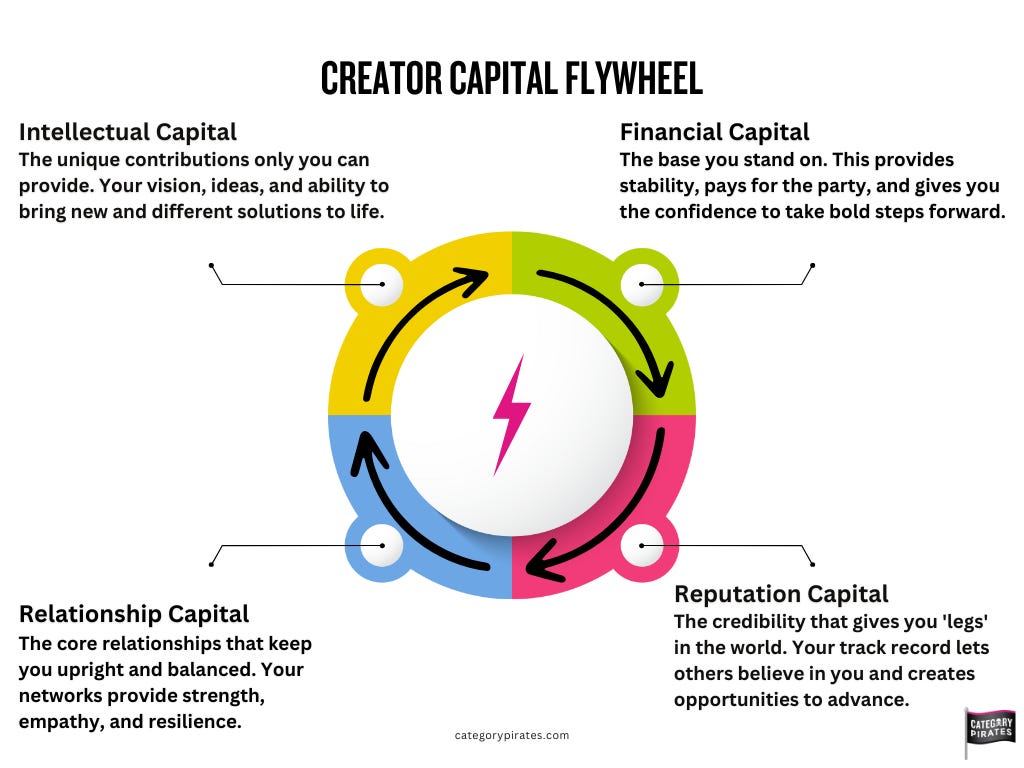
These four capitals aren’t separate buckets. They’re a flywheel.
Your Intellectual Capital feeds your Reputation Capital—when you publish a framework that solves a real problem, people notice.
Your Reputation Capital attracts Relationship Capital—the right people want to collaborate with someone who thinks differently.
Your Relationship Capital drives Financial Capital—opportunities, partnerships, and revenue follow trust.
And your Financial Capital fuels more Intellectual Capital—when you’re not scrambling for the next paycheck, you can invest in creating your best thinking.
Once this flywheel starts spinning, it compounds. You become what we call a Category of One—someone who can’t be replaced or commoditized—because your combination of capitals is unique to you.
“IRON” Mike Steadman went from running a struggling podcast agency to earning $25K+ contracts within months of designing his POV and building offers around his Superconsumers.
Pablo Gonzalez quit corporate construction, invented “Digital Word of Mouth,” and turned his frameworks and event planning knowledge into equity stakes—dramatically increasing his personal wealth and freedom.
They didn’t start from scratch. They mapped what they had, packaged it differently, and pointed it at people who valued it most.
That’s what the Creator Capitalist framework does. It turns what you already have into what you’ve always wanted: a career you own, work that compounds, and income that isn’t capped by someone else’s org chart.
Now here’s our challenge to you.
Don’t just read this and nod. Here are four questions to answer. If you can answer yes to all four, you’re in great shape.
If not, then you will want to dig deeper.
Because it says you’re not ready.
Go through each one. Be honest. The point is to see clearly where you are and where the opportunity is hiding.
Financial Capital
Question 1: Do you have 18-36 months of runway to sustain your current lifestyle if your income stopped today, until you can stand up your Creator Capitalist venture that pays you to be you?
How many months could you sustain your current lifestyle if your income stopped tomorrow? Write the number down. And don’t guess—find the real number based on what’s in your accounts right now.
Your goal is NOT to never work again.
Your goal is to make the leap to do the work you were designed to do.
To use your different, to make a massive difference for others and get paid to create.
That’s why your runway matters more than your retirement.
Are you worried your runway isn’t long enough? Chapter 6 of the book breaks down exactly how to calculate your “pay for the party” number and build a runway around it.
Reputation Capital
Question 2: If someone Googled your name right now, would they find your superpower?
Or would they find your LinkedIn title at someone else’s company? Your pedigree and education, that isn’t unique to you?
Or do you find your superpower. “I solve X problem for Y people to unlock Z outcome?”
Can you describe what you’re known for in one sentence—without referencing your employer? Not “I’m the VP of Strategy at [Company].” Something like “I help mid-market CFOs turn financial complexity into a competitive advantage.” If you can’t do that yet, your Reputation Capital is locked inside an institution.
It exists. It’s just not portable.
Chapter 7 teaches you how to unlock your Reputation Capital to create opportunities for you.
Relationship Capital
Question 3: Can you name five people—right now—who would take your call tomorrow and actively help you if you said “I’m building something new”?
Not people who’d say “that’s great, keep me posted” and then forget.
People who would buy your offer, tell others about it and/or write you a check.
Got five? Great job Pirate!
Chapter 8 helps you catalyze your Relationship Capital. For example, do the five people you just named know each other? Isolated relationships add value linearly. Connected relationships compound.
The best Creator Capitalists don’t just have strong individual relationships—they build constellations where their people know, trust, and amplify each other.
Intellectual Capital
Question 4: Do you have a proprietary process, playbook and intellectual property that makes you money while you sleep?
Think about the last time a colleague, client, or friend came to you with a problem—and you solved it in 15 minutes using a mental framework you’ve been refining for years. You probably shrugged it off. “That’s just how I think about things.”
That framework is Intellectual Capital. And right now, it lives only in your head.
Ask yourself: if you left your company today, would your best thinking leave with you—or stay behind on their servers, in their slide decks, embedded in their processes? How many frameworks, models, or approaches have you built over the years that other people use without crediting you? Have you ever seen someone present your thinking under their name—and felt that specific sting of watching your Intellectual Capital generate value for someone else?
What your answers are telling you
If you went through all four and thought “I have more than I realized”—you’re right. You do. Most people in your position do. The gap isn’t in what you have. It’s in the fact that nobody ever gave you a system for seeing it, organizing it, and building a flywheel around it.
That’s what Creator Capitalist is.
If you went through all four and felt uncomfortable—that’s the right response. Discomfort means you’re seeing the gap between where you are and where you could be. That gap is the entire reason we wrote the book.
Want a faster read on where you stand? We built a Creator Capitalist quiz on the website. Take it, get your results, and see how ready you are to make the shift. Take the quiz at creatorcapitalist.ai
Here’s what the waitlist at creatorcapitalist.ai gets you:
The free opening of the book—immediately. The Introduction and the start of Section 1, delivered to your inbox the moment you sign up. Start reading today.
Early ordering on March 16—a full day before the public launch. You’ll be reading and posting while everyone else is still finding out the book exists. The people who move first on launch day set the tone for the conversation. We want you to be one of them.
And if you want to go even deeper before the book drops—The Pirate Eddie Bot is the only AI on the planet trained on the Creator Capitalist framework, the Four Creator Capitals, Category Design, and 200+ Category Pirates mini-books. This thinking doesn’t exist anywhere else. Ask it about your Superpower. Challenge it on your Intellectual Capital. Let it push back on your blind spots. Start jamming on your capitals now so you’re three steps ahead while everyone else is still cracking the spine. Founding subscribers have full access.
Whether you take the quiz, go deep with the bot, or sit with the self-assessment above—do something with this before March 17.
The book gives you the complete system. The system works better when you don’t walk in cold.
Join the waitlist at creatorcapitalist.ai.
Arrrrrrr,
Category Pirates 🏴☠️
Eddie Yoon
Christopher Lochhead