


Arrrrr! 🏴☠️ Welcome to a free (for now) edition of Category Pirates. Each month, we publish mini-books that share radically different ideas to help you design and dominate new categories. Thank you for reading, and of course, forward this “mini-book” to any friends you think need to hop aboard the Pirate ship.
Dear Friend, Subscriber, and Category Pirate,
You’re busy.
Your calendar is full. Your inbox never empties. People rely on you to get things done.
On paper, your career looks fine. Good education. Solid career trajectory. A résumé that others respect.
And yet something feels off.
You’re working more than ever. Your title and your office are bigger. But somehow you don’t actually feel powerful. You have many direct reports. You no longer have one boss, but many. So why does it feel like you work for all of them?
You feel helpless.
Most people don’t say that out loud.
For decades, most careers ran on the same operating system:
70% reactive: emails, requests, meetings, fire drills
20% active: collaborating and contributing to projects
10% proactive: thinking, creating, deciding what matters
This was the Knowledge Worker economy.
And it worked if you were great at reacting fast, responsively, and reliably. The system rewarded you. People built very real and often lucrative careers this way.
Then AI arrived.
Tasks that took hours to do got done in seconds. Previously impressive output now looks lame when AI can do so much so quickly. AI is bending the time and reality of work.
Being reactive was okay when you needed to react fast every now and then, and then mindlessly execute. You could go on autopilot and mentally relax. But when AI distorts time and productivity, expectations have increased exponentially. Since tasks take much less time, you are expected to do much more. You need the reactivity skills of an F1 driver.
The new reality looks more like this:
70% proactive: thinking, deciding what matters, creating
20% collaborative: working with AI agents and also humans
10% reactive: approving, managing, adding guardrails, and context
Execution became abundant.
Existing knowledge moved closer to being free. Reactivity is non-stop and no longer a competitive advantage. The greatest human cannot work faster than a GPU.
Being busy used to be a signal of a good knowledge worker.
Now, being busy is a poker tell that you are behind the times with AI.
The Value of Your Value Got Devalued
People do not know how to be proactive 70% of the time.
You were never trained for it. You were rewarded for memorizing and regurgitating. You were never expected to think about your thinking. Lots of people went from their parents, to professors to bosses telling you what to do.
Now you have to think on your own?
This is where the anxiety comes from.
The source of value moved upstream:
From doing to deciding
From knowing to judging
From responding to framing
From executing to designing
From answering to questioning
From technique to taste making
You’re busy inside a system that no longer pays for busyness.

That’s why you feel powerless. That’s why you feel helpless.
The good news is that value didn’t disappear. It relocated to people who can frame problems worth solving, see what others normalize or ignore, use AI to scale judgment (not replace it), create approaches that didn’t exist before, and decide what matters before execution begins.
These people are not busier. They are decisive. They are not reacting to the future. They are shaping it.
From Knowledge Worker To Creator Capitalist
The people who made the biggest difference in any era were never the best executors of existing approaches.
They were the ones who brought something different to the problem. A perspective, an insight, a way of seeing that others simply didn’t have.
What’s changed is not that different suddenly matters; it’s that everything else stopped mattering as much.
The world moved from a place where power came from how much you knew, how fast you responded, and how much you could execute—to a world where value comes from how much net new knowledge can you create, how easily can you apply that knowledge to create outcomes, and how can you codify it into Financial, Reputation, Relationship, and Intellectual capital.
You no longer have to trade your precious time for money. You can make money in your sleep. You can get paid to create. You get paid to be you.
This is the new category of work that comes after Knowledge Worker.
The Creator Capitalist.
Creator Capitalism is not about being a ‘greed is good’ raging capitalist. Nor is it purely about the artist’s view that creativity is all about the artist.
It’s the capacity to see problems others miss, frame opportunities others can’t articulate, combine ideas in ways that didn’t exist before, and convert them into a digital asset you can share, sell, and sleep while you make money.
In a world where execution is cheap and knowledge is free, you are no longer paid primarily for what you do. You are paid for what you create.
Creator Capital is the accumulated value of your difference.
Your perspective. Your pattern recognition. Your instincts. Your ability to see and solve problems that others can’t.
When you are paid to create, your work compounds instead of resets. Your income accelerates faster than your hours. Your career is no longer a treadmill—it reaches escape velocity.
That’s what our new book, Creator Capitalist, is about. Not the theory of why work changed—but the frameworks for making the shift yourself. (You can join the waitlist to be the first to get it on March 17th here.)
Let us introduce you to twenty people who prove it’s real.
Anyone can become a Creator Capitalist
Who actually does this?
Is this real? Or is this just a nice theory for people who were already successful?
Fair question.
In Pixar’s great movie Ratatouille, Chef Gusteau’s famous motto is “Anyone Can Cook.” The protagonist is a rat with refined taste named Remy who wins over the most revered and feared food critic in all of Paris, Anton Ego. Think Gordon Ramsey crossed with Simon Cowell and Ricky Gervais in a bad mood. Ego’s POV is that very few people can cook.

The movie is a battle of POVs. Anyone can cook, vs. very few people can cook.
If you haven’t seen it, you should. The movie is all kinds of hilarious and accurate. Chef and Restaurant Mogul David Chang grudgingly admits the most authentic movie about cooking ever is “that f*&#ing rat movie.”
Ego is eventually transformed by Remy’s cooking. He is humbled, then refines and integrates the two POVs. He says, “Not everyone can become a great artist, but a great artist can come from anywhere.”
That’s also true of becoming a Creator Capitalist.
We’re not saying everyone will become a Creator Capitalist. We’re saying a Creator Capitalist can come from anywhere—Singapore, Auburn University, a boat in Canary Wharf, Deutsche Bank, an esthetician school, a farm with zero internet.
One of our favorite things about our new book, Creator Capitalist, is the appendix.
(That’s a sentence nobody has ever written before.)
But it’s true. Because the appendix is where all twenty Creator Capitalist stories live, side by side—the origins, the struggles, the breakthroughs, the playbooks. It’s the part of the book people will dog-ear, screenshot, and send to their friends.
We’re going to give you a brief look at those twenty people right now. And what Pirate Eddie found when he studied all twenty will surprise you: the pattern is there is no pattern.
Trust that Pirate Eddie used all the category science to look for one.
The No-Pattern Pattern
We looked at everything.
Parenting. Education. Net worth. First job. Age. Gender. Seniority. Company size. Whether they came from trauma or privilege. Whether they started at fourteen or forty. Whether they had an PhD, GED or IUD.
None of it predicted who would successfully make the leap.
The only thing these twenty people have in common is that they have nothing in common. Different industries. Different starting points. Different superpowers. Different origin stories. The data refused to cooperate with a tidy narrative.
Which, if you think about it, is the most encouraging finding of all. Because it means the door isn’t locked to people who look a certain way, went to the right school, or had the right connections. The door is open. It’s just that most people are too busy to notice.
Here’s what we mean.
It doesn’t matter if you had wonderful or horrible parents.
Carylyne Chan grew up in Singapore with a psychopathic father who tried to murder her and her mother. She started her first internship at fourteen, not for enrichment—for survival. She wanted control over her physical safety. She had two startup exits and financial independence before she turned thirty.
Jeff Klimkowski’s origin wasn’t trauma—it was a deep childhood friendship with Sean Riley and Ryan Meegan that became the rock-solid foundation for DUDE Wipes. That’s an entirely different level of trust.
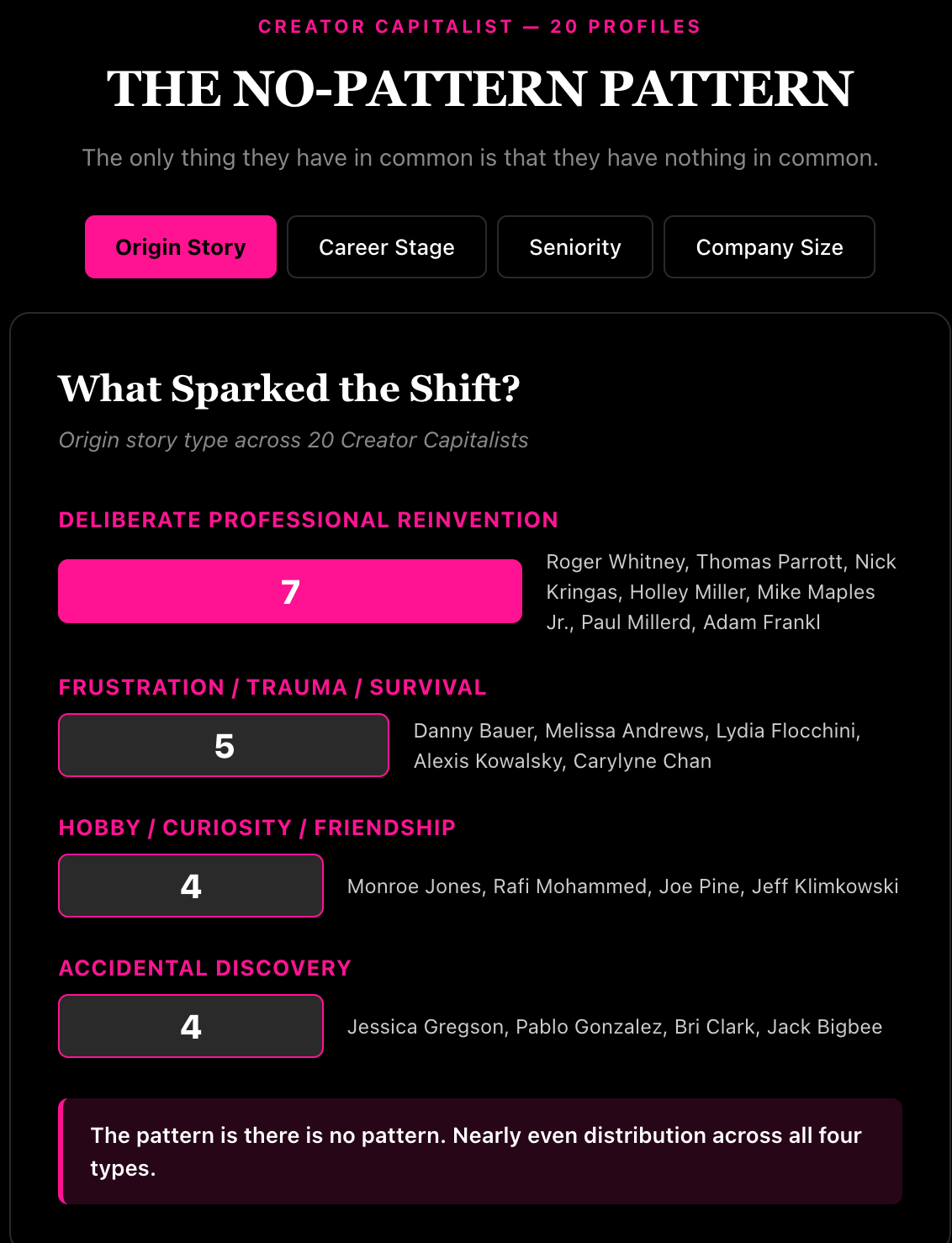
It doesn’t matter where you went to school or the size of your company
Joe Pine created his first Intellectual Capital in high school, compiling a Tolkien Linguistics Dictionary. “I am very much a nerd from way back.” His professor at MIT saw his potential and nurtured it.
Monroe Jones went to Auburn University to study architecture, following in his father’s footsteps. Architecture wasn’t his first love. One of his professors sat him down and said, “This is not your first love. What are you doing?”
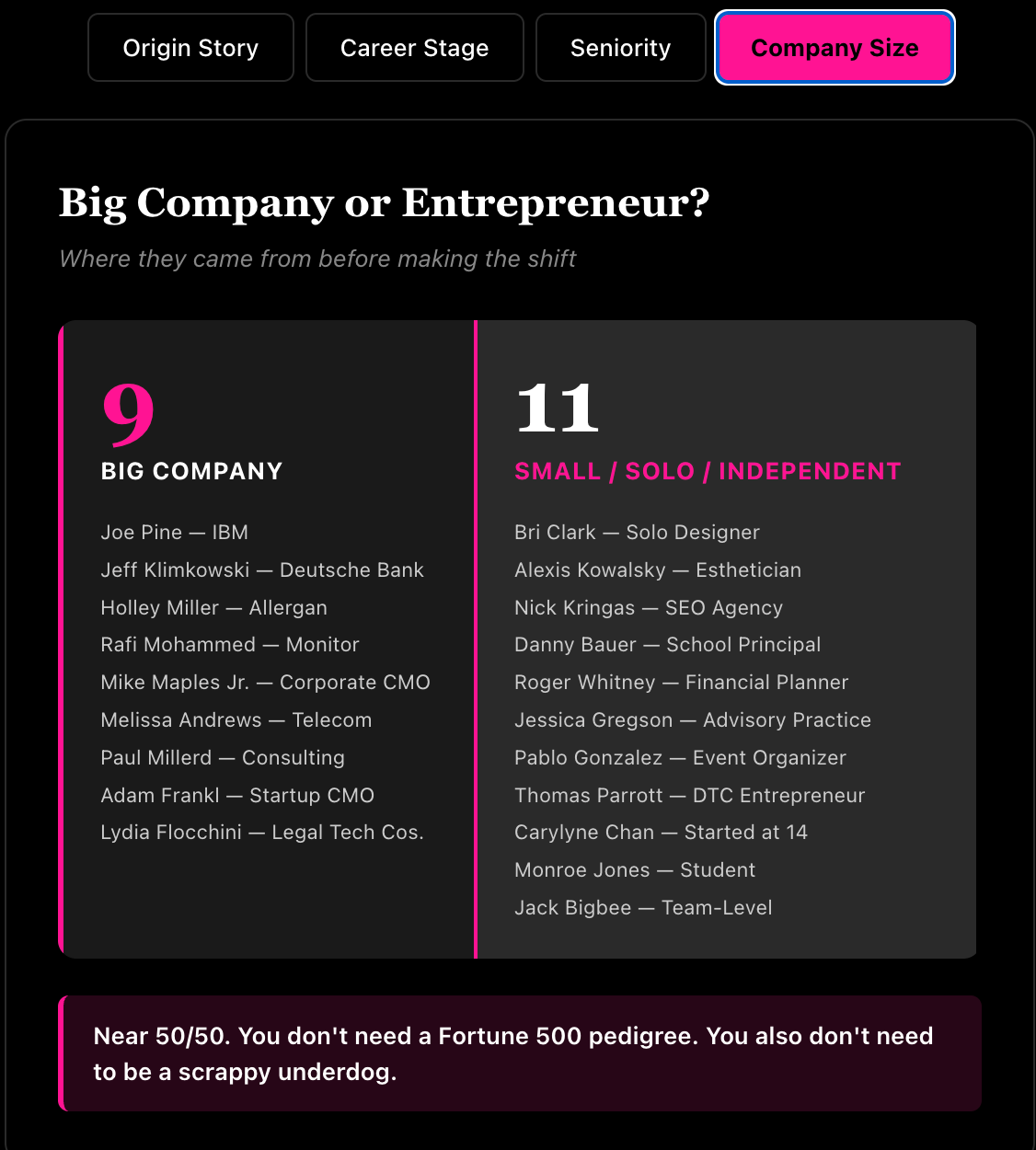
It doesn’t matter what your first job was or how well you did on it.
Danny Bauer was a high-achieving principal who won every award available—and was on the verge of being fired for breaking the unwritten rules of school leadership. He cared more about student outcomes than staying in line.
Alexis Kowalsky went to esthetician school and got rejected from her dream job because they said she needed experience she couldn’t get without a job. So she was forced to become a solopreneur. She built Best Ever Skin, running herself ragged.
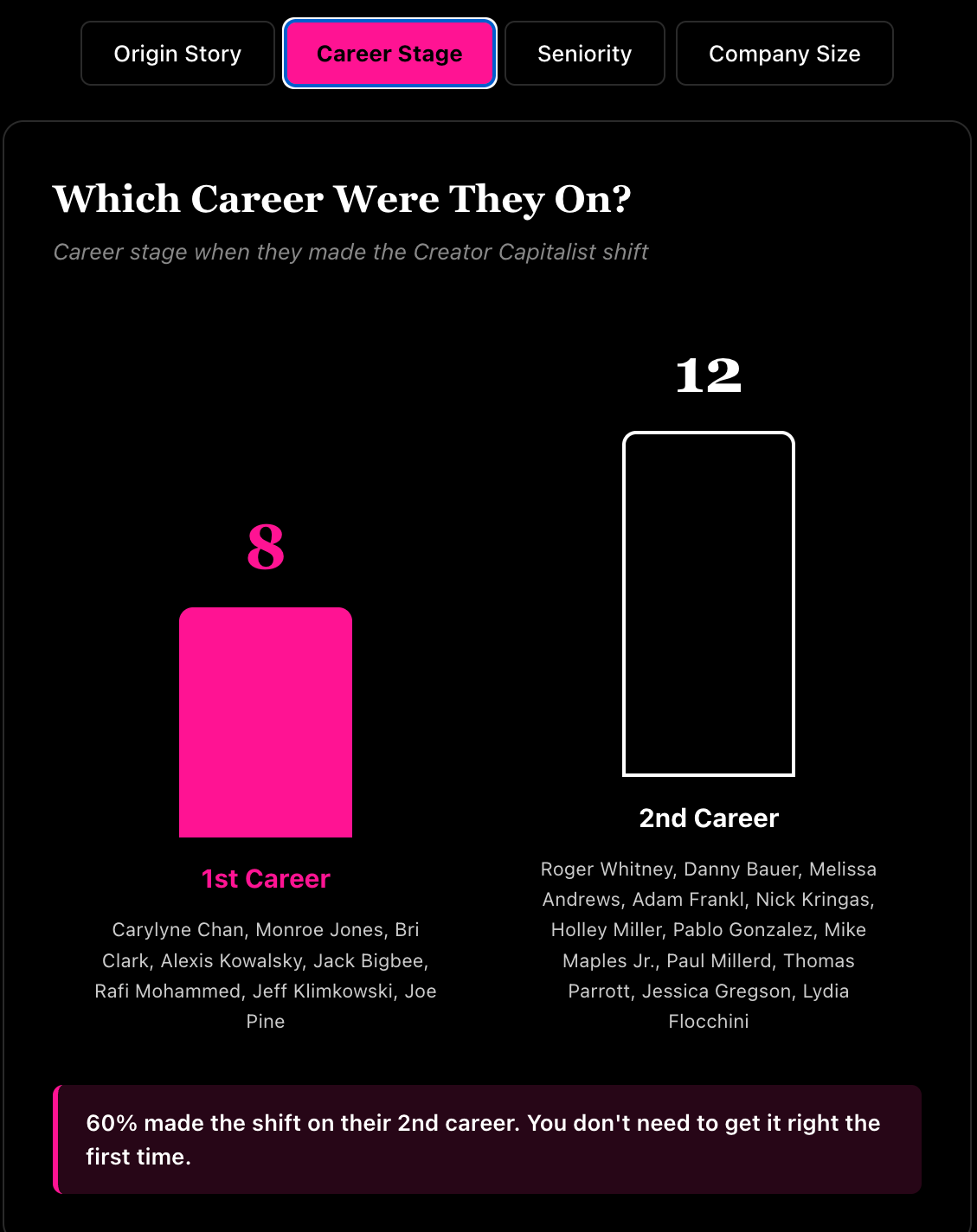
It doesn’t matter if you started young or later in life.
Carylyne Chan had two exits before thirty. Joe Pine has been building on the same body of intellectual capital for three decades—and his ideas feel fresher and more powerful today than when he published The Experience Economy in 1999. Roger Whitney reinvented himself in his forties, after finally achieving professional success, when he realized he was his own superconsumer.
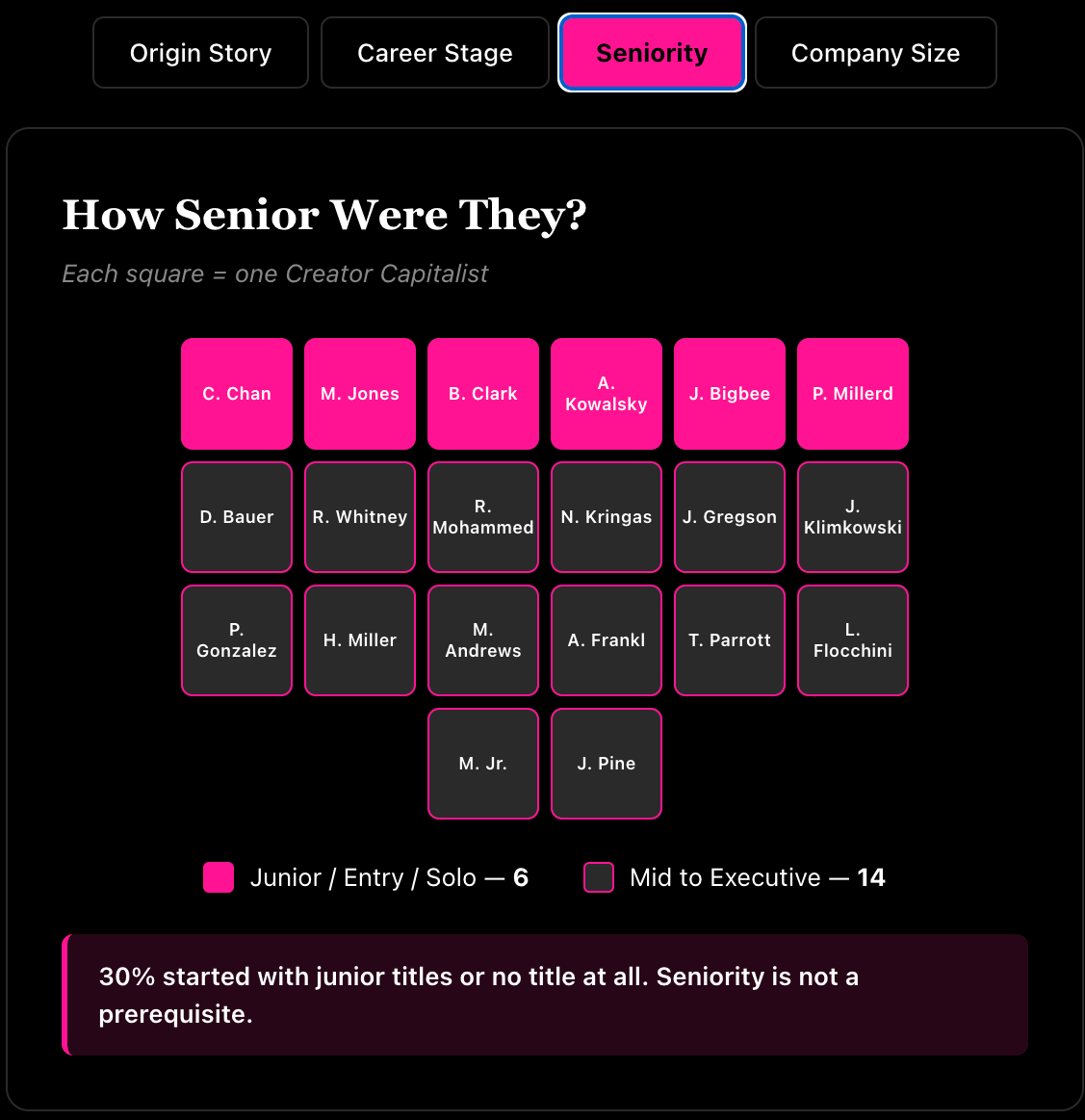
It doesn’t matter how much money you had or didn’t have.
Pablo Gonzalez and his wife made a deliberate choice to lower their cost of living so he could invest in long-term leverage instead of short-term transactions.
Mike Maples Jr. left a successful career as a CMO to become a seed-stage venture capitalist—not because what he was doing was failing, but because he saw the future and it was beautiful and he didn’t want to miss it.
Your gender, your age, your height, your weight, your looks, your ethnicity, and your family of origin don’t matter.
The Pirates in this book aren’t unicorns.
They’re not trust fund kids. They’re not lottery winners. They didn’t get lucky breaks that you couldn’t get.
They’re people who saw a problem worth solving, had the courage to share their perspective, built the Four Capitals (Financial, Reputation, Relationship, Intellectual), and designed work they love instead of work they tolerate.
Some started as financial planners. Some started as music producers. Some started as lawyers. Some started as designers.
What they all have in common is this.
They stopped trading time for money and started building capital that compounds. They chose agency. They saw that today was the best time to start.
Creativity is abundant and emerges from anywhere
You might be saying, “But I’m not creative. How can I be a creator capitalist?”
There’s truth to this. Not everyone is as artistically talented as Monroe Jones. But creativity isn’t something you’re born with. Creativity stems from the desperation to solve a problem you see and that matters to you and others.
Look at where our Creator Capitalists started. Does each job scream creativity to you?
Bri Clark was a solo designer.
Melissa Andrews was in telecom.
Nick Kringas ran an SEO agency.
Adam Frankl was a startup CMO.
Joe Pine was an employee at IBM.
Danny Bauer was a school principal.
Alexis Kowalsky was an aesthetician.
Mike Maples Jr. was a VP of Marketing.
Lydia Flocchini was a legal tech operator.
Rafi Mohammed was a consultant at Monitor.
Roger Whitney was a certified financial planner.
Paul Millerd was in consulting/executive search.
Holley Miller was a marketing director at Allergan.
Jack Bigbee was the “data/tech nerd” on a marketing team.
Jeff Klimkowski was an investment banker at Deutsche Bank.
Jessica Gregson was running an advisory practice from a boat.
Thomas Parrott was a direct-to-consumer/infomercial executive.
Pablo Gonzalez was organizing charity events for young professionals.
Not one of them woke up one morning and said, “I’m going to be a Creator Capitalist.” They became one. Often accidentally at first. Then deliberately.
Isn’t there a pattern and a playbook?
Yes to a playbook. That’s in the book, and we give you a preview in this mini-book.
These six things form the playbook at the heart of our book. Here’s a preview. The book goes deep on each one, with all twenty stories showing you exactly how it works.
1. Each of them found their problem before their product
Here’s what separates Creator Capitalists from Knowledge Workers with good résumés: the problem found them before they found the product.
The most powerful problems are personal.
They are the problems that refuse to leave you alone, irritate you more than others, follow you across roles and industries, and connect directly to your lived experience.
Roger Whitney discovered his clients weren’t really asking money questions—they were asking identity questions about who they’d be when they stopped working. Rafi Mohammed turned a pricing hobby into an obsession after realizing that everyone from Fortune 500 CEOs to his local butcher had a pricing problem. Melissa Andrews saw that farms had zero connectivity while cities were fully wired—and nobody was asking why. Monroe Jones watched producers ridicule artists and decided the real problem in music was shame, not talent.
The problem you’re meant to solve is rarely “out there.”
It’s already been shaping your career. You just haven’t named it yet.
The book walks you through exactly how each of the twenty Creator Capitalists found their problem—and how you can find yours.
2. Every one of them delivered extraordinary outcomes
Most sell effort.
Some sell expertise.
Creator Capitalists sell outcomes. That’s the difference, and it’s the reason they have pricing power.
Holley Miller helped grow a brand from $25 million to $100 million in four years at Allergan—not by adding incremental sales reps, but by reframing the market. The product didn’t change. The belief about the category did.
Pablo Gonzalez helped a client create a $40 million dollar channel from a community-driven growth engine he built on a $6,500/month retainer—an ROI so asymmetric it permanently reframed how he understood the value of relationships.
Monroe Jones has been a trusted creative partner for 40+ years, mostly off the celebrity stage, working with U2, Stevie Nicks, and David Crosby—because he traded short-term credit for long-term Relationship Capital.
When you reliably deliver outcomes, the conversation changes.
You have pricing power.
Pricing power is the foundation of capitalism.
3. They Framed, Named, and Claimed their Superpower
Every Creator Capitalist had a breakthrough moment where the fog cleared, the language clicked, and everything changed.
She who frames, names, and claims the problem wins.
You must have clarity on the problem you are solving and be able to reliably deliver outcomes for a clear superconsumer. But even with this, it doesn’t help if you can’t explain it clearly, concisely, and compellingly.
When you frame the problem, you create a demarcation point in thinking by setting the context and forcing people to consider why this specific idea demands urgent attention.
When you name the problem, you choose a distinctive and sticky label that immediately captures its essence.
When you claim the problem, you become the solution. Not because your product is the best, but because every superconsumer knows your mission in life is to solve the problem.
Thomas Parrott spent months trying to category design his consulting business.
He thought his niche was taking US companies to the UK and Europe. He had done it before. He knew the territory. He had the skills. Except it wasn’t a category. It was a service delivery model with a brutal pipeline. Long sales cycles, complex deals, hard to scale. Then, during an Academy jam session, he mentioned “contribution margin” in the midst of a longer point. Eddie started waving his arms. Christopher started dropping f-bomb after f-bomb. The new category crystallized: Contribution Margin Growth Architect.
Within a week, Thomas had two huge clients. The sales cycle went from 30 weeks to 30 minutes. “I literally iterated what I was doing so clearly: I help e-commerce businesses find operational excellence by focusing on the levers of contribution margin to find solutions for financial misalignment at scale. And they said, ‘We’ve got something going on right now, we’d love to talk.’”
Danny Bauer had been talking about the right thing, the wrong way, for ten years.
His superconsumers—school leaders who cared more about student outcomes than staying in line—didn’t want leadership theory. They wanted leadership that works in real life. As he shared his POV in the Academy, “Ruckus Makers” was a throwaway line. The Pirates hit the brakes and helped him see that Ruckus Maker was not mere branding. It was a filter that drew his superconsumers straight to him like a tractor beam and repelled the risk-averse who weren’t ready.
Jessica Gregson’s advisory practice had many of the right ingredients.
They had experience, capability, care, and a strong advisory instinct. What it didn’t yet have was a named, claimed problem that pulled everything together.
Founder’s Block is the answer.
Founder’s Block existed intuitively before it existed strategically. Jess and her team could see it in clients, feel it in conversations, and work through it in practice—but it hadn’t yet been fully framed as the problem.
Extra Brain is built around a simple but powerful idea: founders don’t lack intelligence, ideas, effort, or ambition—they, at times, lack momentum. Founder’s Block stopped being an internal shorthand and became a rallying point—something clients could recognize themselves in.
Two small words. Massive meaning. Revenue growth 4x higher than the previous year.
Here’s the pattern: every Creator Capitalist in this book had a superpower long before they had the words for it. The naming didn’t create the superpower. It unlocked it. It gave them clarity, and clarity created confidence, and confidence created pricing power, and pricing power created freedom.
If you’re struggling to frame, name, and claim the problem, you’re probably not solving the right problem.
But if there’s something that’s been following you—a pattern you keep seeing, a frustration you keep feeling, a question you keep asking that nobody else seems to ask—that’s not noise.
Remember that framing, naming, and claiming are a mix of art and science. But it is more like a music lyric, poetry or a mantra.
You don’t grab hold of the lyric. It grabs hold of you.
So take a deep breath and recognize you must practice this in public. It will be scary like going on American Idol and singing in front of the world.
But the only way to write a song people can’t forget is to sing it in front of others.
Even if it is a bit out of tune.
The book walks you through the exact framework for framing, naming, and claiming your superpower—so you don’t spend years talking about the right thing the wrong way.
4. They all built The Four Capitals, accidentally at first
Nobody starts by planning all four. That’s the counterintuitive part. Creator Capitalists build four kinds of capital that make courage sustainable—but nearly every one of them started building before they knew what they were building.
Financial Capital (having a long enough runway to make the leap), Reputation Capital (the signal that travels ahead of you), Relationship Capital (the people who multiply your efforts), and Intellectual Capital (the ability to create outcomes for others while you sleep).
Carylyne Chan started building Reputation Capital at 14 with social enterprises, which led to Relationship Capital with school principals, which led to Intellectual Capital as she honed her ability to stay calm in chaos, which led to Financial Capital via a nine-figure exit and financial independence at 29.
Pablo Gonzalez’s wife became a force multiplier, not a constraint—freeing him to invest in Relationship Capital through community building that eventually created a $40 million channel for a single client.
Bri Clark built all four capitals by doing one thing: having the courage to publicly roast businesses’ websites. With love. But she roasted them.
The order doesn’t matter.
The sequence is different for everyone. What matters is that all four eventually get built. Because once they compound together, courage becomes rational. Not reckless.
The book gives you the framework for building all four capitals—which one to start with, how they compound, and when courage becomes rational.
5. They found their bandmates
No one creates a category alone.
The myth of the solo genius is just that—a myth. Every Creator Capitalist in this book found people who sharpened their thinking, expanded their reach, or complemented their blind spots.
Nick Kringas and Lydia Flocchini were two legendary legal pirates who decided to partner up. Two pirates, both crushing it in legal. Lydia was the builder—the operator who could take a category POV and make it real through storytelling, systems, processes, and people. Nick was the strategist—the captain who could navigate shifting seas and see the category opportunity. Together, they were better than the sum of their parts.
Jeff Klimkowski, Sean Riley, and Ryan Meegan started DUDE Wipes with deep childhood friendship as the foundation. Monroe Jones gave up songwriting credit to earn trust—and the more he gave up credit, the more abundance he got. Artists opened up. Songs got better. Relationships lasted decades.
The right collaborators don’t dilute your difference.
They amplify it.
The book gives you a framework for finding the right bandmates—and knowing the difference between collaborators who amplify your difference and ones who dilute it.
6. AI didn’t threaten them—It accelerated them
AI doesn’t replace Creator Capitalists. It makes them exponentially more powerful. But only if you’ve already built the foundation.
Jack Bigbee helped rebuild the Category Pirates business with AI as a co-founder—not by writing code, but by translating intellectual capital into scalable, interactive technology.
Nick Kringas saw that AI was going to transform how clients find and choose lawyers, so he and Lydia Flocchini created LawShift to help personal injury law firms survive and win as AI reshapes discovery.
Melissa Andrews used AI and connectivity to put Starlink on tractors—not because she had better technology, but because she asked better questions.
They used judgment, perspective, and taste with AI to amplify everything they were already doing.
The limiting factor is no longer technology. It’s you. The more human you are, the more powerful AI becomes.
The book walks you through a framework for using AI to scale your Creator Capital—not as a replacement for your thinking, but as an amplifier of it.
Now it’s your turn.
Ask Yourself Four Questions.
You just met twenty people who made the shift.
None of them had an unfair advantage that you don’t have access to. None of them followed a path you couldn’t follow. The only thing they had that you might not have yet is clarity—about the problem they were born to solve, the capital they needed to build, and the courage to do it in public.
If you’ve made it this far, something important has already shifted.
You now understand why being busy stopped working and where power actually went.
You’re no longer confused about why execution feels less valuable. You’re no longer blaming yourself for a system that quietly changed. You’re no longer mistaking motion for progress.
The most important thing Creator Capitalist gives you back is not confidence. (This is no whoo-whoo motivational mumbo-jumbo, new age crap-o-la.)
It’s clarity.
Clarity about why the rules shifted. Why your leverage shrank. Why your instincts were right. And why your different is no longer something to smooth out.
Once you have that clarity, power returns. Not as control over everything. But as control over what you choose to engage with.
You stop chasing approval. You stop over-optimizing execution. You stop waiting for permission to think.
You start deciding before doing. Designing instead of reacting. Creating direction others can follow.
That’s what power looks like now.
So here’s where it gets personal.
Twenty Creator Capitalists showed you what the shift looks like from the outside. But this isn’t about them. It’s about you. And it starts with four honest questions.
Question 1: Do you yearn for different?
The future is being built. Whether you participate or not. And right now, opting out is not neutral. It’s a decision to let other people’s priorities shape your future.
The original American Dream was never about money. It was about agency. The right to pursue opportunity. The freedom to own your future. But over time, that dream was quietly rewritten. The new promise became stability instead of upside. Security instead of agency. Retirement instead of relevance.
Don’t retire from work. Retire from work that drains you.
Question 2: Do you still want to play someone else’s game?
Most people spend their lives trying to win games they didn’t design.
They optimize for rules they didn’t choose. They compete on metrics they didn’t invent. They chase rewards defined by someone else. And then they wonder why winning feels empty.
The most successful people in the world do something different. They don’t fight harder for position inside existing games. They create games worth playing. Not by cheating. Not by escaping reality. But by reframing what matters. They decide which problems are worth solving, which outcomes actually count, which rules they’ll play by—and who they want on the field with them.
That’s category design. Master it, and you become a category of one—not a creator who competes, but a Creator Capitalist who owns.
What problem has been following you across roles, across industries, across years? What do people come to you for that they don’t go to anyone else for? What do you see that others normalize or ignore?
The book gives you the framework for designing it.
Question 3: Are you ready to build the four capitals?
It takes courage to be legendary.
Not the loud kind. Not the “burn the boats” kind. Real courage is the willingness to take on work that is hard, uncertain, worth doing, and visible enough to fail in public.
That kind of courage doesn’t come from motivation. It comes from preparation. Courageous people aren’t fearless. They’re prepared. They’ve built enough foundation underneath themselves that they can take a meaningful leap without destroying their lives if it doesn’t work.
Recklessness is acting without a basis. Courage is acting because you’ve built one.
That’s what the Four Capitals are for. Financial Capital gives you the runway to make the leap. Reputation Capital is the signal that travels ahead of you. Relationship Capital is the people who multiply your efforts. Intellectual Capital is the ability to create outcomes for others while you sleep.
You don’t need all four to start. Carylyne started with Reputation Capital at fourteen. Pablo started with Financial Capital by lowering his cost of living. Joe started with Intellectual Capital in high school. Bri started with the courage to share her thinking when no one was watching.
You start with whichever one you’ve already been building—whether you knew it or not.
The book shows you the framework for building them—and the order that makes courage sustainable.
Question 4: Do you believe your different can make a massive difference for others…and you?
This is the real question.
Your superpower is not your skill set. It’s not your résumé. It’s not your experience. It’s not even your intelligence.
Your real superpower is the specific way your different helps other people achieve massive outcomes and abundance.
The only advantage left is different applied to meaningful problems.
Creator Capitalists don’t win because they work harder. They win because they tap into what is uniquely theirs—their perspective, their instincts, their superpower—and apply it to the problems that matter most.
You are not late. You are not obsolete. You are, in fact, the only person in the history of humanity with your specific superpower.
Do you believe that?
We believe it with all our hearts. We believe you are designed to be different. We believe you are destined to make a difference.
Nothing about this path is guaranteed. Creator Capitalism is not safe. It’s not fair. And it’s not for everyone. It asks you to own your choices, trust your judgment, be responsible for what you create, and accept that different carries risk.
But it also offers something rare. A career that compounds instead of resets. Work that stays interesting instead of exhausting. And the chance to be well-paid for making the difference only you can make.
The future does not need more busy people. It needs people who can think upstream, think differently, create new value, and take responsibility for shaping outcomes.
You’re standing at the moment where power moved. With a decision to make.
Being busy without power was the symptom. The shift in how work creates value was the cause. Your different is the leverage.
And if you choose to play it—deliberately, courageously—and on your own terms, you won’t just survive a post-AI world. You’ll help shape it. By using who you are to create what’s missing. And getting paid (well) for making the biggest difference you can.
Knowing the shift and making the shift are two very different things.
This mini-book showed you that the world changed, that Creator Capitalists are real, and that the shift is available to anyone.
But knowing the shift happened and knowing how to make it are two very different things.
Creator Capitalist—the book—goes deep on all twenty stories. Not just who they are, but exactly how they found their problem, framed and named their superpower, built the four capitals, found their bandmates, and used AI to accelerate everything. The frameworks. The sequences. The mistakes. The breakthroughs. The specific moves you can make — starting now.
The future needs you.
Go create it.
Arrrrrrr,
Category Pirates
P.S. - Creator Capitalist launches March 17th.
Join the waitlist to be the first to know when the book drops.
Each profile in the book is a full deep-dive—the origin, the struggle, the breakthrough, and the playbook behind their transformation. Here’s a taste of the 20 Creator Capitalists you’ll meet:
Roger Whitney started as a certified financial planner, helping one client at a time. Became the creator of the Rock Retirement Club, unlocking the insight that retirement is an identity transition, not a financial event. 1,400 paying members, 8 million podcast downloads.
Monroe Jones started as an architecture student at Auburn, but switched to music after a professor told him, “This is not your first love.” Became a trusted creative partner for 40+ years, unlocking the idea that studios must be sanctuaries from shame. Worked with U2, Stevie Nicks, and David Crosby — mostly off the celebrity stage.
Carylyne Chan started as a fourteen-year-old intern in Singapore, working not for enrichment but for survival. Became a two-time startup founder, unlocking the superpower of calm in chaos. Nine-figure exit and financial independence before thirty. Angel invested in 70+ companies.
Thomas Parrott started as a DTC/infomercial executive with a brutal 30-week sales cycle. Became the Contribution Margin Growth Architect, unlocking a category that collapsed that cycle to 30 minutes. Added a zero to his project size with the same level of effort.
Danny Bauer started as a high-achieving school principal who won every award available — and was nearly fired for breaking the unwritten rules. Became the creator of Better Leaders Better Schools, unlocking the “Ruckus Maker” identity as a tractor beam for superconsumers.
Melissa Andrews started as a telecom operator watching farms operate with zero connectivity while cities were fully wired. Became the creator of Connected Farms, unlocking “Digital Darkness” as the category name that worked across five countries. Cut her sales cycle from six months to six weeks.
Jessica Gregson started running an advisory practice from a boat in Canary Wharf. Became the creator of Extra Brain, unlocking “Founder’s Block” as the problem founders couldn’t articulate. Revenue growth 4x higher than the previous year.
Adam Frankl started as a startup CMO. Became the creator of the “developer-facing startup” category, unlocking a name for something thousands of founders were living but nobody had defined. Helped JFrog craft “Release Fast or Die” — five years later, it became the title on their S-1 IPO filing. His own book became an Amazon bestseller.
Lydia Flocchini started as a legal tech operator across five companies. Became the co-creator of LawShift, unlocking the “Scaling Stall” as the silent killer of legal tech growth. One client generated $140K in pipeline in less than a month. Eddie told her to quadruple her prices. She did.
Nick Kringas started as an SEO agency owner who generated over $400 million for personal injury firms. Became the co-creator of LawShift with Lydia, unlocking a new category as AI was about to destroy his old one. After one Strategy Therapy session, his client said, “$5,000/month toward solving this problem is nothing to me.”
Rafi Mohammed started as a consultant at Monitor with a PhD from Cornell. Became the godfather of pricing strategy, unlocking the insight that everyone — from Fortune 500 CEOs to his local butcher undercharging for Korean-style ribs — has a pricing problem.
Holley Miller started as a marketing director at Allergan. Became a category reframer, unlocking the belief shift that grew a brand from $25 million to $100 million in four years. The product didn’t change. The belief about the category did.
Pablo Gonzalez started as a charity event organizer who lowered his cost of living so his wife could be the primary breadwinner. Became a community-driven growth architect, unlocking the power of relationships as leverage. Built a $40 million channel for a single client on a $6,500/month retainer.
Joe Pine started as an IBM employee who compiled a Tolkien Linguistics Dictionary in high school. Became the creator of The Experience Economy, unlocking a category that’s been compounding for twenty-five years and still feels fresher than when he published it in 1999.
Jeff Klimkowski started as an investment banker at Deutsche Bank, working 100-hour weeks, packing and shipping wipes by night. Became the co-founder of DUDE Wipes, unlocking a category that 20–30 VCs said would never work. $300K from Mark Cuban. Well over $300 million in retail revenue.
Bri Clark started as a solo designer. Became someone who gets paid for transformation, not just design, unlocking all four capitals by publicly roasting businesses’ websites. Lives in a dry cabin in Alaska with no running water. Runs off mountains with a paraglider.
Alexis Kowalsky started as an esthetician, rejected from her dream job because she needed experience she couldn’t get without a job. Became the owner of Best Ever Skin, unlocking the realization that discounts were costing her $200,000. Nearly tripled revenue in two years. Then bought a building.
Jack Bigbee started as the “data/tech nerd” on a marketing team. Became an AI co-founder, unlocking the ability to translate intellectual capital into scalable, interactive technology for the Category Pirates business.
Mike Maples Jr. started as a VP of Marketing / CMO. Became a seed-stage venture capitalist at Floodgate, unlocking a life where his comparative advantage compounds. Early conviction bets on Twitter, Twitch, and Okta. “I can’t believe I’m getting paid to do this stuff.”
Paul Millerd started in consulting and executive search. Became the author of The Pathless Path, unlocking over $350,000 in royalties. When asked what number would interest him, he said, “$600,000.” Then released a $100 Italian-printed premium hardcover and sold 250 copies in two weeks to 22+ countries.