


Welcome to the Pirate Street Journal. The Wall Street Journal covers companies. We cover categories.
Every other Friday, we go deeper with a Deep Dive Report, calling where the category goes next. Become a Founding Member to get every Deep Dive Report, mini-book, audiobook, and access to the Pirate Eddie and Christopher bots.
Piratey disclaimer: This is NOT financial advice. None of us have Series 63, Series 6 7, CPAs, CFAs, IUDs, IEDs, and hopefully not IBS.
Think of this like professional wrestling. It’s entertainment.
Don’t be so smart you’re stupid and suplex your safety net savings.
Dear Friend, Subscriber, and Category Pirate,
Anthropic just confidentially filed to go public as soon as Thanksgiving 2026.
They are reportedly seeking a $2 trillion dollar valuation. Is it crazy? Probably not, though the ethos behind Anthropic might be crazier than its economics. Time will tell. Should you invest? Be careful about investing in the first year of an IPO, as we wrote about the SpaceX IPO. And trust us, if Anthropic IPO goes out, we will all be invested in it through index funds whether we want to or not.
But according to Andreesen Horowitz, 98% of US households are not paying for AI.
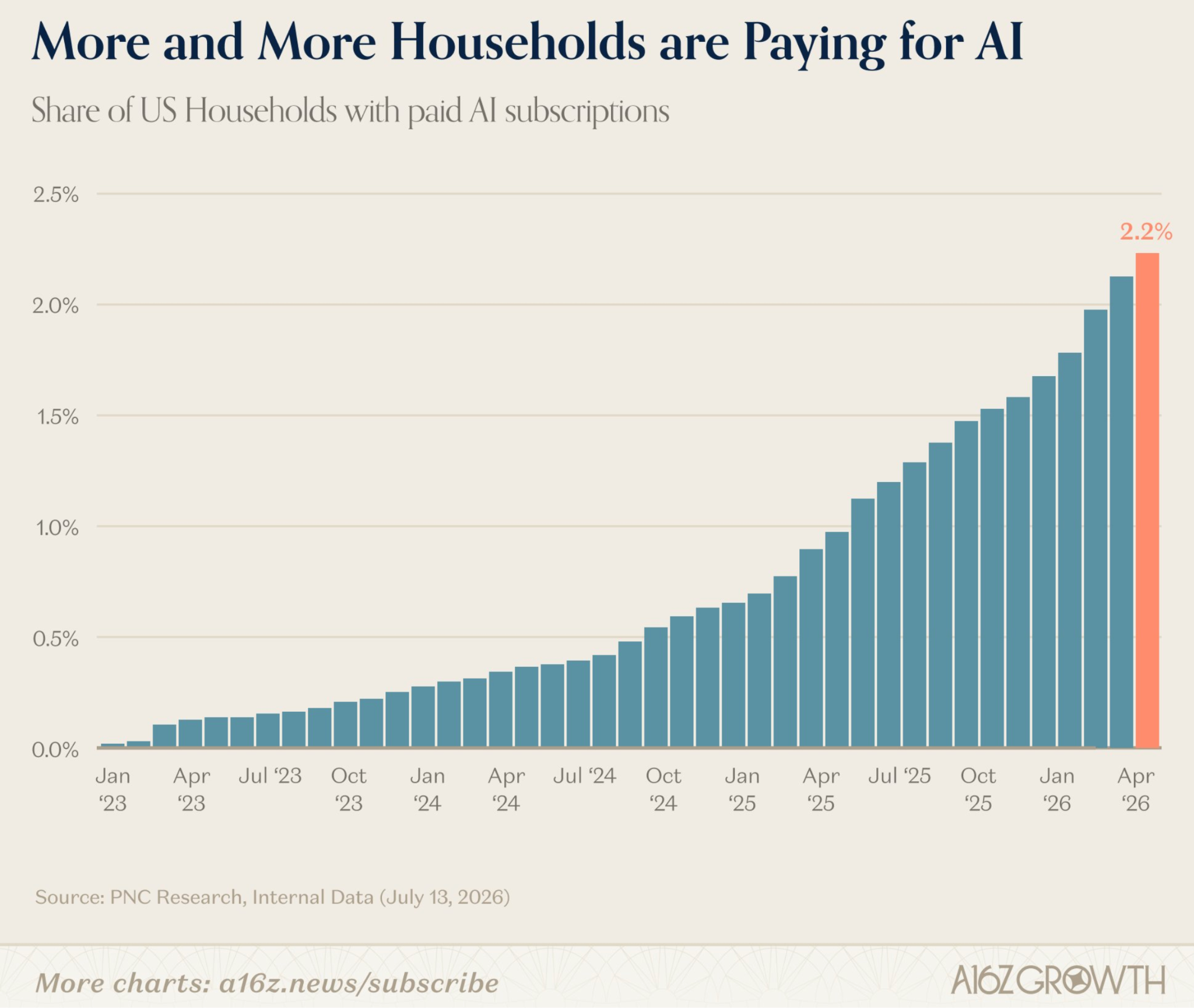
The reason is simple.
Not enough have seen what is in it for them to pay for it. To make it worse, Dario Amodei, Sam Altman and more cried wolf with weirdly specific and uncorroborated AI doomer predictions. Given the unclear upside and hyperspecific (and ultimately wrong) downside, why would the average consumer sign up?
The truth is the first wave of AI was really the category of Productivity AI.
Specifically, how to make coders exponentially more productive through Claude Code and Codex. It was B2B, not B2C.
Breaking news for big tech: the average consumer doesn’t dream about being more productive.
The business case for paying for AI only really made sense if you were in the business of creating AI software or creating content. OpenAI, Anthropic, SpaceX all massively grew their revenue and valuations. AI hardware companies like Nvidia, Micron, AMD grew their valuations even more explosively.
Thankfully, a 29 year old just kick started the second wave of AI, which is the category of Personal AI.
Personal AI is not about making the average programmer more productive. Personal AI is about making the average consumer richer in 7 specific ways:
Money
Time
Mind
Fun
Health
Relationships
Protection
We think it could be worth $10K to the average person.
In cold hard cash. In about ten minutes, Personal AI can build you a treasure map showing you where the ten stacks are right now, just waiting for you to pick it up. Which makes paying for AI a no brainer, especially if it means you can make 50x your money on a $200/year subscription.
The Problem with AI is With Most of the People Leading AI
AI is likely the greatest invention in the history of humanity.
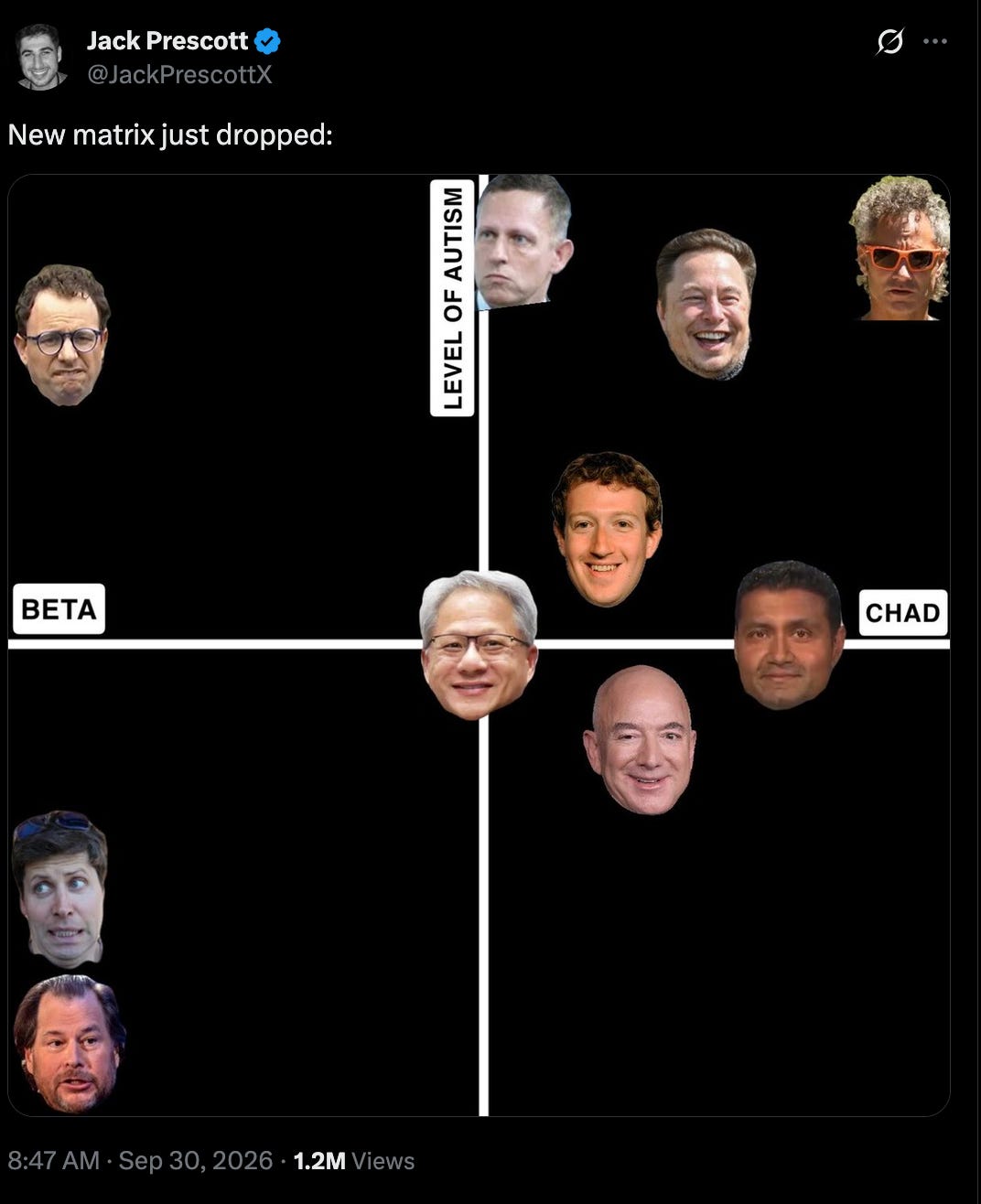
But the problem is the first wave of AI leaders are ‘on a spectrum.’ Many are socially awkward. Their IQ to EQ ratios are one sided. This is not to excuse what they say, but provide context for when they say weird stuff.
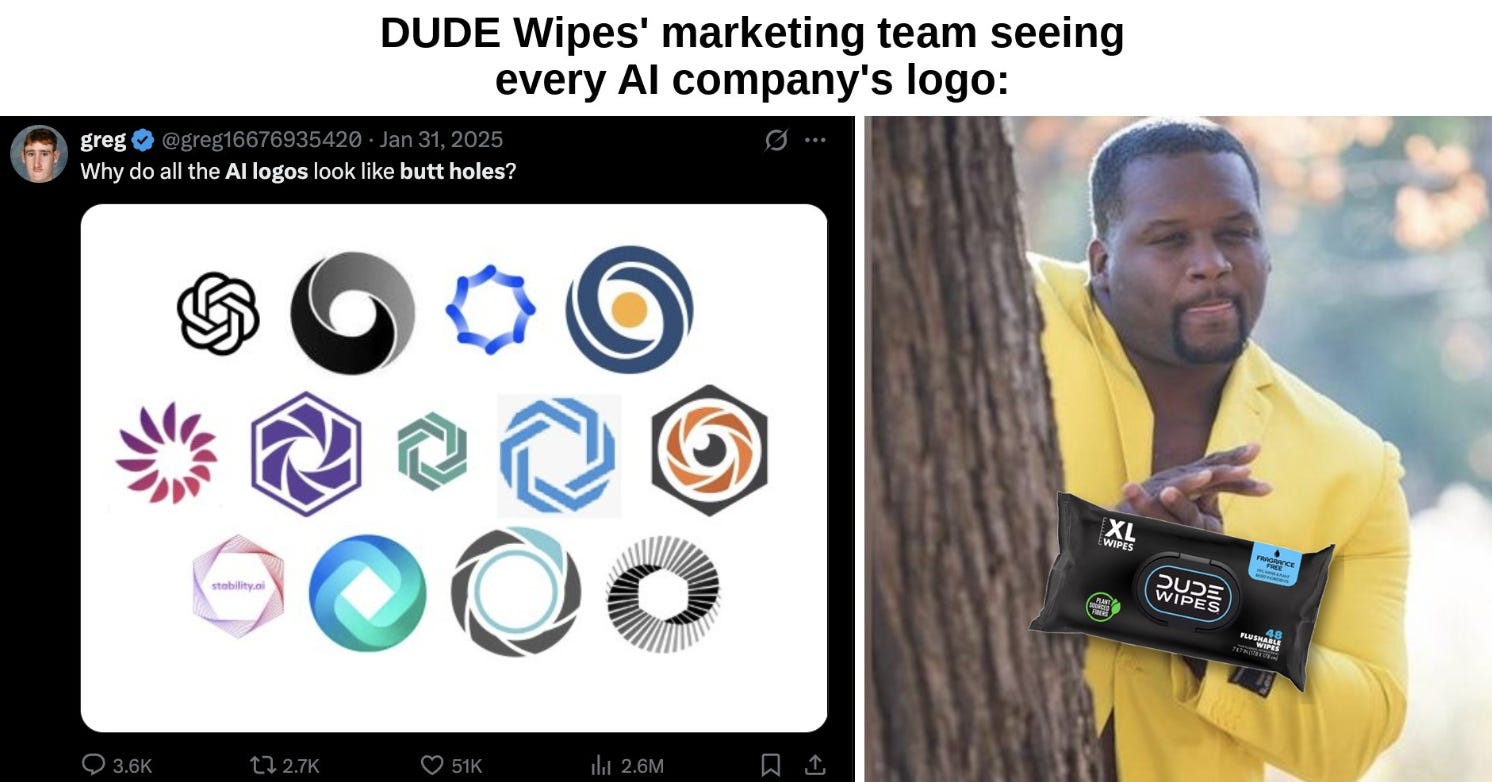
This also doesn’t explain why so many of AI chatbot logos look the way they do. It’s almost as if Pirates Sean Riley, Ryan Meegan and Jeff Klimkowski were paying the AI logo designers to create demand for Dude Wipes.
This is why SNL had to step in recently to translate for Dario. (The Anthropic leadership scares us like no others. Read this.)
This is also why Jensen is the Prime Minister of AI.
Not because he is super smart and successful. But because he comes across as a regular human. He cleaned toilets at IHOP. He spent years of his childhood in small town Kentucky. He’s been married to his college girlfriend for 41 years. He tells stories about getting so smashed on ‘Somaek’ (a mix of Soju and Korean beer) that he ended up kissing a dude in Samsung’s Supply Chain organization on the lips.
You know, normal stuff normal people do.
The good news is Jensen now has help from Alexandr Wang.
Alexandr Wang is Kickstarting the Personal AI Category
Alexandr might be the most important exec at Meta since Sheryl Sandberg.
That’s a bold statement, since Sandberg helped create $415 billion dollars of market capitalization during her 14 years at Facebook. She’s widely credited as the adult in the room who built the advertising business that throws off hundreds of billions in cash.
Alexandr co-founded Scale AI. At 19. Shortly after dropping out of MIT. At 24, he became the youngest billionaire ever when Scale AI was valued at $7.3 billion. When he was 28, Meta bought 49% of Scale AI. Then Zuckerberg made Alexandr Chief AI Officer of Meta. He assembled a 100 person secretive team and built Muse. One thing Zuck is great at is acquisitions.
By launching Muse, Alexandr added $200 billion in market capitalization for Meta in 15 months of working at Meta.
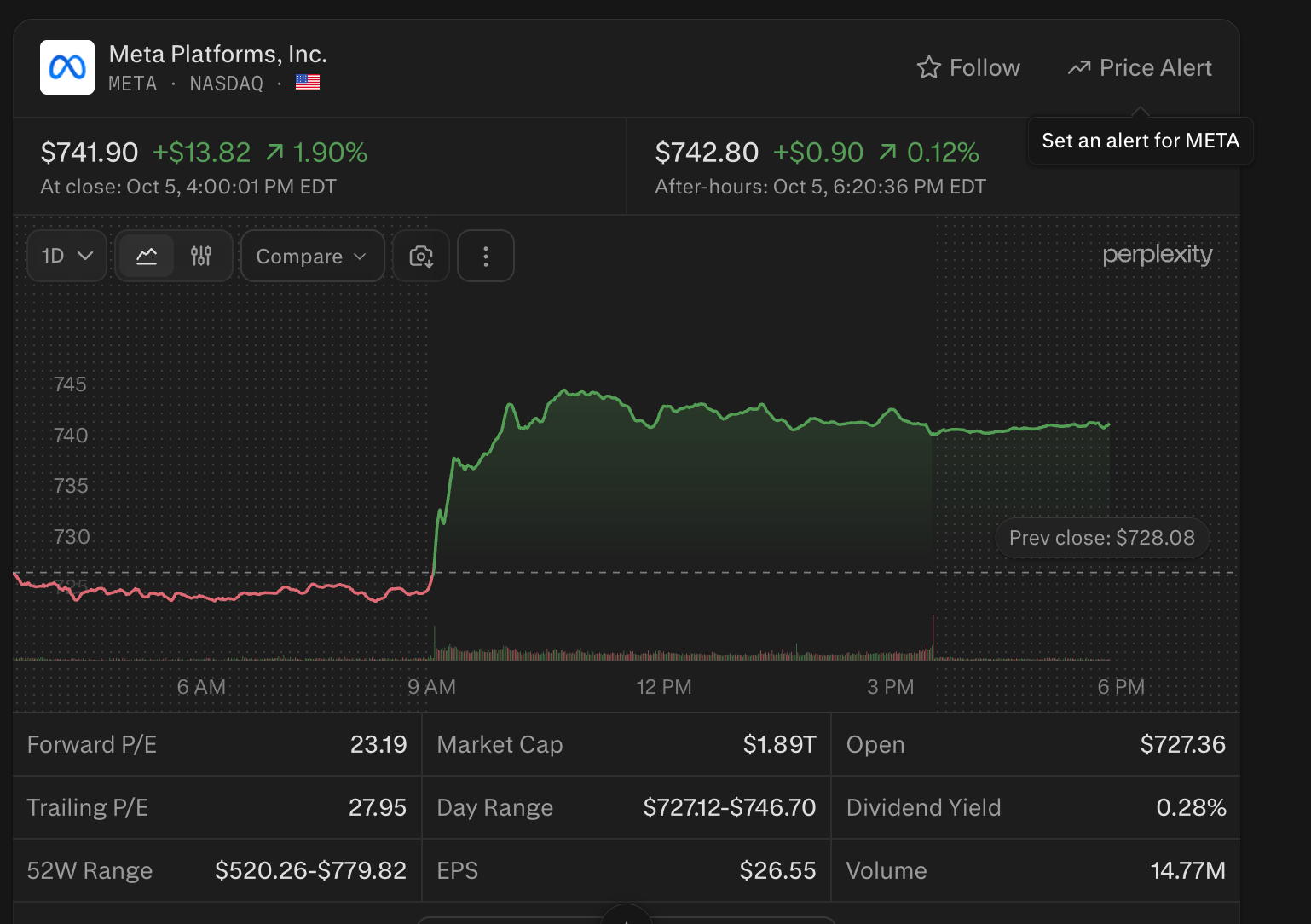
Meta stock from the Sept 8, 2026 Muse launch to Oct. 5, 2026. Up 21% 📈.
But his writing might be as impressive as his technical skills.
Alexandr posted an article on X, “Why We are Building Muse.”
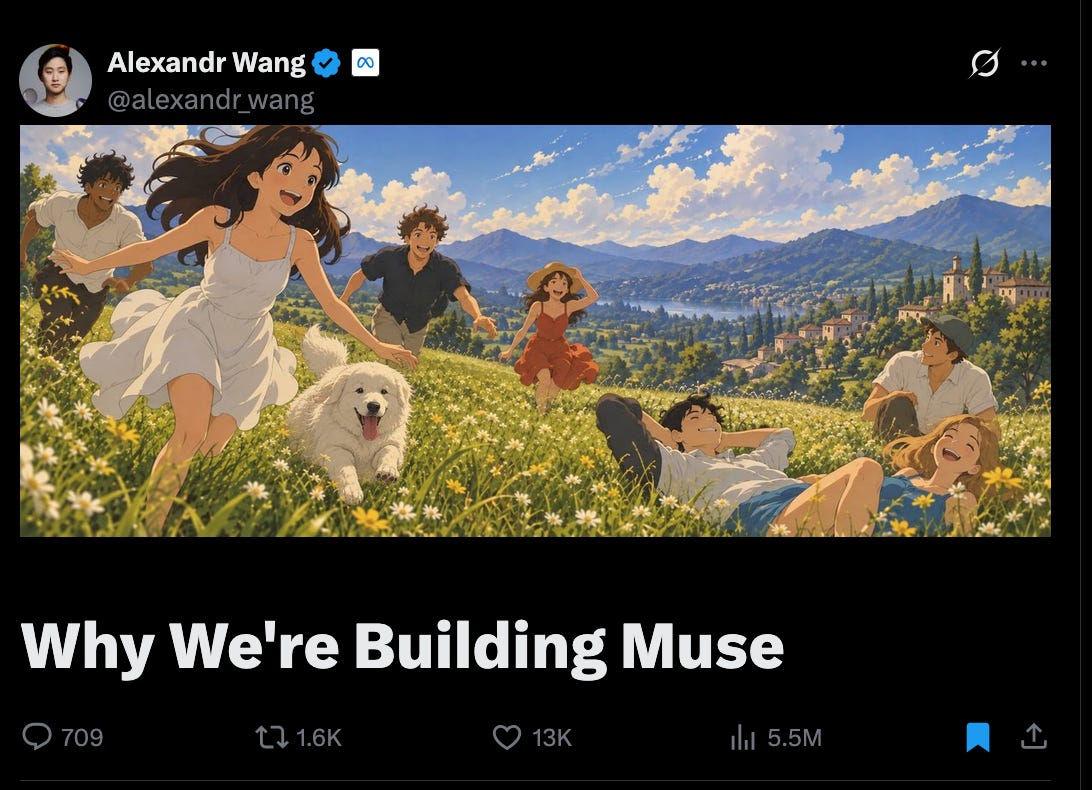
We urge you to read the article in full below. We bolded our favorite lines.
Most people never say what they want. It’s not because we don’t want. We want fiercely and constantly. It happens in the moments before falling asleep or while daydreaming on the car ride home. We want to spend more time with our families, overcome social anxiety, eat healthier food, open a bakery, build an app, or just find a few more moments of calm in a hectic life. But rarely do we get to even express these dreams, and even more rarely do they ever come true.
When we can’t name our dreams, we mostly can’t reach them. The world is a maze of forms and gatekeepers and schedules and obstacles, and most dreams die by a thousand paper cuts long before they are said aloud. They die in the not-knowing-where-to-start and in the phone calls never made.
Every unrealized want is a quiet tragedy of human potential.
Now imagine every person on earth with a second mind beyond their own. A general manager whose whole job is to find out what you want and make sure it happens. Someone that hears the half-sentence, “I feel like there’s something more I could be doing,” and helps fill in the blanks. This might not be a genie in a bottle, but it can be someone that says, “This is the thing you’ve been dreaming of your whole life. Let’s go get it. Here’s how.” And then builds a plan. Sends the email. Makes the phone call. Finds the funding. Keeps you on schedule. Clears the way and solves all the problems it can until the human part, the wanting and the dreaming, is all that’s left.
Here’s the best part: we have no idea what people will want. The world until now has been shaped by the small number of fanatics who have somehow found a way to make their wants real. But we’ve never seen humanity with every single person’s agency fully switched on. Eight billion people who just need to write their dream down in order to get started making it happen.
So we built Muse to help people build the world they want.
Here’s to wanting. Here’s to dreaming. Here’s to everyone.
The essay is hauntingly emotional and relational. And beautifully and concisely written.
It’s not about GPUs, linear algebra and total addressable markets. It’s not about government regulation. It’s certainly not about a 10% chance of an extinction event for humanity (aka inane garbage put forward by Anthropic & OpenAI because they want government protection from doing their jobs to deliver effective and safe products).
It reads like a person writing to another person.
He writes extensively about the problem. People never say what they want. Every unrealized want is a tragedy of human potential.
His POV is tight, easy to remember and repeat, “So we built Muse to help people build the world they want.”
Not like a robot writing to investors and regulators. Which is exactly like Zuck’s essay about AI from August 10, 2026.
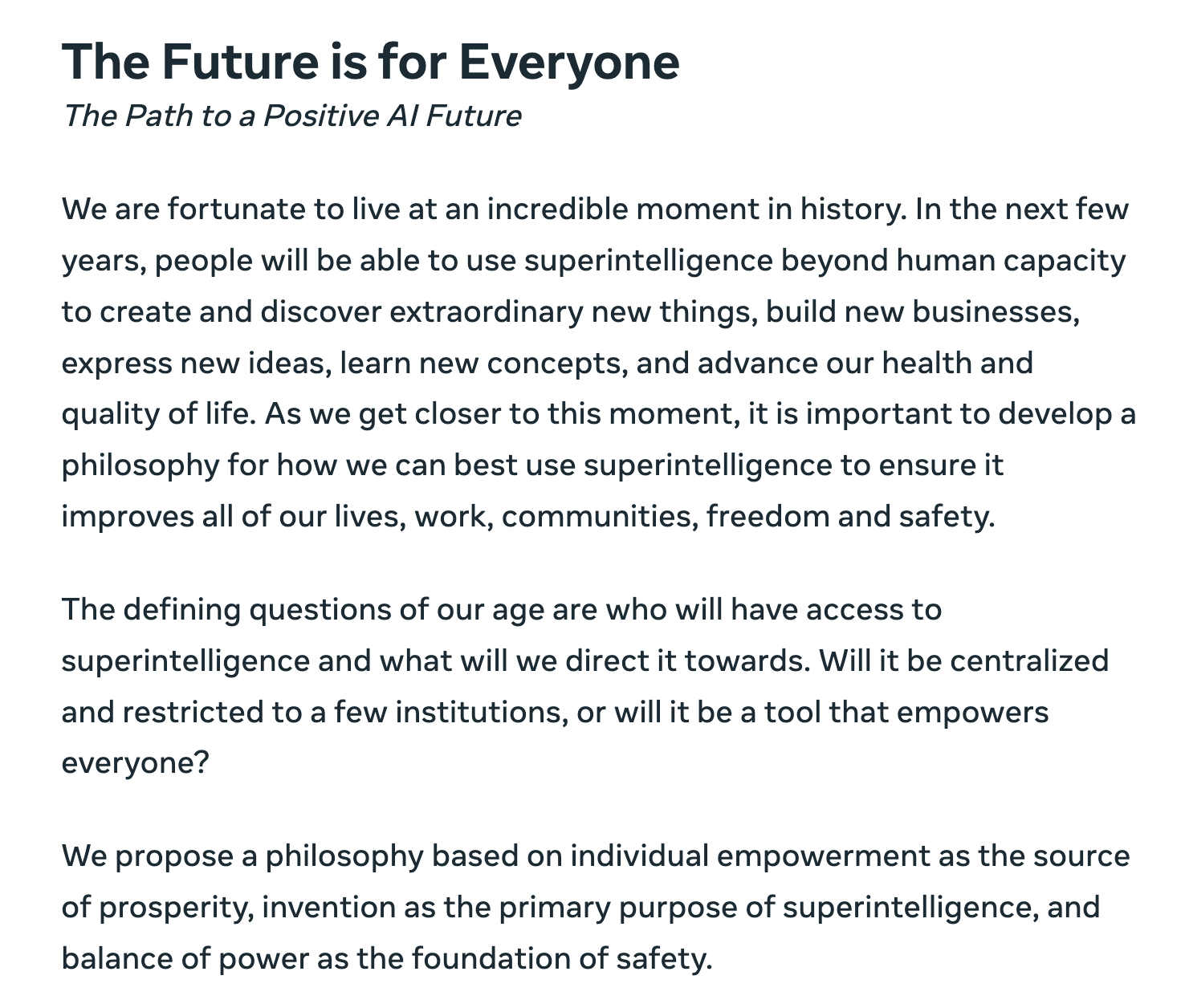
If you want to read Zuck’s whole essay, it’s here.
But this is the tale of the tape.
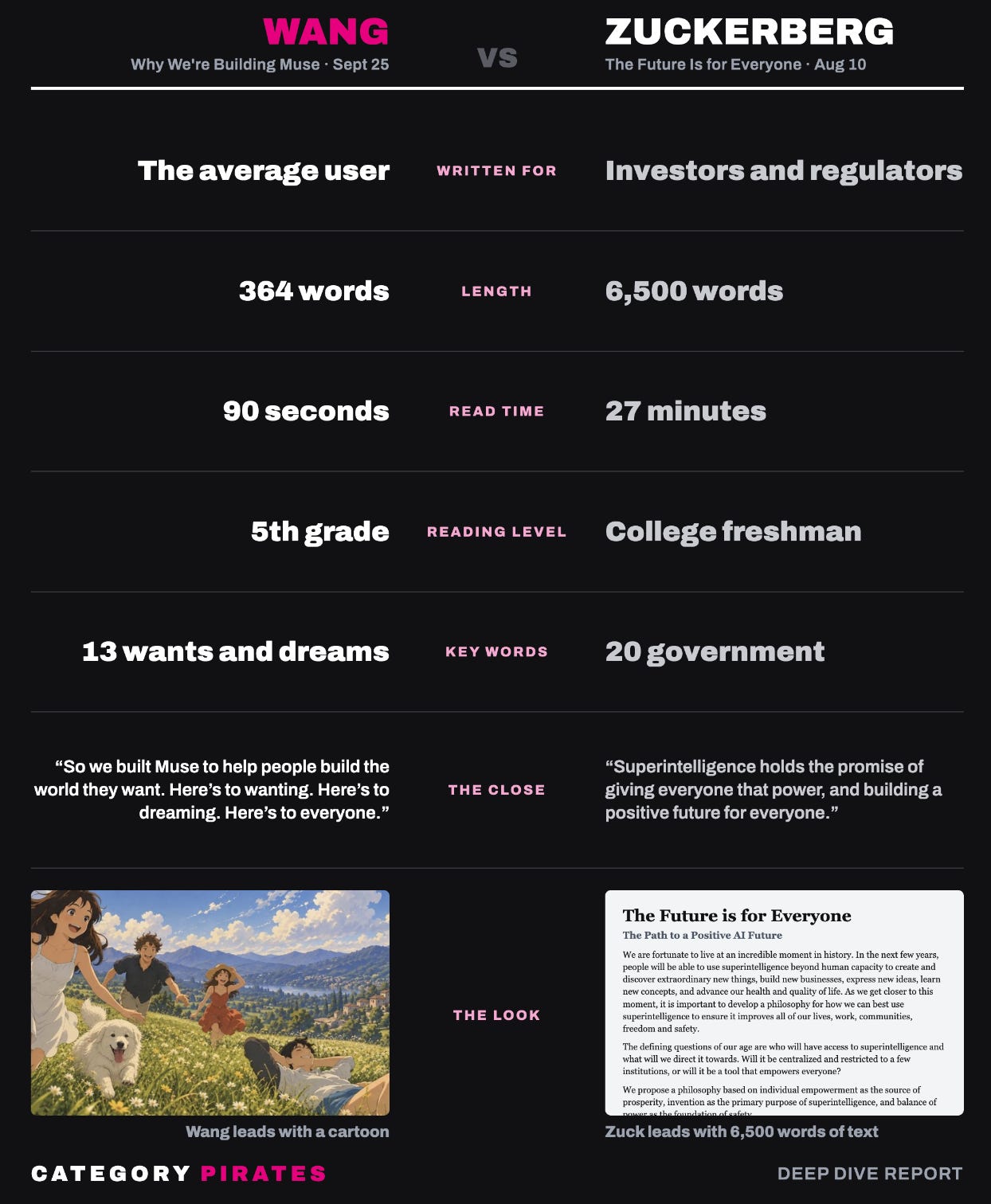
Let’s go deeper, using the Category Manifesto mini-book.
We scored both Wang and Zuck’s essays against the Category Manifesto’s 8 steps. It turns out the MIT dropout gets an A while the Harvard dropout gets a D.
If you ever needed more proof about the power of languaging, here it is.